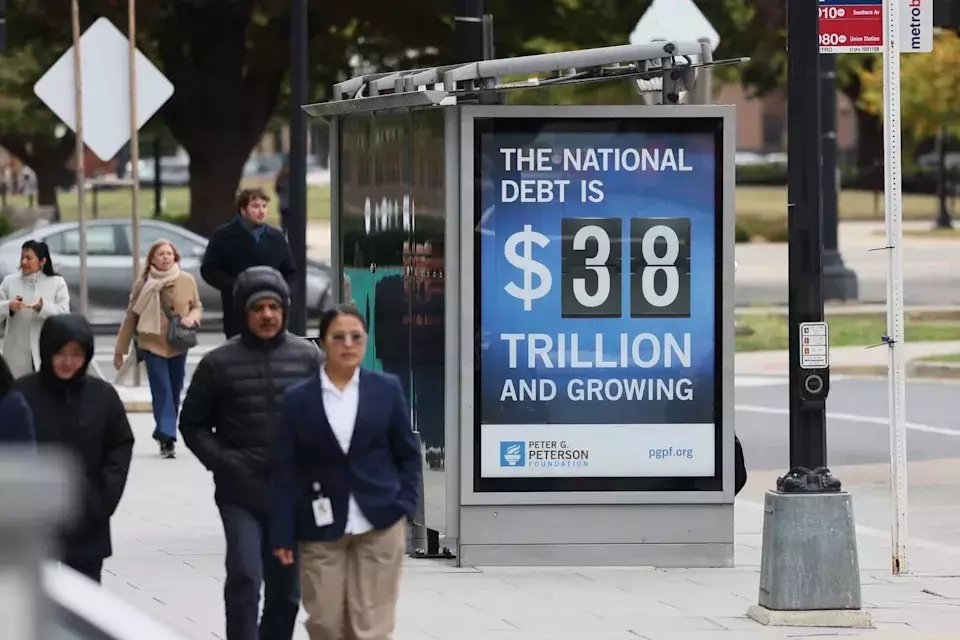
US Debt Surges, Fueling Investor Shift to Bitcoin and Gold
The United States' federal debt has now escalated to an all-time high, prompting a notable shift in investor behavior. As the national debt continues its rapid ascent, market participants are increasingly turning their attention to alternative assets, specifically Bitcoin and gold. This movement underscores a prevailing concern about the potential for currency debasement and the long-term stability of traditional financial instruments.
Soaring National Debt Drives Investment Trends
In a recent announcement last week, the U.S. Treasury Department confirmed that the federal government's debt has soared to an unprecedented $39.7 trillion. This figure represents an alarming daily increase of roughly $7 billion. To put this into perspective, if this daily borrowing amount were a cryptocurrency, its market capitalization would place it among the top 16 digital assets globally.
This substantial debt accrual comes despite the debt ceiling being raised by $5 trillion to $41.1 trillion in July 2025, under the 'One Big Beautiful Bill Act'. More than half of this increased limit has already been consumed. Projections from the Bipartisan Policy Center indicate that the next debt ceiling will likely be reached between late winter and mid-summer of 2027. Globally, total debt had already hit a record $353 trillion by the end of the first quarter of 2026, according to the Institute of International Finance's Global Debt Monitor.
The underlying dynamic fueling the rise of both Bitcoin and gold is a concept known as the 'debasement trade'. Throughout financial history, governments unable to balance their budgets eventually face a critical choice: default on their debt or inflate it away. When a nation finances its deficits through continuous borrowing and maintains artificially low interest rates to service this debt, the purchasing power of its currency inevitably diminishes. Assets with a finite or fixed supply, such as gold and Bitcoin, tend to appreciate in real terms against such declining currencies. This mechanism has historically propelled significant rallies in gold prices and is now increasingly doing the same for Bitcoin.
Currently, Bitcoin is trading at approximately $63,800, a significant rise from below $58,000 at the beginning of June. Gold futures are also strong, recorded at $4,097.50 per troy ounce. Both assets have demonstrated consistent upward trends as the national debt continues its climb. Goldman Sachs, in a June 2026 research note, reiterated its structural argument for gold, pointing to robust central bank purchases, averaging around 60 tonnes per month, as a solid price floor. Notably, China's People's Bank of China acquired an additional 14.93 tonnes in June 2026, marking its 20th consecutive month of gold accumulation.
On the cryptocurrency front, corporate treasury departments have sustained their Bitcoin acquisitions even through bearish market periods. Strategy holds 843,775 BTC, while Metaplanet has amassed over 43,000 BTC, with a goal of reaching 100,000 by year-end. Both companies explicitly state their Bitcoin holdings serve as a hedge against fiat currency debasement, rather than purely speculative investments. Furthermore, Spot Bitcoin ETFs have retained over $100 billion in cumulative assets under management, despite $4.9 billion in outflows during Q2, suggesting that institutional capital introduced during the 2024 approval wave has largely remained invested despite price fluctuations.
Apollo chief economist Torsten Slok has cautioned that the U.S. debt-to-GDP ratio severely constrains fiscal maneuverability during potential economic downturns, thereby reinforcing the structural case for assets existing outside the conventional financial system. The current paradox facing the debasement trade lies in the Federal Reserve's monetary policy. A September rate hike is now fully anticipated by futures markets, and a hawkish Fed generally strengthens the dollar, a condition that typically undermines the appeal of both Bitcoin and gold due to their inverse correlation with the dollar. However, the long-term structural argument remains compelling: higher interest rates make servicing the $39.7 trillion debt increasingly expensive, which, in turn, amplifies pressure on the Fed to eventually reverse its course. Each rate increase today arguably makes an eventual policy pivot more inevitable, and such a pivot, when it occurs, would act as a powerful catalyst for the debasement trade. Bitcoin's hard cap of 21 million coins and gold's inherent physical scarcity offer similar arguments for value preservation across different asset classes. With the U.S. adding billions to its debt daily, both assets are attracting investment for fundamentally the same reasons.
The escalating U.S. national debt is clearly reshaping investment paradigms, pushing capital into traditionally uncorrelated assets. This trend reflects a deep-seated concern among investors regarding monetary policy and the long-term health of the global economy. As central banks navigate complex economic landscapes, the allure of finite and decentralized assets like Bitcoin and gold is likely to persist, offering a perceived sanctuary amidst financial uncertainty. This dynamic highlights the critical need for prudent fiscal management and innovative economic strategies to restore confidence in conventional financial structures.
