Distressed Debt Market Forecast: H2 2026 Outlook and Software Sector Concerns
Money

Distressed Debt Market Forecast: H2 2026 Outlook and Software Sector Concerns

authorBy Ramit Sethi
DateJul 28, 2026
Read Time3 min

Optimism permeates the distressed investment landscape, with astute investors identifying value where others perceive risk. Despite the prevailing strength of the US economy and a flourishing equity market, experts are foreseeing substantial distressed investment prospects emerging in the latter half of 2026. This outlook stems from the belief that while the broader economic picture remains healthy, specific sectors will face considerable pressure. Industry leaders, including Jeremy Burton from PineBridge Investments and strategists Vishwas Patka and Joyce Jiang from Morgan Stanley, largely agree that the US economy's fundamental indicators are positive, supported by strong capital expenditure growth and consumer resilience.

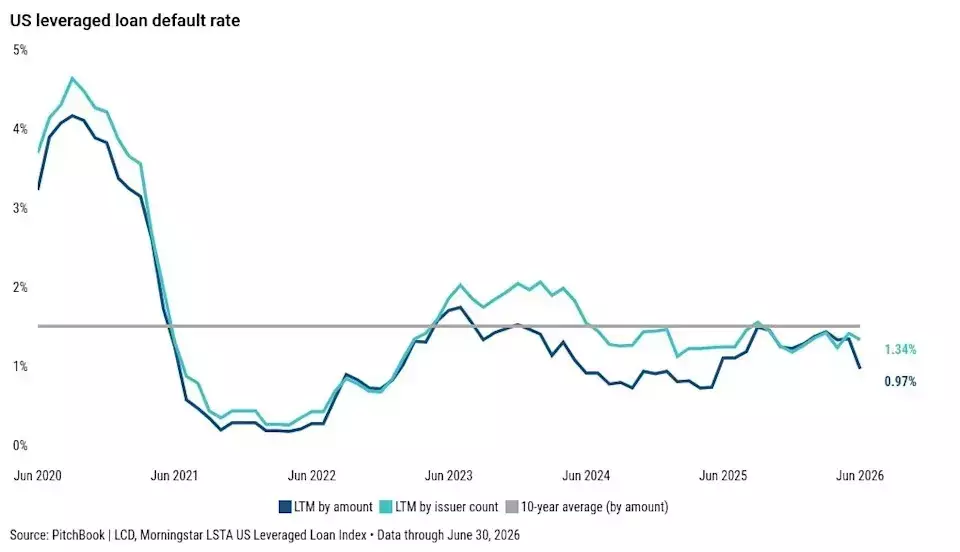
However, beneath this veneer of stability, warning signs are surfacing, particularly within leveraged loan markets. While trailing 12-month default rates for the Morningstar LSTA US Leveraged Loan index remain relatively low, the distress ratio – representing loans trading below 80 cents on the dollar – has been steadily climbing. This increase, especially notable in the software sector where a significant portion of distressed debt resides, suggests an impending period of financial strain. The high-yield market, tracked by the Morningstar US High Yield bond index, shows a more stable picture with its distress ratio nearing October 2025 lows, primarily due to a lighter representation of software and services companies.

The primary catalyst for this anticipated distress is the persistently high cost of capital. Figures like Surbhi Gupta of Houlihan Lokey and Jonathan Barzideh of Canyon Partners emphasize that elevated interest rates, compounded by geopolitical factors and trade tensions, are creating a fertile ground for distressed opportunities. Many debt deals from 2021-2022, initially patched up with liability management exercises (LMEs), are now faltering, potentially signaling a new default cycle. Josh Baumgarten of Beach Point Capital reinforces this, predicting a 'day of reckoning' as businesses struggle with prohibitive capital costs and constrained access to financing. Furthermore, the K-shaped economic recovery is exacerbating the plight of lower-income consumers, who are hit hardest by rising energy prices and mounting debt, contributing to vulnerabilities in consumer-discretionary sectors. Investment professionals are now strategically targeting sectors such as energy, housing, cyclicals, building products, and even software, given the evolving impact of AI on valuation models.

This evolving financial landscape underscores the dynamic interplay between economic resilience and targeted vulnerabilities. As capital costs remain elevated, and specific industries navigate rapid transformations, the discernment and strategic agility of distressed investors will be crucial in uncovering valuable opportunities amidst the challenges. The market's current state is a testament to the persistent need for vigilance and adaptive strategies in navigating complex economic currents, ultimately fostering a more robust and responsive financial ecosystem.

More Articles
Money
Diesel Prices Surge Amidst Volatile Oil Markets and Supply Disruptions
Despite a downturn in global crude oil prices, the benchmark retail diesel price in the U.S. has notably increased for the third consecutive week, climbing by 17.9 cents per gallon to reach $5.313/g. This rise contrasts sharply with falling crude futures, highlighting a growing disconnect between crude and refined product markets. Geopolitical tensions, attacks on refining infrastructure in the Middle East and Russia, and environmental factors like low Rhine River levels are contributing to a tight diesel supply, driving prices upward independently of broader oil market trends.
By Mr. Money MustacheJul 28, 2026
Money
ServiceNow's Promising Future Amidst AI-Driven Transformation and Workflow Automation
Night View Capital highlights ServiceNow (NOW) as an attractive investment in its Q2 2026 investor letter, emphasizing the company's strong position in workflow automation. Despite recent software sector concerns, Night View Capital views AI integration as a significant growth driver, believing that ServiceNow's platform, which streamlines digital workflows, is crucial for businesses adopting AI. The firm sees the current market downturn for software valuations as a temporary overreaction, confident in ServiceNow's ability to adapt and thrive.
By Bola SokunbiJul 28, 2026
Money
US Trade Deficit Narrows in June, Impact on Q2 GDP Growth
The U.S. goods trade deficit saw a contraction in June, largely due to a widespread reduction in imports. However, this improvement is likely insufficient to prevent trade from negatively impacting the second quarter's economic growth. Exports also experienced a decline, reaching a five-month low, primarily driven by a significant decrease in industrial supplies shipments, including petroleum, potentially influenced by a fragile ceasefire agreement.
By Mr. Money MustacheJul 28, 2026
Money
SpaceX Stock Experiences Volatility: Analyst Boosts Outlook Amid AI Data Center Vision
SpaceX's stock saw a significant drop, then a rapid recovery, on news of a bullish analyst rating and Elon Musk's ambitious plans for orbiting AI data centers. Analyst Douglas Harned reiterated an 'outperform' rating, setting a price target of $239, citing the successful Ship 40 test and future Starship capabilities. Musk envisions a $28.5 trillion market for in-orbit AI data centers, which could revolutionize the company's valuation. This article explores the recent stock fluctuations and the factors driving investor sentiment.
By Mr. Money MustacheJul 28, 2026
Money
From Custodian to Advanced Technician: Laniya Brooks' Journey with Meta and Mike Rowe's Workforce Academy
Laniya Brooks, once a data center custodian, is now being trained as an advanced technician through America's Workforce Academy (AWA), a joint initiative by Meta and Mike Rowe. This program, backed by Meta's $115 million pledge, aims to address the nationwide shortage of skilled tradespeople by providing training and guaranteed job placement, particularly in areas critical to data center construction.
By Bola SokunbiJul 28, 2026