Leverage's High Price: Examining the Impact of the Chip Market Downturn
Money

Leverage's High Price: Examining the Impact of the Chip Market Downturn

authorBy T. Harv Eker
DateJul 29, 2026
Read Time3 min
The semiconductor industry's recent downturn has starkly illuminated the inherent risks and amplified consequences of employing financial leverage. This analysis delves into how leveraged investment vehicles react during periods of significant market volatility, highlighting the disproportionate impact on instruments designed for daily resets.

Unpacking the amplified risks in volatile markets.

The Dual Impact: Unleveraged vs. Leveraged Semiconductor Funds

The semiconductor sector has recently experienced a notable decline, causing widespread concern among investors. While traditional semiconductor exchange-traded funds (ETFs), such as the iShares Semiconductor ETF, have seen a substantial reduction in value, products employing leverage, like the Direxion Daily Semiconductor Bull 3X Shares, have suffered an even more dramatic downturn. This divergence underscores the amplified risk associated with leveraged investments during market corrections, as their daily resetting mechanisms can lead to significantly larger losses over extended periods.

The Mechanics of Daily Leveraged ETFs: Understanding Compounding Effects

A crucial distinction in the world of leveraged ETFs lies in their operational structure, specifically their daily reset feature. Unlike traditional investments, these funds aim to provide a multiple of their underlying index's performance on a daily basis. This means that their returns do not simply scale by the leverage factor over longer timeframes. Instead, daily fluctuations compound, often leading to performance deviations that can be far more extreme than a direct multiplication of the underlying index's cumulative return. This characteristic is particularly critical to comprehend when the market exhibits high volatility or moves sideways, creating a challenging environment for these specialized funds.

The Steep Road to Recovery: Overcoming Significant Losses in Leveraged Portfolios

The path to recovering from substantial losses is inherently more challenging for leveraged investments. A simple percentage drop requires a disproportionately larger percentage gain to return to the original value. For instance, a fund that declines by 63% would need to rally by approximately 170% to regain its initial position, a stark contrast to a fund that experienced a 25% drop, which would need a 33% gain. This mathematical reality emphasizes the heightened risk profile of leveraged products and the profound impact of market downturns on capital preservation.

The Enduring Appeal and Growing Landscape of Leveraged Financial Products

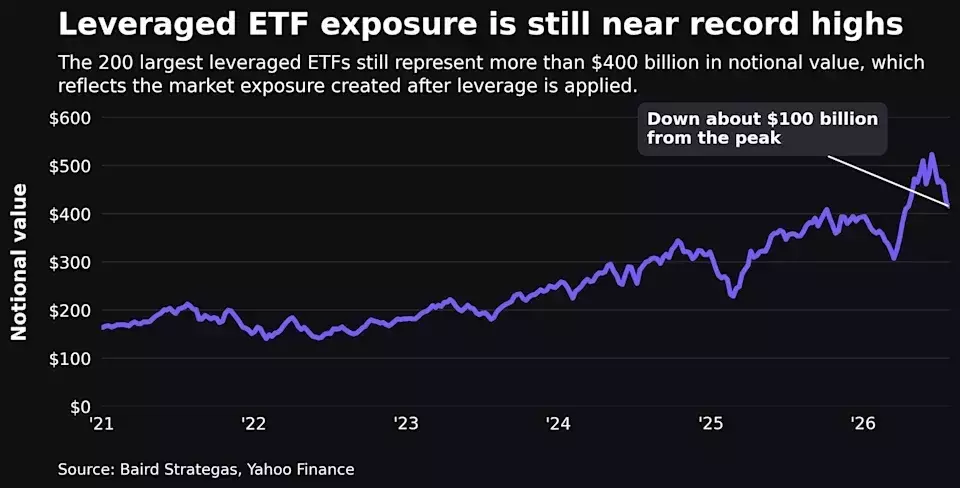
Despite the evident risks, leveraged financial products continue to attract considerable investor interest, becoming an increasingly integrated part of Wall Street's offerings. The trend of applying leverage to even newly listed or highly speculative assets, such as companies fresh off their initial public offerings, signifies a persistent demand for magnified exposure to market movements. This sustained appetite is reflected in the substantial notional value represented by leveraged ETFs, indicating that a significant portion of market exposure is still tied to these amplified investment tools, even after recent market adjustments.

A Deeper Dive: The Magnitude of Leverage in the Current Market Context

While recent market contractions have led to a decrease in the overall notional value of leveraged ETFs, the scale of this reduction, when viewed against the preceding boom in such products, is perceived by some experts as relatively minor. This suggests that despite the significant dollar amounts involved in the decline, the fundamental structure and investor base for leveraged products remain robust. The market's continued reliance on these instruments underscores a broader trend of embracing amplified investment strategies, even as the inherent challenges of volatility are laid bare.

More Articles
Money
Distressed Debt Market Forecast: H2 2026 Outlook and Software Sector Concerns
Despite a robust US economy, the distressed debt market anticipates significant opportunities in the latter half of 2026, primarily driven by elevated capital costs. While overall default rates remain low, a rising distress ratio in leveraged loans, particularly within the software sector, signals impending challenges. Experts foresee a new cycle of restructuring as companies grapple with higher interest rates and limited capital availability, urging a focus on vulnerable sectors like energy, housing, and certain cyclicals.
By Ramit SethiJul 28, 2026
Money
Diesel Prices Surge Amidst Volatile Oil Markets and Supply Disruptions
Despite a downturn in global crude oil prices, the benchmark retail diesel price in the U.S. has notably increased for the third consecutive week, climbing by 17.9 cents per gallon to reach $5.313/g. This rise contrasts sharply with falling crude futures, highlighting a growing disconnect between crude and refined product markets. Geopolitical tensions, attacks on refining infrastructure in the Middle East and Russia, and environmental factors like low Rhine River levels are contributing to a tight diesel supply, driving prices upward independently of broader oil market trends.
By Mr. Money MustacheJul 28, 2026
Money
ServiceNow's Promising Future Amidst AI-Driven Transformation and Workflow Automation
Night View Capital highlights ServiceNow (NOW) as an attractive investment in its Q2 2026 investor letter, emphasizing the company's strong position in workflow automation. Despite recent software sector concerns, Night View Capital views AI integration as a significant growth driver, believing that ServiceNow's platform, which streamlines digital workflows, is crucial for businesses adopting AI. The firm sees the current market downturn for software valuations as a temporary overreaction, confident in ServiceNow's ability to adapt and thrive.
By Bola SokunbiJul 28, 2026
Money
US Trade Deficit Narrows in June, Impact on Q2 GDP Growth
The U.S. goods trade deficit saw a contraction in June, largely due to a widespread reduction in imports. However, this improvement is likely insufficient to prevent trade from negatively impacting the second quarter's economic growth. Exports also experienced a decline, reaching a five-month low, primarily driven by a significant decrease in industrial supplies shipments, including petroleum, potentially influenced by a fragile ceasefire agreement.
By Mr. Money MustacheJul 28, 2026
Money
SpaceX Stock Experiences Volatility: Analyst Boosts Outlook Amid AI Data Center Vision
SpaceX's stock saw a significant drop, then a rapid recovery, on news of a bullish analyst rating and Elon Musk's ambitious plans for orbiting AI data centers. Analyst Douglas Harned reiterated an 'outperform' rating, setting a price target of $239, citing the successful Ship 40 test and future Starship capabilities. Musk envisions a $28.5 trillion market for in-orbit AI data centers, which could revolutionize the company's valuation. This article explores the recent stock fluctuations and the factors driving investor sentiment.
By Mr. Money MustacheJul 28, 2026