Porsche's Innovative Patent for Dynamic Racing Stripes
Cars

Porsche's Innovative Patent for Dynamic Racing Stripes

authorBy Larry Chen
DateApr 09, 2026
Read Time2 min
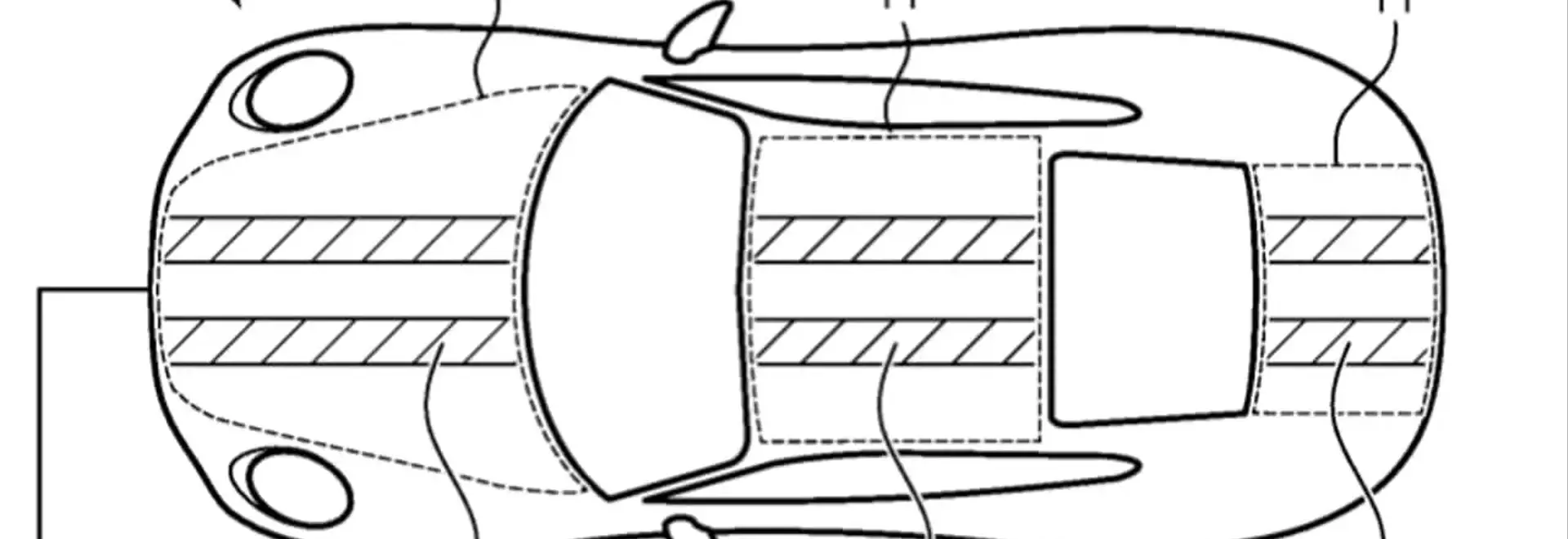
Porsche has recently secured a patent for a novel technology that promises to revolutionize vehicle aesthetics and functionality. This innovation involves dynamic racing stripes that can appear and vanish, offering a new level of personalization and interactive communication directly on the car's exterior.

Unveiling Tomorrow's Automotive Style and Functionality

The Ingenious Concept of Disappearing Stripes

Porsche's latest patent introduces an innovative system where racing stripes, typically a fixed design element, can be made to appear and disappear on demand. This is achieved through the application of advanced film materials, specifically electronic paper or paramagnetic coatings, to the vehicle's outer surface. These materials possess the remarkable ability to alter their color and visibility when an electrical voltage is applied, transforming the car's appearance with a simple command.

Beyond Aesthetics: Practical Applications of Dynamic Design

The utility of this technology extends far beyond purely decorative purposes. Porsche envisions these dynamic stripes serving as functional indicators for drivers. For instance, the stripes could intuitively change color to reflect the car's current drive mode, such as illuminating green for an eco-friendly setting or shifting to red to signify a performance-oriented sport mode. Furthermore, in electric vehicles, this technology could offer a visual representation of the car's charge status directly on its exterior, providing a quick and clear overview to the owner.

Technological Underpinnings: A Step Forward in Smart Surfaces

The core of this groundbreaking system lies in its use of cutting-edge materials and electronic control. The exterior film, whether electronic paper or a paramagnetic coating, acts as a canvas that responds to electrical stimuli. This concept builds upon existing electrochromic glass technology, which is already used in various applications to change opacity. Porsche's patent represents a significant advancement, applying similar principles to a larger surface area and integrating it seamlessly into the vehicle's design for both aesthetic appeal and practical information display.

Future Implications for Vehicle Customization and Information Display

This patent highlights Porsche's commitment to pushing the boundaries of automotive design and technology. By integrating dynamic visual elements into the car's exterior, the company is exploring new avenues for personalization and communication. This development could pave the way for more interactive vehicle surfaces, where cars not only transport but also visually inform and adapt to the owner's preferences and the car's operational state, offering a glimpse into the future of intelligent automotive exteriors.

More Articles
Cars
Volkswagen Halts ID.4 Production in US, Teases Future Electric SUV
Volkswagen has ceased production of its ID.4 electric SUV at its Chattanooga, Tennessee facility to make way for the 2027 Atlas. Despite this, the company confirms plans for a "future version of ID.4" for the North American market, suggesting a revamped electric SUV is on the horizon, potentially utilizing the advanced MEB+ platform for improved efficiency and performance.
By Larry ChenApr 09, 2026
Cars
The Dominance of GM's Supercharged LT4 Engine
GM's LT4 engine, introduced in 2015, revolutionized the performance vehicle market. With its 6.2-liter displacement and Eaton supercharger, it delivers up to 682 horsepower, making it a formidable successor to the LS9. This V8 powerhouse has been integrated into several iconic GM models, including the Corvette Z06, Cadillac CTS-V, Camaro ZL1, and Escalade-V, proving its versatility and enduring appeal in high-performance applications.
By Brock YatesApr 09, 2026
Cars
Scout's Terra Pickup and Traveler SUV Face Significant Production Delays
New reports indicate that Scout's anticipated Terra pickup and Traveler SUV models are experiencing substantial production delays. The Terra pickup may not arrive until 2030, while the Traveler SUV's debut is reportedly pushed to 2028. These setbacks come years after the initial concept reveals, attributed to technical hurdles and evolving electric vehicle strategies. Despite the company's official statement targeting 2027 for initial production and 2028 for customer deliveries, uncertainty lingers regarding these timelines and the original sub-$60,000 price point.
By Akira MarutaApr 09, 2026
Cars
Next-Gen Toyota GR86: Hybrid Power with Undiminished Driving Purity
Anticipation builds for the next iteration of the Toyota GR86, with recent insights suggesting a shift towards a mild-hybrid powertrain. While a slight reduction in horsepower is projected, the vehicle is expected to retain its characteristic lightweight and compact design, ensuring the engaging driving experience remains at its core. This strategic evolution aims to blend modern efficiency with the beloved attributes of a pure sports car.
By Jeremy ClarksonApr 09, 2026
Cars
2026 Land Rover Defender vs. Ford Bronco: Off-Road Icons Compared
This article provides a detailed comparison between the 2026 Land Rover Defender and the 2026 Ford Bronco, two prominent off-road SUVs. It highlights their differences in powertrain, interior luxury, design, technological features, and pricing, helping potential buyers determine which vehicle best suits their adventurous lifestyle and budgetary considerations. The Defender offers premium features and robust towing, while the Bronco emphasizes rugged utility and customization.
By Brock YatesApr 09, 2026