J.P. Morgan's Forecast Shake-Up: A Hawkish Turn in Fed Rate Expectations Amidst Inflation Concerns
Navigating Uncertainty: J.P. Morgan's Bold Shift in Federal Reserve Rate Projections
Inflation Indicator Shows Promise, Yet Fed's Stance Remains Unclear
Recent economic figures indicate a positive trend as the Federal Reserve's preferred inflation gauge showed a decrease in June, primarily due to lower energy costs. However, during his latest appearance, Fed Chairman Kevin Warsh created market uncertainty by declining to confirm whether the Personal Consumption Expenditure (PCE) price index would maintain its role as the primary inflation indicator, and offered no alternative.
Wall Street's Discontent and J.P. Morgan's Decisive Response
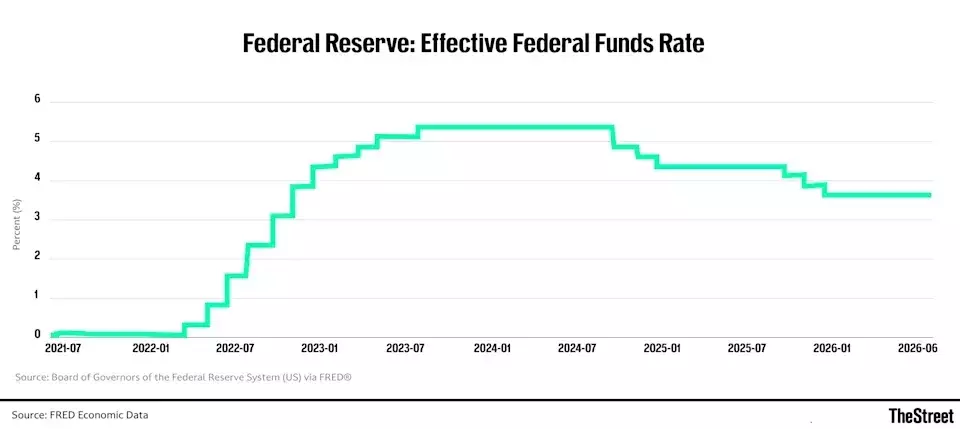
This lack of clarity from the Fed Chairman caused considerable unease among investors, overshadowing the Federal Open Market Committee's (FOMC) decision to keep short-term benchmark interest rates unchanged. In the immediate aftermath of Warsh's press conference, J.P. Morgan dramatically altered its forecast, adopting a more aggressive stance on future rate adjustments, encapsulated by their direct report titled "Talk is Cheap."
J.P. Morgan's New Rate Hike Projections
Michael Feroli, Chief U.S. Economist at J.P. Morgan, now projects a 25 basis-point rate hike in December, significantly sooner than the previous expectation of late 2027. While maintaining the Federal Funds Rate within a specific range after this initial increase, the bank's analysis also highlights a tangible risk of a September rate increase, underscoring the urgency for the Federal Reserve to clarify its inflation strategy.
Warsh's Communication Under Scrutiny and Market Volatility
Feroli's research emphasized that the Federal Reserve Chairman's ambiguous statements cast doubt on the central bank's commitment to tackling inflation, leading to heightened policy uncertainty. This perception could compel the FOMC to act more assertively to fulfill its mandate for price stability, as market participants seek clearer guidance.
The Fed's Balancing Act: Employment Versus Price Stability
The Federal Reserve operates under a dual mandate from Congress, aiming to achieve both maximum employment and stable prices. The FOMC's recent post-meeting statement, while brief, acknowledged economic expansion amidst geopolitical uncertainties and energy price fluctuations. Despite repeated assurances from Warsh to bring inflation down to its 2% target, he offered no concrete plan, leading to frustration from market observers who question the timeline for decisive action.
Market Reassessment of Fed's Interest Rate Outlook
Following the July FOMC meeting, traders have adjusted their expectations for future rate hikes. The probability of a September rate increase has decreased, but a cumulative probability suggests that rates will likely be higher by the December FOMC meeting. Major financial institutions like BofA Global Research foresee multiple rate hikes starting in September, while others, such as Citigroup, maintain their forecasts for rate reductions later this year and into next year.
Underlying Factors Behind June's PCE Drop and Economic Indicators
The debate surrounding the PCE's future role as the primary monetary policy tool, coupled with a lack of clarity on its potential replacement, has exacerbated market anxieties. While headline PCE declined in June, core PCE still rose, indicating underlying inflationary pressures. Rising gasoline prices due to geopolitical tensions and a low savings rate among consumers further complicate the economic outlook, alongside a lower-than-expected GDP increase, raising questions about consumer resilience in the face of ongoing economic headwinds.
