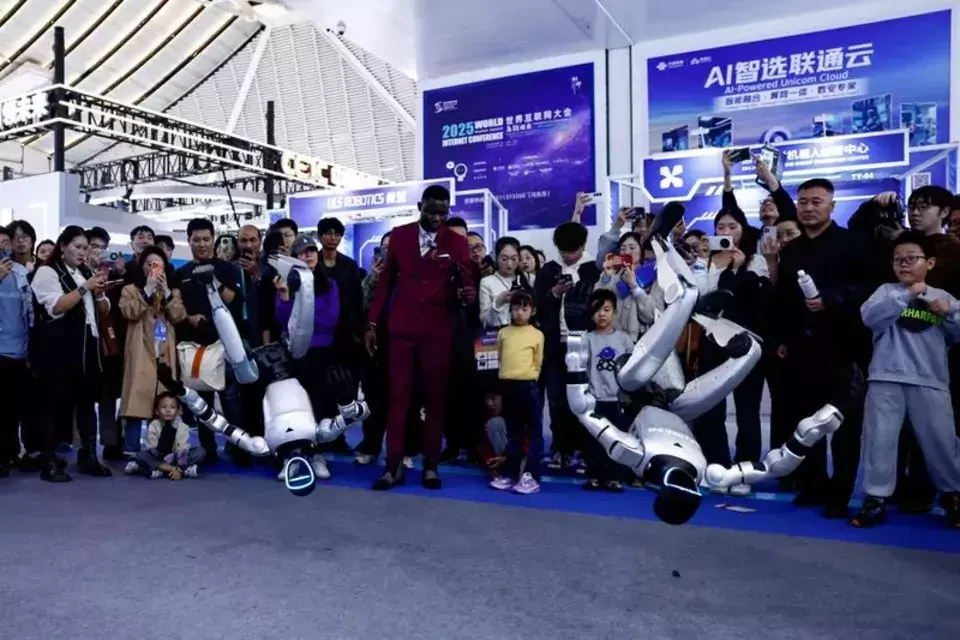
China's Humanoid Robots Face Commercial Reality Check Beyond Demos
Chinese humanoid robot manufacturers, having captivated audiences with their advanced creations, are now facing the critical task of proving their commercial applicability. This year's World Robot Conference in Beijing serves as a crucial platform for these companies to demonstrate how their innovations can reliably contribute to economic value, moving beyond mere impressive displays.
Chinese Humanoid Robots Transition from Spectacle to Commercial Scrutiny
In mid-August 2026, Beijing hosted the World Robot Conference, an event that gathered over 300 companies and featured more than 2,000 exhibits, alongside the launch of over 150 new products. This significant gathering coincided with the Shanghai stock market debut of Unitree, a leading humanoid robot manufacturer globally by sales volume, whose initial public offering was notably oversubscribed by individual investors.
Unitree's founder, Wang Xingxing, was scheduled to address the conference, focusing on the future trajectory of the humanoid industry over the next decade. This period marks a pivotal moment where the conversation around Chinese humanoids is shifting from viral demonstrations to a more pragmatic evaluation of commercial reality. Investors and potential clients are increasingly prioritizing a robot's productive capacity, its requirement for human oversight, and its ability to generate a tangible return on investment, rather than just its performance in complex physical feats.
While China has seen robots deployed in specific sectors like hotel food delivery and certain assembly line operations, widespread adoption across various industries beyond initial pilot projects remains largely unachieved. Industry leaders, such as Yu Chao, CEO of Lumos Robotics, a Mitsubishi Electric-backed startup exhibiting at the conference, emphasize the need for embodied AI technologies to prove their practical utility. Yu predicts that companies failing to demonstrate value creation for customers will likely face significant challenges. Robotics analyst Georg Stieler estimates that a substantial portion of humanoid robots produced this year might primarily serve as data collection tools for training, rather than performing productive tasks.
The economic considerations are also stark. Guotai Securities, a Chinese brokerage, suggests an industrial humanoid robot would need to cost around 160,000 yuan (including maintenance) to be economically viable within two years, compared to an average worker's annual salary of 80,000 yuan. However, current market prices for such robots typically range from 300,000 to 500,000 yuan, as reported by the Berlin-based think tank MERICS.
To further test their capabilities, the World Humanoid Robot Games, held from August 22 to 26 at Beijing's National Speed Skating Oval, incorporated competitions designed around practical work scenarios. These events, which moved beyond traditional races, football, and fighting, included tasks related to factory operations, hotel services, household chores, electric vehicle charging, and complex dexterous manipulations. These challenges specifically aimed to assess robots' ability to identify unfamiliar objects, execute continuous tasks in varied environments, recover from errors, and complete assignments without constant human intervention.
The transition from impressive demonstrations to economically viable products is a global challenge. In the United States, Jerry Wang, CEO of AIxCrypto Holdings, launched RoboShare, a platform for businesses to rent robots on a task-by-task basis, highlighting the existing bottlenecks beyond robot technology itself, such as the scarcity of skilled operators and the high costs associated with transportation, deployment, and maintenance.
Adding another layer of complexity is the geopolitical landscape. The U.S. Federal Communications Commission's recent restrictions on foreign-made advanced robotic devices, impacting companies like Unitree, underscore the potential for trade barriers to influence market dynamics. IDC, a technology research firm, forecasts a significant reduction in U.S. humanoid sales by 2030 under its worst-case scenario, despite China currently accounting for 82% of global humanoid shipments.
This shift towards practical application and economic viability underscores a crucial evolutionary phase for the humanoid robot industry. While the initial excitement surrounding their advanced capabilities was undeniable, the industry's sustained growth and integration into various sectors will depend on its ability to offer tangible, cost-effective solutions that genuinely enhance productivity and efficiency in the real world. The Beijing conference and the accompanying robot games represent not just a showcase of technological prowess, but a critical crucible for the commercial future of humanoid robotics.
