Canada's Pipeline Dreams: A Risky Bet on Future Oil Output
Canada is currently facing a significant challenge in its energy sector, as ambitious pipeline expansion projects are moving forward despite a noticeable reluctance from oil sands companies to commit to substantial production increases. This disconnect is largely driven by uncertainties surrounding future climate policies and the evolving landscape of long-term global oil demand. The situation creates a precarious balance, with the nation's aspirations for enhanced oil export capabilities potentially outstripping the actual supply needed to fill these new infrastructures.
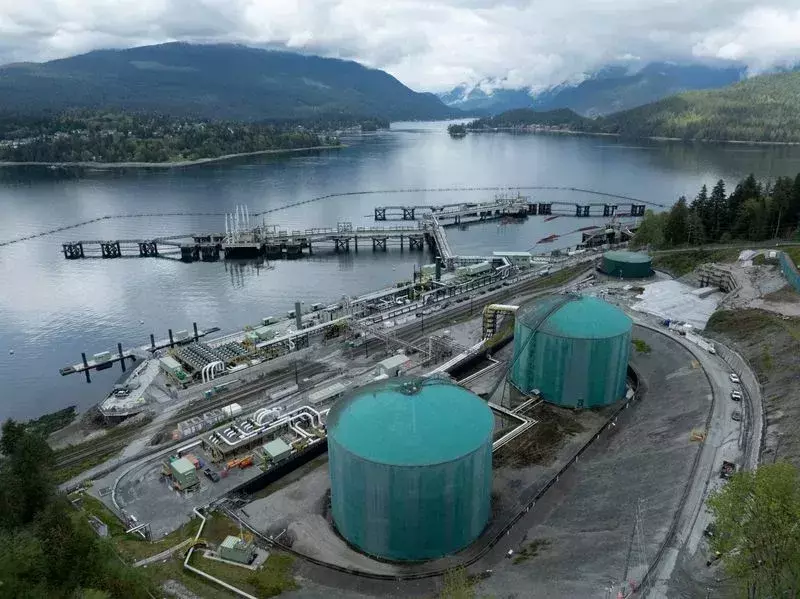
Numerous pipeline initiatives are either underway or in the planning stages across Canada, designed to transport crude oil to the United States and various international markets via the Pacific coast. Should all these projects materialize, the nation's total oil export pipeline capacity could see a remarkable 45% surge, equating to an additional 2.25 million barrels per day, by the year 2035. However, achieving this level of utilization would necessitate an increase in Canadian oil production by over a third within the next decade, a growth rate that significantly surpasses its current annual average. Furthermore, it would require oil producers to initiate large-scale oil sands ventures, a type of investment largely absent for more than a decade.
The discrepancy between the proposed pipeline capacity and the projected pace of oil output growth underscores a fundamental challenge for Canada. Despite a more favorable regulatory environment and a growing international interest in Canadian oil, the country may struggle to realize its long-held ambition of becoming an "energy superpower." Major industry players, including Suncor Energy and Canadian Natural Resources, have recently indicated their unwillingness to accelerate production plans. Echoing this sentiment, Enbridge, a prominent pipeline operator, announced in July the postponement of a second phase for its Mainline pipeline expansion, attributing the decision to a lack of commitment from customers regarding increased capacity.
Colin Gruending, Executive Vice-President of liquids pipelines at Enbridge, noted producers' disciplined approach. He acknowledged that while they might eventually increase production, the pipeline development may have been slightly premature. As the world's fourth-largest oil producer and a major exporter, Canada directs approximately 90% of its oil output to the United States. The vast reserves within Northern Alberta's oil sands are well-known, but existing export infrastructure is nearing full capacity. In the near term, global buyers are increasingly looking to Canada due to disruptions in oil trade caused by geopolitical events. However, the long-term outlook for production growth is clouded by uncertainties related to domestic and international climate policies, as well as geopolitical factors.
Among the six proposed Canadian pipeline projects, some entail incremental capacity expansions, such as those planned for the Enbridge Mainline and Trans Mountain systems. These smaller-scale projects could be executed relatively quickly and cost-effectively. In contrast, a more ambitious undertaking like Alberta's proposed 1-million-barrel-per-day east-west oil pipeline to the Pacific coast presents a considerably higher risk due to its immense scale. Approximately half of the planned capacity expansions, totaling around 950,000 barrels per day, are intended for oil shipments to the U.S., including a proposal for a new crude pipeline that would revive elements of the former Keystone XL project.
Historically, constructing new pipelines has been fraught with political opposition and environmental hurdles. Concurrently, low oil prices, regulatory uncertainties, and a focus on shareholder returns have suppressed the necessary investments to substantially boost oil output. In 2025, Canadian oil production increased by 4% to reach an unprecedented 5.35 million barrels per day, with most analysts forecasting another 3% to 4% growth in 2026. This growth rate, however, pales in comparison to the 8% or higher rates observed in the 2000s and 2010s, a period marked by the construction of new oil sands mines.
Annual capital investment in Canada's oil sands peaked in 2014 at C$35 billion, significantly higher than the C$14.2 billion invested in 2024, according to Statistics Canada. The last major new oil sands project, Suncor's Fort Hills, became operational in 2018. Since then, companies have primarily focused on expanding existing operations. Imperial Oil CEO John Whelan noted at a June conference that the oil sands industry has spent C$10 billion less per year in the last decade compared to the preceding one. Whelan also estimated that building enough production to fill the proposed east-west pipeline alone, along with the carbon capture project mandated by the Canadian government, would require over C$100 billion in capital investment. Wood Mackenzie analyst Mark Oberstoetter remarked that while such projects were feasible in the past, a different perspective on long-term oil prices and a "growth-at-all-means" philosophy among companies prevailed then, a stark contrast to today's approach.
Energy consultancy Novi Labs identified 19 potential oil sands growth projects that could add 652,000 barrels per day of production by 2037. However, only a portion of these projects, proposed by companies such as Cenovus Energy, Imperial Oil, Strathcona Resources, and Suncor, have received final investment decisions. When Novi Labs included other proposed oil sands growth projects that companies have indicated are in their medium- or long-term plans but lack specific timelines, an additional 730,000 barrels per day could be added. Nevertheless, this combined growth still falls short of the output needed to fully utilize the proposed pipelines by more than 850,000 barrels per day. Despite these challenges, Canadian oil executives express greater optimism about the future, buoyed by the Prime Minister's commitments to streamline permitting for energy projects and ease environmental and climate regulations. However, many of the proposed policy changes, negotiated between the industry and federal and Alberta governments, including agreements on carbon pricing, financial support, and permitting timelines, have yet to be finalized into legislation. Kendall Dilling, president of the Oil Sands Alliance industry group, stated in an interview that their objective is to see significant projects move forward if the investment conditions are adequately established.
The ambitious expansion of Canada's pipeline infrastructure stands at a crossroads, awaiting a definitive commitment from oil producers to increase output. The current hesitancy, driven by economic uncertainties and environmental considerations, poses a substantial hurdle to the nation's energy sector aspirations. The future success of these projects hinges on a delicate balance between policy adjustments, sustained investment, and the confidence of major oil companies to embark on large-scale production endeavors once again.
