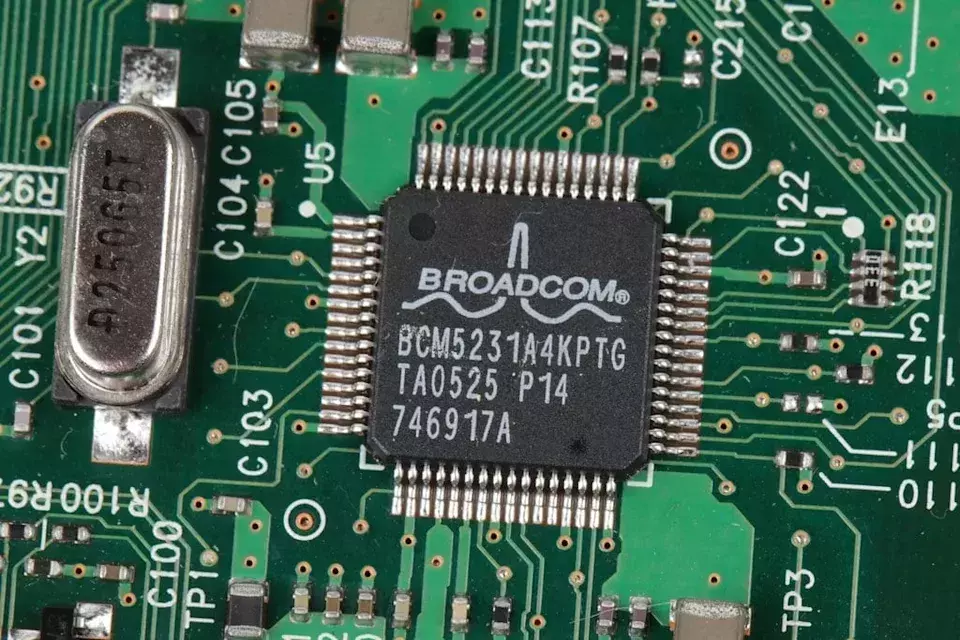
Broadcom's Dominance in AI Chip Market and Investment Appeal
Broadcom stands out as a compelling investment due to its strategic positioning in the artificial intelligence (AI) semiconductor industry. The company's unique dual-engine AI strategy, encompassing custom Application-Specific Integrated Circuits (ASICs) and high-speed networking silicon, allows it to effectively capture capital from leading hyperscalers. This approach fosters a utility-like market lock-in, providing stability amidst typical semiconductor market cycles. With strong financial metrics, including impressive revenue growth, significant free cash flow, and a consistent history of dividend increases, Broadcom presents itself as a robust option for investors looking for long-term growth in the AI domain.
Broadcom's investment allure is rooted in its innovative dual AI engine framework. This strategy leverages both custom silicon solutions, co-developed with clients, and advanced high-speed switching silicon, such as their Tomahawk and Jericho series. These networking chips are essential for connecting the custom AI hardware clusters used by major tech entities like Google, Meta, OpenAI, and Anthropic. This means that even as these hyperscalers develop their own proprietary AI hardware to reduce reliance on costly GPUs, they continue to depend on Broadcom for critical networking infrastructure. This dual capability ensures Broadcom benefits from AI capital expenditures from multiple angles, creating a resilient business model that transcends typical semiconductor market fluctuations.
Financially, Broadcom demonstrates exceptional performance. In the second quarter of fiscal year 2026, the company reported a substantial 47.9% year-over-year increase in revenue, reaching $22.19 billion. AI semiconductor revenue alone soared by 143% to $10.80 billion. Management projects continued strong growth, with third-quarter total revenue estimated at $29.4 billion and AI semiconductor revenue expected to hit $16 billion, representing over 200% year-over-year growth. The CEO, Hock Tan, has set ambitious targets, expecting full-year fiscal 2026 AI semiconductor revenue to reach $56 billion, with an aim to surpass $100 billion in AI sales by 2027. The company's robust AI bookings, exceeding $30 billion against $10.8 billion shipped, provide clear visibility into its future growth trajectory extending into 2028. Furthermore, Broadcom boasts a strong free cash flow of $10.26 billion in Q2, accounting for 46% of its revenue, and an adjusted EBITDA margin of 69%. Operating income also saw a significant increase of 85.07% year-over-year, underscoring the company's operational efficiency and profitability.
Regarding capital returns, Broadcom has an impressive record, having increased its dividend for 15 consecutive years, with the most recent hike being 10% to $0.65 per quarter. The company also has a $10 billion share buyback program extending through December 31, 2026, with $7.8 billion already utilized in the first quarter. This combination of hypergrowth in AI and a strong capital return mechanism makes Broadcom an attractive proposition. While NVIDIA is often seen as the primary AI silicon trade, Broadcom offers a more appealing valuation with a forward P/E of 21, a PEG ratio of 0.44, and a substantial cash reserve of $19.63 billion, alongside a declining total liabilities trend. Its FCF margins of 46% further highlight its financial strength.
Despite the inherent risks associated with customer concentration, particularly with a few hyperscalers driving the AI franchise, Broadcom is actively mitigating this by diversifying its client base. The addition of two new major customers with $6 billion in purchase orders, alongside significant gigawatt commitments from Anthropic, OpenAI, and Meta extending through 2028, demonstrates a broadening customer roster. This expansion helps moderate concentration risk and enhances the stability of its future revenue streams. The company’s consistent performance and strategic growth initiatives solidify its position as a valuable investment, particularly given its current valuation in the market.
