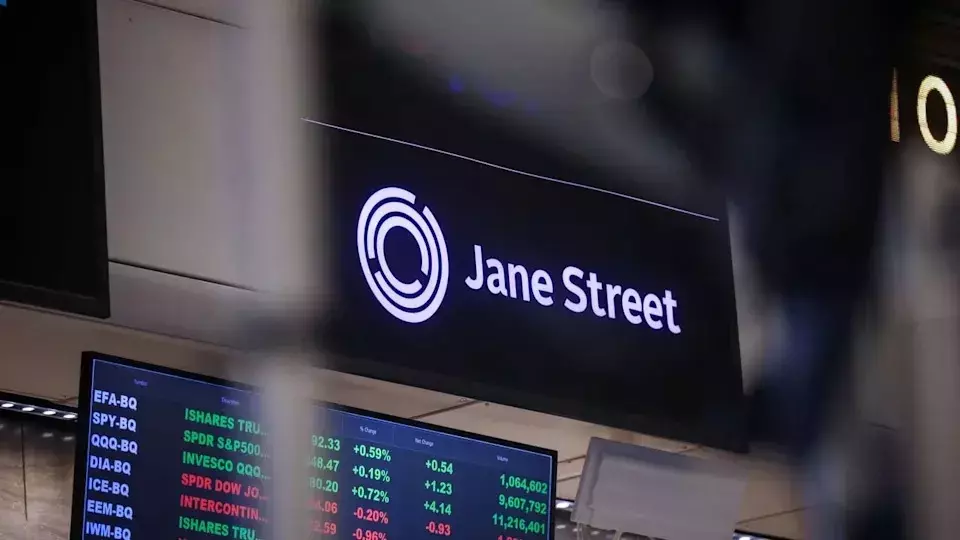
Jane Street Faces Significant Losses in July Amid Market Volatility
Money

Jane Street Faces Significant Losses in July Amid Market Volatility

authorBy Mr. Money Mustache
DateAug 17, 2026
Read Time3 min

Jane Street, a leading quantitative trading firm, encountered a substantial financial setback in July, incurring a $15 billion loss. This significant downturn was largely attributed to its substantial investment in Situational Awareness, an AI-focused hedge fund, and a broader decline in its long positions within the technology sector amidst a widespread market sell-off. This marked a critical moment for Jane Street, as it was the first time since 2016 that its monthly trading revenue turned negative.

In an internal communication, Jane Street's leadership acknowledged July as a 'challenging month,' directly linking a portion of the financial damage to a sharp decline in Situational Awareness's performance. The executives noted that their investment in the externally managed AI fund had grown significantly due to strong performance earlier in the year. However, a severe drawdown subsequently left their stake roughly at its initial value for the year, though still showing overall gains since the initial investment. The firm also explained that its hedging strategies proved ineffective because the losses in AI stocks accumulated gradually throughout the month, rather than occurring as a sudden market shock. Additionally, the firm's long-held positions in Asian stocks outside the AI sector, which had previously demonstrated robust performance, also turned unfavorable.

Despite the substantial losses in July, Jane Street's cumulative trading revenue for the current year has already surpassed $40 billion, exceeding its total revenue of $39.6 billion for the entirety of 2025. Following this period of financial strain, Jane Street has reportedly reduced a significant portion of its exposure to the problematic positions that led to the losses. The firm has also adopted a more conservative approach across other areas of its portfolio. Situational Awareness, led by former OpenAI researcher Leopold Aschenbrenner, faced even more severe consequences, losing approximately $35 billion in assets after prime brokers initiated margin calls, forcing a distressed sale of its publicly traded holdings to Ken Griffin's Citadel. The fund, which once held $45 billion at its peak in early July, saw its assets shrink to about $10 billion after Citadel acquired its highly leveraged positions, including stakes in SK Hynix and CoreWeave, at prices below market value. Situational Awareness had employed leverage as high as 400% and concentrated its public portfolio on investments in AI infrastructure companies.

In the aftermath, Aschenbrenner initiated efforts to rebuild, including a $400 million investment in an undisclosed private company, signaling his commitment to recovery. In a letter to investors, he vowed to learn from the challenging experience. This incident underscores the inherent risks and rapid shifts present in the highly volatile world of hedge funds and technology investments, emphasizing the critical importance of robust risk management and adaptive strategies in navigating unpredictable market conditions.

More Articles
Money
Laramide Resources Expands Uranium Exploration in Sweden
Laramide Resources has successfully obtained exploration licenses for key uranium-rich regions in Sweden, namely Hotagen and Arjeplog-Arvidsjaur. This strategic move positions the company, already active in uranium development across the US and Australia, at the forefront of Europe's promising uranium landscape. The acquisition follows recent legislative changes in Sweden, which have reinstated uranium mining, signaling a transformative shift for the nation's energy sector and creating significant opportunities for uranium supply chain development.
By Ramit SethiAug 17, 2026
Money
Global Market Dynamics: Retail Sales, Interest Rates, and Geopolitical Tensions
This report examines the intricate interplay of global market factors, including a dip in U.S. retail sales, shifting Federal Reserve rate hike expectations, and the impact of geopolitical events like the Iran conflict on oil prices. It also delves into Japan's economic challenges and China's slowing growth, highlighting how these elements collectively shape the contemporary financial landscape and influence investor sentiment worldwide.
By Chika UwazieAug 17, 2026
Money
Unitree's 'Superman' Robot Achieves Record-Breaking Speed, Outpacing Usain Bolt
Unitree has unveiled its new humanoid robot, 'Superman,' which boasts a top speed of 12.66 meters per second, surpassing Usain Bolt's fastest recorded sprint. This announcement comes just days before Unitree's highly anticipated IPO on the Shanghai STAR Market, which has already seen unprecedented investor demand, valuing the company at nearly $9 billion. The robot's remarkable speed and the company's strong market debut highlight the growing interest and investment in advanced robotics and embodied AI.
By T. Harv EkerAug 17, 2026
Money
Mothercare Faces Financial Setback Amidst Middle East Crisis and Boots Partnership Termination
Mothercare experienced a significant financial downturn in the fiscal year ending March 2026, reporting a statutory loss of £5.0 million. This reversal from the previous year's profit is largely attributed to decreased retail sales by franchise partners, impacted by the ongoing Middle East crisis and the conclusion of its UK agreement with Boots. The company is actively pursuing refinancing and strategic adjustments to mitigate these challenges and restore market presence.
By Vicki RobinAug 17, 2026
Money
Mortgage and Refinance Rates: Purchase vs. Refinance on August 17, 2026
As of Monday, August 17, 2026, current purchase mortgage rates are notably lower than refinance rates, according to Zillow's lender marketplace data. The 30-year fixed purchase rate stands at 6.54%, which is 5 basis points below the corresponding refinance rate. Similarly, the 15-year fixed purchase rate is 5.86%, 2 basis points lower than its refinance counterpart, and the 5/1 ARM purchase rate of 6.24% is 20 basis points lower than the 5/1 refi rate.
By Bola SokunbiAug 17, 2026