AI Chip Trade Reshapes Emerging Market Investments
The landscape of emerging market investments is undergoing a significant transformation, with artificial intelligence (AI) chip manufacturing becoming a central driver. Once perceived as a distinct investment category, emerging markets are now deeply integrated into the global AI supply chain. This evolving dynamic necessitates a closer look at the constituents of emerging market exchange-traded funds (ETFs) to understand their true exposure, especially in the context of the burgeoning AI hardware sector.
Emerging Markets Shift Focus to AI Chips, Redefining Investment Strategies
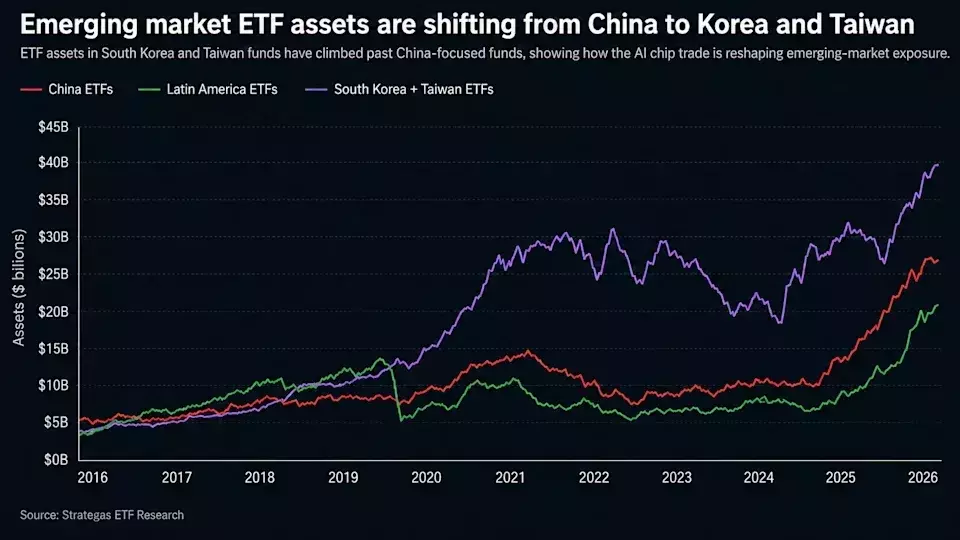
In a notable shift observed by Strategas ETF Research on Monday, June 29, 2026, the cumulative assets in ETFs concentrating on South Korea and Taiwan have surpassed those of funds primarily focused on China. This development highlights a pivotal repositioning within the emerging market investment sphere, moving its core towards leading semiconductor manufacturing hubs. Countries like South Korea, home to industry giants such as Samsung and SK Hynix, and Taiwan, boasting Taiwan Semiconductor Manufacturing (TSM), are now at the forefront of this new investment trend. Previously, emerging markets offered investors a route to diverse economies, often characterized by rapid consumer growth, commodities, and unique currency dynamics, distinct from the major US stock market plays. However, a significant portion of current emerging market investment now funnels through the global AI supply chain, closely linking these markets to the same technological cycles that influence American tech companies. This integration means that what was once a clear diversification strategy is now more akin to another avenue for investing in AI hardware. Consequently, recent downturns in semiconductor stocks have ripple effects far beyond US chip ETFs, impacting country-specific and broader emerging market funds, particularly those with significant holdings in South Korea and Taiwan. Adding to this complexity, the composition of various emerging market funds can differ substantially. For instance, the iShares MSCI Emerging Markets ETF (EEM) includes South Korea due to MSCI's classification, whereas the Vanguard FTSE Emerging Markets ETF (VWO) excludes it, classifying South Korea as a developed market. This difference in classification leads to EEM having approximately 5% greater semiconductor exposure than VWO, according to Strategas. Therefore, effective portfolio diversification increasingly depends on a thorough examination of the specific holdings within each investment vehicle.
This shift underscores a crucial lesson for investors: diversification is no longer solely about adding an international or emerging market ticker to a portfolio. It demands a granular understanding of the underlying assets within each fund. While emerging markets can still provide valuable diversification, many now serve as direct conduits to the AI chip trade. This evolving landscape requires investors to be more vigilant and informed about the true nature of their emerging market exposures, ensuring that their investment strategies align with their desired level of tech sector engagement.
