Woven City: Toyota's Futuristic Laboratory for Innovation
Toyota's Woven City, an innovative urban prototype situated near Mount Fuji in Japan, is transforming into a bustling center for technological experimentation and advancement. Conceived as a 'proof of concept' (POC) hub, this visionary project provides a dynamic environment where new ideas and inventions can be rigorously tested and refined in a real-world setting. With its initial inhabitants, known as 'Weavers,' having settled in by the close of 2025, the city is rapidly evolving into a collaborative ecosystem where residents and innovators work hand-in-hand to shape the future of smart living and mobility. The core principle driving Woven City is a culture of experimentation, encouraging both successes and failures as integral steps toward groundbreaking discoveries.
Daisuke Toyoda, a senior vice president at Woven by Toyota, has championed this experimental ethos, stating his vision for a city where individuals feel empowered to explore unconventional ideas. This sentiment was echoed during a recent media event marking the completion of the first phase of residential development, emphasizing a commitment to progress even in the face of setbacks. The city’s foundations are built on the former site of a Toyota factory, which produced millions of vehicles over five decades before its closure in 2020. Toyota unveiled plans for Woven City at the 2020 CES technology showcase, signaling its strategic shift towards becoming a comprehensive mobility provider.
A notable aspect of Woven City is its integrated approach to technology within daily life. For instance, Kota Oishi, a product team leader at Toyota, and his children reside in the city, actively engaging with emerging technologies. His 10-year-old child, for example, frequently visits the public Inventor labs to observe and report on robot malfunctions, contributing valuable real-time feedback to developers. This hands-on interaction fosters a unique learning environment where children can collaborate with engineers, nurturing their curiosity and problem-solving skills from an early age.
Educational innovation is also a key component of Woven City. Z-kai Group, an established educational institution, launched a nursery school within the city in early 2025, offering after-school programs for older children. The company is actively pursuing numerous 'proof of concept' projects to identify technologies that can be effectively scaled and applied beyond Woven City. One such innovation is a vertical tablet device, developed by Woven by Toyota, which uses projection mapping to guide students in remote learning scenarios. This technology, which enables teachers to provide precise visual cues on students' notebooks, is slated for wider implementation outside Woven City in the coming months.
Despite its ambitious vision, Woven City is currently a sparsely populated community, with only about 100 full-time residents and an additional 200 daily workers. However, this select group plays a crucial role in the city's experimental framework. Businesses like UCC, a prominent Japanese coffee chain, operate within Woven City, leveraging residents' willingness to share personal data for research purposes. Cameras in the UCC café monitor customer behavior, feeding data to Toyota’s Woven City AI Vision Engine. This AI analyzes activities like attention levels while working or reading, providing insights that could inform future product development, such as improved vehicle features designed to enhance driver focus. Similarly, Daikin is experimenting with allergen-free indoor environments, a technology that could eventually translate into healthier vehicle interiors. Another significant initiative within Woven City is Arene, Toyota’s advanced software development platform, which debuted in the 2026 RAV4 and is poised for integration into a broader range of Toyota and Lexus models.
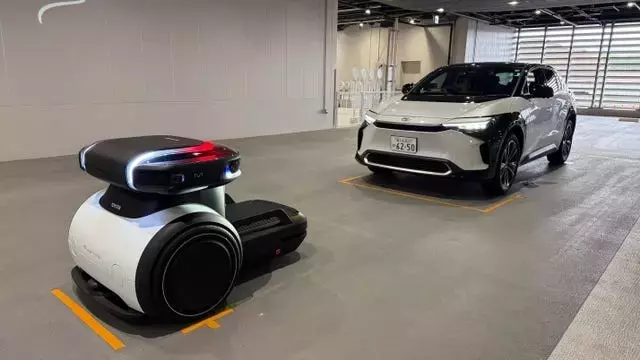
Beyond fixed installations, Woven City serves as a testbed for diverse mobility solutions. Toyota is trialing various concept vehicles, including the compact e-Palette BEV and the three-wheeled Swake scooter, which was first showcased at the 2025 Japan Mobility Show. The Toyota Guide Mobi, a compact, self-driving robot, is being developed to wirelessly 'tow' passenger vehicles by controlling their steering, offering a cost-effective alternative to expensive lidar sensors for parking assistance. Autonomous shuttles also provide essential transportation between Woven City and a nearby train station, demonstrating practical applications of self-driving technology. The interactions of Weavers with these advanced mobility services generate invaluable data for Toyota, highlighting the city's potential to drive significant advancements in automotive and urban technologies. As Woven City continues to grow and welcome more residents, its promise as a living laboratory for future innovation will become even more apparent.
