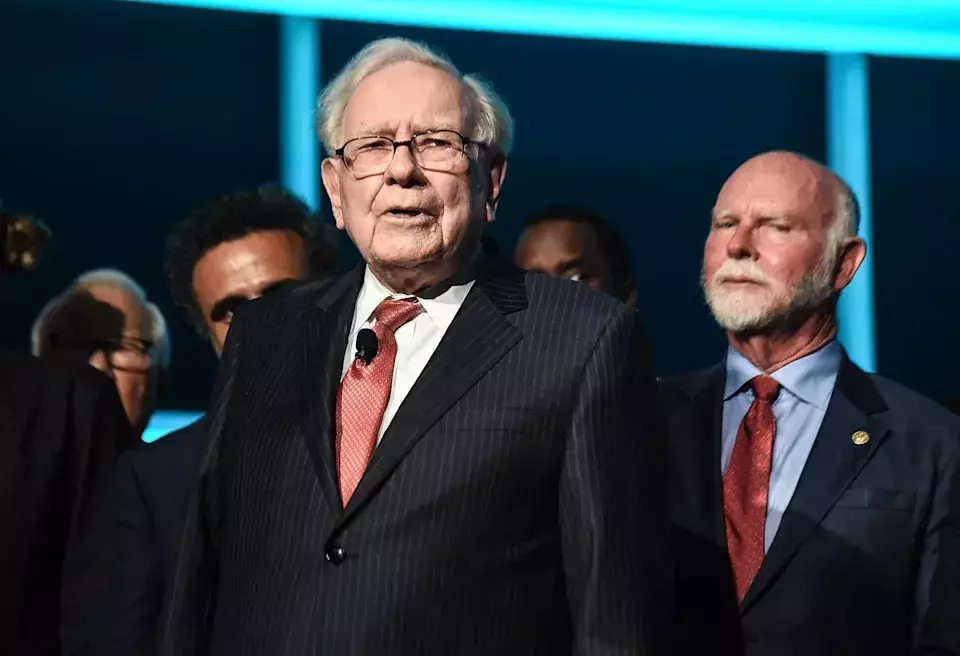
Warren Buffett's Enduring Investment Strategy: The Power of Index Funds
Money

Warren Buffett's Enduring Investment Strategy: The Power of Index Funds

authorBy T. Harv Eker
DateAug 02, 2026
Read Time3 min

Many believe that the most successful investors possess exclusive insights or sophisticated financial models that are inaccessible to the general public. However, Warren Buffett, a legendary figure in finance, spent six decades demonstrating that consistent success stems from patience and simplicity rather than complexity. He has repeatedly emphasized a singular investment recommendation for the average person, a low-cost exchange-traded fund (ETF) that anyone can acquire with minimal fees.

Buffett's long-standing advice, reiterated in shareholder letters, interviews, and annual meetings for decades, centers on the merits of a low-cost S&P 500 index fund. In his 2013 letter to Berkshire Hathaway shareholders, he famously detailed his instructions for the money left to his wife, advocating for a portfolio composed of 10% short-term government bonds and 90% in a very low-cost S&P 500 index fund, specifically mentioning Vanguard. He asserted that this straightforward approach would outperform most professionally managed funds, including those employed by pension funds and institutions. The Vanguard S&P 500 ETF (VOO), which mirrors the S&P 500 and boasts a mere 0.03% annual fee, perfectly embodies Buffett's recommendation. This ETF provides broad exposure to 500 of America's largest companies across diverse sectors, automatically adjusting its holdings as market conditions change, thereby simplifying portfolio management for investors.

Buffett's own investment history at Berkshire Hathaway stands as a testament to his "buy and hold" philosophy. His long-term holdings in companies like Coca-Cola and American Express, acquired decades ago, have generated substantial dividends and capital appreciation, proving the power of sustained investment over frequent trading. Furthermore, Buffett famously won a bet against Protégé Partners, demonstrating that a simple S&P 500 index fund could significantly outperform a selection of hand-picked hedge funds over a ten-year period. This outcome, along with data indicating that the vast majority of active large-cap mutual funds fail to beat the S&P 500 after fees, underscores the effectiveness of passive, low-cost investing. While the Vanguard S&P 500 ETF may not offer the excitement of speculative trading or the allure of a star fund manager, its broad market exposure, minimal costs, and Warren Buffett's decades of endorsement solidify its position as a prudent choice for most long-term investors.

The wisdom embedded in Warren Buffett's investment philosophy is profound, advocating for accessibility and simplicity in a world often captivated by complexity. His consistent championing of low-cost S&P 500 index funds reminds us that foundational principles like patience, long-term vision, and minimizing expenses are paramount to achieving financial prosperity. This approach fosters a disciplined mindset, encouraging individuals to focus on sustainable growth rather than succumbing to the allure of short-term market fluctuations or the often-disappointing results of active management. Embracing such a strategy empowers investors to build a secure future, reflecting a belief in the enduring strength of the market and the power of consistent, incremental progress.

More Articles
Money
Cathie Wood's Strategic Divestment from Snowflake Amid Tech Stock Rally
Cathie Wood, the prominent investor behind Ark Investment Management, has recently reduced her stake in Snowflake, a cloud software company, by selling approximately $5.5 million worth of shares. This move comes after Snowflake's stock experienced a significant surge of nearly 10% in the past five trading days. Wood's investment philosophy often involves capitalizing on gains from her high-growth tech investments, despite the fluctuating performance of her flagship Ark Innovation ETF, which has seen both remarkable highs and notable lows. Her strategy is rooted in a strong belief in the transformative, deflationary power of technological innovation, particularly in areas like artificial intelligence, which she argues is misunderstood by many market observers.
By Natalie PaceAug 02, 2026
Money
Carmelo Anthony Reveals How a $100M Contract Shrinks to Below $50M Due to Taxes and Lifestyle Creep
NBA legend Carmelo Anthony highlights the significant reduction of a $100 million contract to less than $50 million after taxes and other expenses. He emphasizes the impact of state and local taxes, particularly in high-tax areas like New York, and the pervasive issue of lifestyle creep, where increased spending accompanies higher income, hindering long-term wealth accumulation. The article suggests strategies for building generational wealth, including smart spending habits, diversified investments like real estate, and tax-efficient financial planning.
By Vicki RobinAug 02, 2026
Money
Salesforce's Year-End Price Projection: A Deep Dive into Growth and Risks
Salesforce (CRM) is poised for a significant year-end surge, with a price target of $258.69, suggesting a 40.58% upside. This bullish outlook is driven by the rapid expansion of its Agentforce AI segment, aggressive share buybacks, and a conservative valuation. Despite a challenging 2026, recent strong quarterly results and strategic financial maneuvers underpin confidence in its future performance, particularly in the burgeoning AI market.
By JL CollinsAug 02, 2026
Money
Newlyweds Navigate Financial Deception: A Journey to Rebuild Trust and Tackle Debt
Sana and Arhem's marriage began with a significant financial revelation: Arhem concealed $30,000 in credit card debt before their wedding, which later escalated to a total of $165,000. This financial infidelity deeply impacted their relationship, leading them to seek guidance from financial expert Ramit Sethi. Sethi's advice focused on not only debt repayment but also rebuilding trust through couples therapy and fully merging their finances to ensure complete transparency.
By Dave RamseyAug 02, 2026
Money
Pizza Chain Closures Signal Industry-Wide Economic Pressure
Several major pizza chains, including Papa John's, Pizza Hut, and Papa Murphy's, are facing significant challenges, leading to the closure of hundreds of locations. Factors like inflation, increased labor and ingredient costs, and the rise of third-party delivery services are squeezing profit margins and altering consumer behavior. While many chains struggle, Domino's has managed to maintain growth by prioritizing value and customer order volume.
By Dave RamseyAug 02, 2026