Volkswagen Prioritizes Atlas and Considers New Pickup for North American Market
Volkswagen is strategically reorienting its production in North America, halting the manufacture of the ID.4 electric compact SUV at its Chattanooga, Tennessee facility. This move frees up capacity to concentrate on the launch of the new Atlas SUV, slated for the 2027 model year. Concurrently, the automaker is actively exploring the introduction of a new vehicle specifically designed to cater to the preferences of American consumers, with strong indications pointing towards a long-rumored Volkswagen pickup truck for the region.
Strategic Production Shift and Future Product Plans
Volkswagen has revealed its decision to cease local manufacturing of the ID.4 electric compact SUV at its Chattanooga, Tennessee plant by the end of this month. Although the 2026 ID.4 will remain available, VW intends to fulfill demand using its existing inventory, which is expected to last until 2027. While a future iteration of the ID.4 for North America is planned, specific details are being withheld for a later announcement. This strategic adjustment aims to optimize the Chattanooga facility's operations, allowing Volkswagen to allocate resources towards high-volume models critical for the North American market, notably the impending launch of the redesigned Atlas.
As Volkswagen redirects its manufacturing focus away from the ID.4, its primary attention will shift to the introduction of the all-new Atlas, scheduled for the 2027 model year. This production realignment is an integral component of a broader strategy for the Chattanooga facility, where Volkswagen plans to emphasize vehicles with high sales potential in the North American region. The company has confirmed it is exploring options for a new product, described as being specifically developed to address the unique demands of the U.S. consumer base, aligning with VW's goal of prioritizing high-volume offerings. While Volkswagen has not yet disclosed details, industry speculation strongly suggests this new model could be the long-anticipated Volkswagen pickup truck for the American market.
Volkswagen's Entry into the North American Pickup Segment
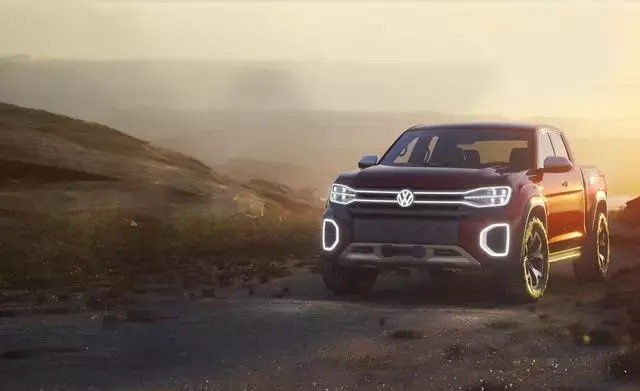
Volkswagen has consistently been a significant player in the global pickup truck market, though its presence in the U.S. segment has been limited. However, speculation about a VW-branded truck for North America has persisted for years, often fueled by the company's own concept vehicles. Notably, concepts like the 2018 Tanoak and the 2019 Tarok have showcased Volkswagen's potential designs and capabilities for a pickup tailored to the region. Kjell Gruner, President and CEO of Volkswagen Group of America, has previously indicated that a pickup truck is a consideration for market growth, reinforcing these long-standing rumors.
If Volkswagen indeed decides to proceed with a pickup truck, it would have several strategic options for market positioning. A model akin to the 2019 Tarok concept could target the compact pickup segment, competing with popular vehicles such as the Ford Maverick and the Hyundai Santa Cruz, and potentially upcoming entries like the Slate pickup. Alternatively, a truck inspired by the Tanoak concept might aim for a larger mid-size market, offering competition to established models like the Honda Ridgeline, Ford Ranger, Chevy Colorado, and Toyota Tacoma. Such a vehicle would likely feature a unibody chassis, similar to the Ridgeline, differentiating it from traditional body-on-frame trucks. Regardless of the chosen segment, Volkswagen's proven EA888 2.0-liter four-cylinder engine could be a viable powertrain option. Given the prominent role of the truck market in American automotive culture, and Volkswagen's explicit focus on meeting U.S. consumer needs, all signs point to the potential development of a new pickup truck by the bran
