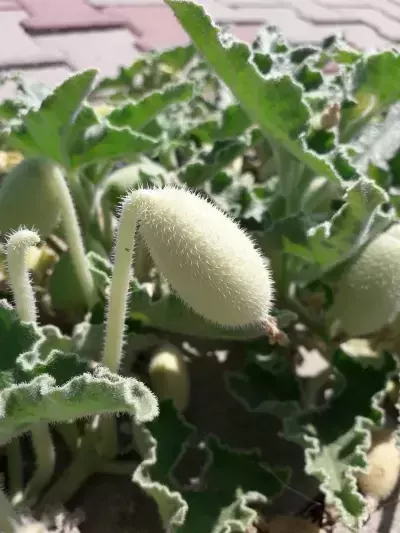
Unveiling the Explosive Seed Dispersal of the Squirting Cucumber
A recent scientific inquiry has shed light on the extraordinary method of seed propagation employed by the squirting cucumber, a less palatable relative of the common variety. This plant showcases a truly unique adaptation: a ballistic seed dispersal system that propels its offspring with impressive force and accuracy. The detailed investigations by researchers, leveraging advanced imaging and high-speed videography, have uncovered the intricate biomechanics behind this fascinating natural spectacle. Their work not only illuminates a peculiar aspect of plant life but also offers potential inspiration for novel engineering solutions, bridging the gap between botanical phenomena and material science.
The Ingenious Mechanics of Seed Projection
Researchers have meticulously dissected the ballistic seed dispersal of the squirting cucumber, uncovering the precise mechanisms enabling its impressive propagation. This unusual plant, despite its toxicity, harnesses an internal pressurized fluid system to forcibly eject its seeds, ensuring their wide distribution. The study’s lead, a Ph.D. student, initiated the investigation after being presented with these peculiar fruits, intrigued by their explosive nature. The motivation was clear: to comprehend the complete mechanics of this botanical explosion, a feat that sets it apart from its domesticated counterparts and ensures its survival through effective offspring dispersion.
The initial phase of the research involved an extensive photographic analysis of hundreds of squirting cucumber specimens, both from their natural Turkish habitat and local botanical gardens. This allowed scientists to accurately measure the consistent angle between the plant's stem and the mature fruit, which hovered just above 50 degrees. This specific inclination was identified as the optimal ballistic angle, designed to achieve maximum range, allowing seeds to be launched over considerable distances—up to nearly 40 feet—at velocities approaching 30 miles per hour, creating an ideal trajectory for widespread distribution. Further internal examination through micro-CT scans revealed the precise arrangement of seeds within the fruit, perfectly aligned for their explosive departure, ensuring they exit uniformly, round end first, a testament to nature's precise engineering for effective reproduction. This intricate process of pressurized fluid ejection and calculated launch angle positions the squirting cucumber as a remarkable example of ballistic seed dispersal in the plant kingdom, offering valuable insights into evolutionary adaptations.
Beyond Propulsion: The Adhesive Advantage of Squirting Cucumber Seeds
Following the explosive propulsion, the next crucial phase of the squirting cucumber's seed dispersal strategy involves the unique properties of its seeds' outer coating. Scientists observed that these seeds possess a remarkably sticky, slimy surface. When allowed to dry on a glass slide, a single seed demonstrated an astonishing adhesive capacity, capable of supporting a weight of up to six pounds. This discovery suggests that the high launch velocities are not merely for distance but also play a critical role in ensuring that upon impact, the seeds firmly adhere to whatever surface they encounter. This adhesion could then facilitate further travel, as the seeds might be carried by animals, wind, or water, expanding their potential for germination in new locations.
The adhesive quality of these seeds, particularly their ability to alter stickiness based on moisture levels, has profound implications for material science. This natural property could inspire the development of novel adhesive materials that respond dynamically to environmental conditions, such as humidity or dryness. Experts in biomechanics and material science highlight the potential for these findings to be translated into practical applications, including advancements in soft robotics for tasks like agricultural seed distribution or targeted drug delivery within the human body. The squirting cucumber, despite its humble appearance, thus emerges as a significant biological model, offering innovative solutions for designing smart materials and functional systems that mimic its highly evolved and effective reproductive strategy.
