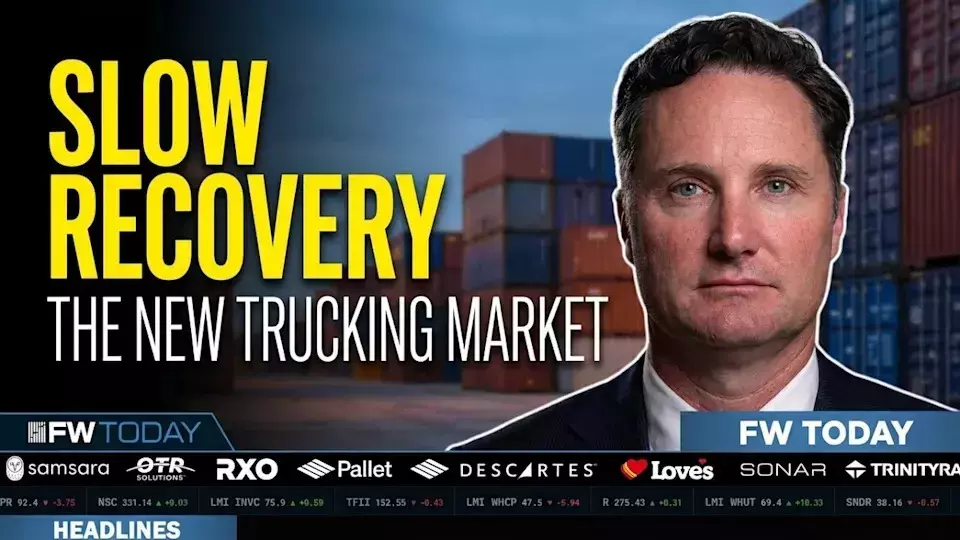
Trucking Market Evolution: Why Capacity Remains Constrained
Triumph Financial's CEO, Aaron Graft, asserts that the prevailing conditions in the trucking sector are not merely part of a typical economic cycle but represent a fundamental structural shift. He points to rising legal challenges, stricter regulations, and new legislative mandates as formidable obstacles preventing the influx of new carriers and drivers into the market. This scenario suggests a prolonged period of constrained capacity, which could redefine long-term profitability and operational dynamics within the freight industry.
The Evolving Landscape of Freight Transportation: A Deep Dive with Triumph Financial's CEO
In a recent candid video interview, following Triumph Financial's impressive quarterly earnings report where revenue surged by 49%, Aaron Graft, the visionary CEO and founder of Triumph, elucidated the distinctive nature of the contemporary trucking market. Contrary to conventional cyclical fluctuations, Graft highlighted that the current market upswing is rooted in profound structural changes. He emphasized that the cumulative impact of heightened litigation risks, stringent regulatory oversight, and complex legislative frameworks acts as a significant deterrent to new market entrants.
Graft drew a sharp contrast with past market cycles, particularly referencing 2021, where the driving force was often the pursuit of the cheapest capacity, frequently leading to the engagement of unqualified or inadequately vetted personnel. Today, he argues, the landscape is dramatically altered. Carriers, despite potentially earning substantial fees for freight movement, face the looming specter of multi-million dollar legal judgments, making cautious and compliant operations paramount. "This feels more structural," Graft remarked, acknowledging the industry's inherent cyclicality but suggesting that the present conditions possess a resilience that might extend beyond previous patterns.
Insights from Triumph's factoring business, which commands a significant share of the market, further underscore this tightening. The average invoice size saw a notable 26% increase quarter-over-quarter, even as Triumph's customer base expanded by 4%. Interestingly, the volume of loads tendered to owner-operators, especially those with one to four trucks, showed a decline. This suggests a departure of smaller entities from the market, contributing to a supply contraction rather than a surge in demand.
Regarding brokerage margins, the first quarter witnessed some compression as established contracts faced strain. However, by the second quarter, the gross dollar earnings per load for brokers began to rise. This was attributed to a substantial increase in load sizes, which outpaced the reduction in margins. Graft provided a clear illustration: a 10% margin on a $3,000 load now yields more than a 15% margin on a $1,500 load, signifying a shift in revenue dynamics.
Triumph itself has capitalized on the prolonged soft market by identifying and eliminating over $30 million in internal inefficiencies, a testament to the company's adaptive strategies. On the payments front, Triumph now processes approximately 65% of all brokered freight, with annualized payments reaching an astounding $54 billion. Graft also pointed out that inflation has expanded the total addressable market for brokered freight from $110 billion to $135 billion. Triumph's innovative LoadPay product, initially envisioned as a "Venmo for trucking," has evolved into a comprehensive digital companion for carriers, offering instantaneous 24/7 funding through strategic partnerships, including C.H. Robinson.
Looking ahead, Graft cautioned that the market remains more "brittle" than many perceive. This implies that even a modest increase in demand could trigger significant rate hikes due to the scarcity of adequately vetted and available capacity. He concluded by noting that small carriers, after accounting for inflated diesel and equipment costs, are struggling to achieve substantial profits, thus diminishing the incentive for aggressive re-entry into the market.
The current state of the trucking industry, as articulated by Aaron Graft, offers a compelling perspective on the profound shifts underway. It underscores the critical importance of adaptability, strategic innovation, and a keen understanding of evolving market dynamics for all stakeholders. The challenges posed by litigation, regulation, and a tight labor market are not transient but appear to be reshaping the very foundation of freight transportation, demanding a more robust and resilient approach from industry players. This new paradigm calls for continuous re-evaluation of operational models and an emphasis on long-term sustainability over short-term gains, ultimately fostering a more sophisticated and discerning market environment.
