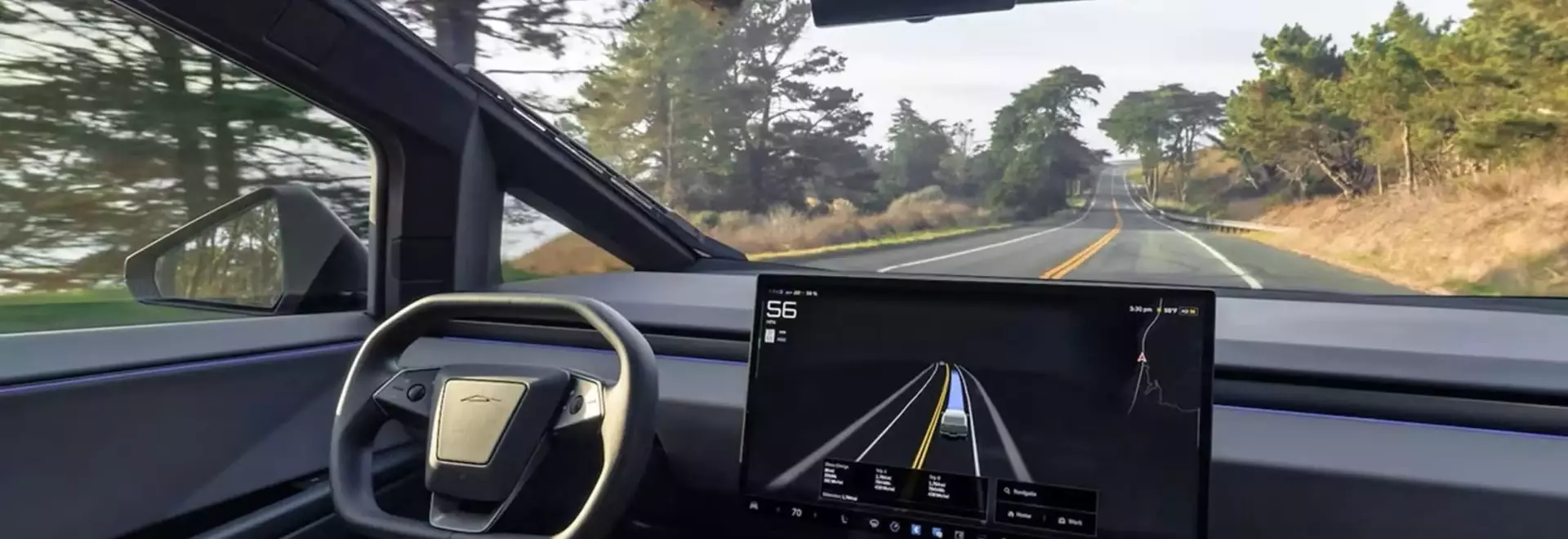
Tesla Cybertruck's Full Self-Driving System Misinterprets Road Markings at High Speeds
Recent reports highlight significant safety concerns regarding Tesla's Full Self-Driving (FSD) system, particularly in the Cybertruck model. An owner recounted a perilous experience where his Cybertruck veered sharply at 72 mph, mistaking a painted road arrow for an actual obstruction. This incident underscores a growing body of evidence suggesting the limitations of Tesla's camera-centric 'Vision' system, which, unlike radar or lidar, struggles to differentiate between benign road markings and genuine hazards. Such occurrences, if left unchecked, pose considerable risks not only to the vehicle's occupants but also to other drivers on the road, prompting an urgent reevaluation of autonomous driving technologies' current capabilities and their readiness for widespread deployment.
The incident, first brought to light within a private online community for Cybertruck owners, detailed how Tom Liu's vehicle initiated an abrupt swerve on multiple occasions. Initially, the cause was unclear, but subsequent experiences revealed the FSD system's faulty interpretation of painted road arrows. This failure to accurately perceive the driving environment highlights a critical vulnerability in the system's design. While Tesla CEO Elon Musk has consistently advocated for the superiority of camera-based systems, these real-world scenarios suggest a disparity between aspiration and current technological reality. Had Liu not been vigilant, the misinterpretation could have led to a severe accident, a chilling reminder of the nascent stage of autonomous vehicle development.
Further corroboration from other Cybertruck owners on the same platform paints a concerning picture of systemic issues. One owner described their vehicle's repeated attempts to dodge a painted cyclist symbol, while another noted erratic movements caused by tar-filled road cracks. These accounts collectively suggest that the FSD system struggles with common road anomalies, leading to unpredictable and potentially dangerous reactions. Such glitches, although sometimes resulting in minor inconveniences, could escalate into serious hazards in high-traffic or complex driving conditions. The inability to distinguish between trivial visual cues and actual obstacles raises fundamental questions about the robustness and reliability of Tesla's autonomous driving suite.
The recurring problems with Tesla's FSD and Autopilot systems have attracted considerable scrutiny, including numerous lawsuits and federal investigations. These legal and regulatory challenges underscore the serious implications of deploying technology that, while revolutionary in concept, appears to be imperfect in practice. Despite these criticisms, a segment of Tesla users maintains that the FSD system has, on occasion, prevented serious collisions, creating a polarized debate around its overall efficacy and safety. However, the incidents described by Cybertruck owners, where the vehicle reacts inappropriately to non-threatening road markings, serve as stark reminders that truly safe and reliable autonomous driving remains a distant goal, emphasizing the indispensable role of human oversight in current semi-autonomous vehicles.
The continuous reports of unexpected behaviors from Tesla's FSD system, particularly the Cybertruck's tendency to swerve in response to painted road features, emphasize the inherent challenges in achieving fully autonomous driving. These events highlight that despite advancements, the technology still faces significant hurdles in accurately interpreting complex and dynamic driving environments. The necessity for human intervention to avert potential accidents, as demonstrated by the Cybertruck owner's experience, clearly indicates that current camera-based systems, while sophisticated, are not yet foolproof. This ongoing dialogue between technological aspiration and real-world performance necessitates continued development, rigorous testing, and transparent communication from manufacturers to ensure public safety and foster trust in the future of autonomous transportation.
