SpaceX's Nasdaq 100 Entry: A Deep Dive into Market Dynamics
Money

SpaceX's Nasdaq 100 Entry: A Deep Dive into Market Dynamics

authorBy Ramit Sethi
DateJul 07, 2026
Read Time3 min
SpaceX's recent entry into the Nasdaq 100 index presents a fascinating case study in market mechanics, particularly for a company with a significant portion of its shares still restricted from public trading. This unique situation is poised to influence its stock performance as passive investment flows in, while future share unlocks could introduce new dynamics.

Navigating New Frontiers: The SpaceX Market Phenomenon

Nasdaq's Unprecedented Move: Fast-Tracking SpaceX into the Nasdaq 100

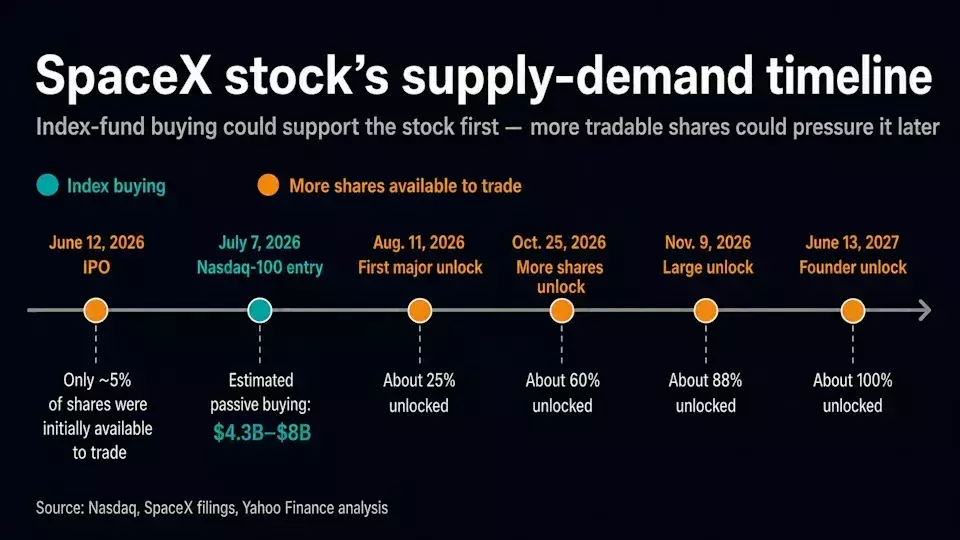
The Nasdaq exchange has made a remarkable decision by including SpaceX, a major initial public offering (IPO), into its prestigious Nasdaq 100 index within merely fifteen trading days of its market debut. This rapid integration means SpaceX is now part of one of the market's most influential passive investment vehicles, even before a substantial portion of its shares are widely available for trading. This scenario creates an investment landscape rarely observed on such a grand scale, prompting considerable interest and analysis from market watchers.

The Power of Passive Investment: Index Funds and Mandatory Buying

Index funds operate under strict rules, requiring them to mirror the composition of their tracked benchmarks. With SpaceX's inclusion in the Nasdaq 100, funds aligned with this index are now mandated to purchase SpaceX shares. This influx of capital will necessitate a strategic adjustment of their existing portfolios to maintain alignment with the benchmark. This process, known as rebalancing, is projected to result in a significant wave of forced buying for SpaceX stock, with estimates ranging from billions of dollars according to financial institutions like JPMorgan and BNP Paribas.

The Supply Conundrum: Limited Float Meets High Demand

A critical factor in this market equation is the limited availability of SpaceX shares on the public market. Initially, only a small fraction of the company's total shares was accessible for public trading. The majority remains held by insiders, employees, and early investors, subject to lock-up periods that prevent immediate sale. This restricted 'float' contrasts sharply with the impending surge in demand from index funds, setting up a unique supply-demand dynamic. The accompanying chart visually illustrates this timing mismatch: index fund buying precedes the release of more tradable shares, with significant unlocks scheduled for later in the year.

Short-Term Momentum vs. Long-Term Valuation: A Dual Perspective

This staggered release of shares has immediate implications for SpaceX's stock price. The initial tight supply, coupled with mandatory purchases from index funds, is likely to provide strong support for the stock in the near term. However, this early price appreciation may not fully reflect the stock's intrinsic demand, as a true market test will only occur once a larger volume of shares becomes freely tradable. SpaceX's past performance, characterized by rapid gains followed by significant pullbacks, underscores the volatility that can arise from such market conditions.

Key Price Levels and Future Market Trajectories: Identifying Critical Thresholds

Investors are closely monitoring crucial price levels for SpaceX. The range of $172 to $180 is identified as a potential resistance zone, influenced by technical indicators and recent trading activity. A sustained breach above this level could pave the way for the stock to challenge its all-time high of over $200. Conversely, if the stock remains below this range, choppy trading is anticipated. A dip below $150 would signal a more bearish outlook, suggesting a shift in market sentiment and potentially sustained downward pressure.

More Articles
Money
Today's Mortgage and Refinance Rates: A Downward Trend on July 7
Mortgage and refinance interest rates are trending downwards as of Tuesday, July 7, 2026. The average 30-year fixed rate is now 6.36%, a decrease of 4 basis points from yesterday. The 15-year fixed loan rate has also dropped to 5.83%, while the 5/1 ARM stands at 6.31%. This article provides a detailed overview of current rates for various mortgage products and explains the key differences between fixed-rate and adjustable-rate mortgages, along with a helpful mortgage calculator to estimate monthly payments.
By T. Harv EkerJul 07, 2026
Money
Micron Technology's Ascendance in the AI Era and Market Dynamics
Micron Technology (MU) has emerged as a leading AI stock, experiencing significant growth. Its shares have surged dramatically over the past year and year-to-date, fueled by its critical role in manufacturing high-end memory chips essential for AI GPUs. The company recently expanded into the automotive sector through a partnership with General Motors, yet faces a lawsuit regarding alleged market manipulation amidst rising memory prices. Despite legal challenges, Micron reported strong fiscal third-quarter earnings, surpassing analyst expectations for both revenue and earnings per share.
By JL CollinsJul 07, 2026
Money
Bank of America's Performance Challenges Jim Cramer's Projections
Bank of America Corp. (BAC) has seen its stock rise by over 20% in the last year, despite financial commentator Jim Cramer's earlier valuation concerns. Major banks like Citi and Morgan Stanley have increased their price targets for BAC, citing strong earnings expectations and revenue momentum, suggesting a market sentiment that diverges from Cramer's initial assessment of the stock's trading multiple.
By T. Harv EkerJul 07, 2026
Money
Tech Giants Warn of Impending Price Hikes Amid Memory Chip Shortage
Apple's Tim Cook and Best Buy's CEO Corie Barry have issued warnings about potential price increases for electronic devices due to a global shortage of memory chips. Despite these warnings, consumers are not rushing to purchase items, indicating a cautious spending approach in the face of economic uncertainties like inflation and geopolitical tensions. This consumer behavior suggests a broader sentiment of economic pessimism.
By Bola SokunbiJul 06, 2026
Money
Applied Materials Achieves Significant Growth in Q1
Applied Materials, a leader in semiconductor equipment, experienced a remarkable 33% surge in its stock value during the first quarter of 2026. This impressive performance was primarily driven by strong fiscal Q1 earnings that surpassed analyst expectations, fueled by increasing investments in AI computing. The company's robust technology portfolio and strategic positioning in the high-bandwidth memory and gate-all-around logic sectors are key factors in its continued success and positive outlook.
By Scott PapeJul 06, 2026