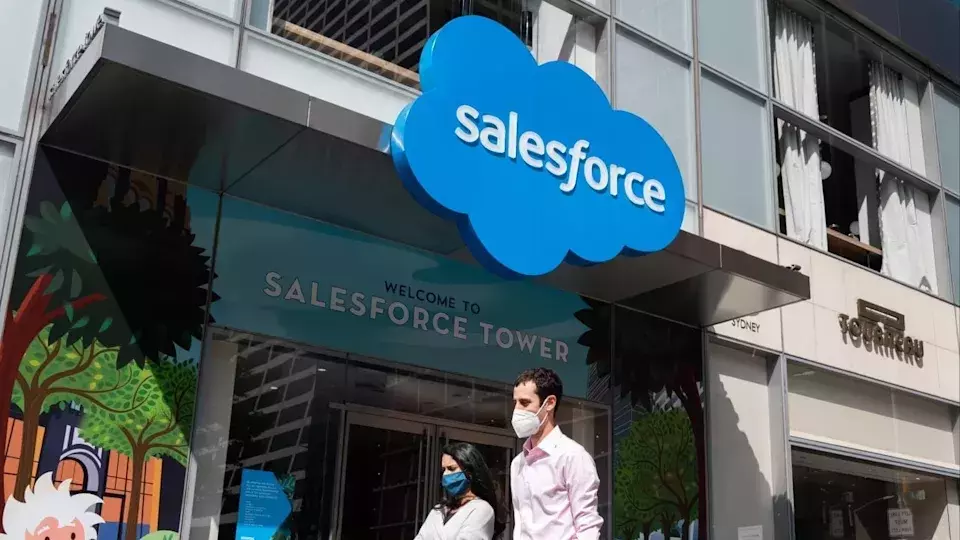
Salesforce: Poised for a Resurgence and Significant Growth
Unlocking Potential: Salesforce's Path to Triple-Digit Returns
Analyst's Optimistic Forecast for Salesforce's Future
Scott Berg, an analyst at Needham & Co., has set a formidable price target of $400 for Salesforce (CRM), signaling a potential upside of over 117% from its current trading price. This bold prediction is primarily fueled by the exceptional growth of Agentforce, which saw its Annual Recurring Revenue (ARR) surge by 205% year-over-year to $1.2 billion. This optimistic outlook underscores the belief in Salesforce's innovative strategies and its capacity to deliver substantial returns for investors.
Market Performance Amidst a Period of Contraction
Salesforce has experienced a challenging period in the market, with its stock price decreasing by 30.17% year-to-date and 28.15% over the last year. This decline saw the stock fall from highs in the mid-$240s in late 2025 to a 52-week low of $146.32. This downturn has prompted considerable discussion among market observers regarding the underlying causes and the company's potential for recovery.
Key Factors Contributing to the Stock's Decline
The recent dip in Salesforce's stock can be attributed to two main factors. Firstly, Morgan Stanley downgraded the stock, citing a slower-than-anticipated acceleration in organic revenue growth. They noted that Agentforce, while growing rapidly, still constitutes a small fraction (2.6%) of the total revenue. Secondly, the company's noncurrent debt significantly increased from $10.4 billion to $39.3 billion to finance a $25 billion accelerated share repurchase program. This move, while reducing diluted share count, added substantial leverage and introduced integration risks associated with Informatica.
Resilience and Growth Drivers Despite Market Pressures
Despite the stock's recent struggles, analysts remain confident in Salesforce's long-term prospects. This optimism is underpinned by the company's strong financial performance, particularly its consistent outperformance in earnings. In Q1 FY27, Salesforce reported earnings per share (EPS) of $3.88, significantly beating the estimated $3.13. This marks the fifth consecutive quarter of exceeding expectations. Furthermore, revenue grew 13.3% year-over-year to $11.13 billion, and the combined ARR for Agentforce and Data 360 reached nearly $3.4 billion. Management has also raised its FY27 revenue guidance to $45.9 billion to $46.2 billion and reiterated its FY30 target of $63 billion.
Wall Street's Favorable Assessment and Institutional Backing
The consensus among Wall Street analysts reflects a positive sentiment towards Salesforce. Out of 52 analysts covering CRM, a significant majority (6 Strong Buy, 34 Buy) recommend purchasing the stock, with only a small number issuing a "Strong Sell" rating. This bullish stance is further reinforced by institutional investors, such as Bank of America, which increased its holdings by 2.56 million shares in Q1, bringing its total position to approximately $2.19 billion.
Comparative Analysis with Industry Counterparts
When stacked against its peers in the enterprise software sector, Salesforce's current valuation presents a compelling case. ServiceNow (NOW) trades at $111.23, with an implied upside of about 26%. Oracle (ORCL) shows the largest analyst-implied upside at roughly 91%, despite a significant decline in its stock price due to heavy investments in AI data centers. HubSpot (HUBS) has experienced the steepest decline, with only about 15% upside. Salesforce's consensus upside of 31% appears moderate in this comparison, but Berg's aggressive $400 target positions it competitively for over 100% returns, especially given its cleaner cash flow economics.
Current Market Data and Shifting Investor Sentiment
Salesforce is currently priced at $184.02, with a consensus price target of $241.72, suggesting an implied upside of around 31%. The stock is trading approximately 31% below its 52-week high of $267.75, with a forward P/E ratio of about 14x. While CRM saw a 30.17% decline year-to-date, contrasting with the S&P 500's 9.55% gain, recent trading activity indicates a positive shift. Shares have risen 12.44% in the past week and 12.74% over the past month. Public sentiment on platforms like Reddit's r/stocks also moved from bearish in mid-July to bullish by late July, signaling growing confidence among retail investors.
The Path Forward: Opportunities and Challenges
The optimistic scenario for Salesforce hinges on Agentforce's ability to drive significant monetization and the successful implementation of consumption-based models like Flex Credits, leading to multi-year revenue acceleration. If these initiatives prove successful, the current cRPO of $33.6 billion (up 14%) could serve as a solid foundation, and the $50 billion buyback authorization would further enhance EPS. In this scenario, Berg's $400 target becomes a realistic aspiration. Conversely, the bearish perspective suggests that if Agentforce, at 2.6% of revenue, fails to significantly impact organic growth, or if Informatica integration faces disruptions, or if high-interest rates negatively affect debt management, the stock could struggle. Salesforce also faces intense competition from industry giants like Microsoft, ServiceNow, and Oracle in the AI enterprise market. However, the prevailing sentiment indicates that the consensus 31% upside is reasonable, and recent market rebounds suggest a positive shift in investor perception. Even partial validation of the Agentforce thesis could lead to a significant re-rating of the stock, making Berg's ambitious $400 target an increasingly plausible outcome.
