Salamanders' Remarkable Cold Tolerance Discovered
In ancient folklore, salamanders were believed to withstand flames. While that's a myth, certain species demonstrate an astonishing resilience to another harsh element: extreme cold. A recent study has revealed that blue-spotted salamanders possess a remarkable capability to thrive in freezing conditions, engaging in what scientists term 'supercooling.'
Surprising Winter Activity of Blue-Spotted Salamanders
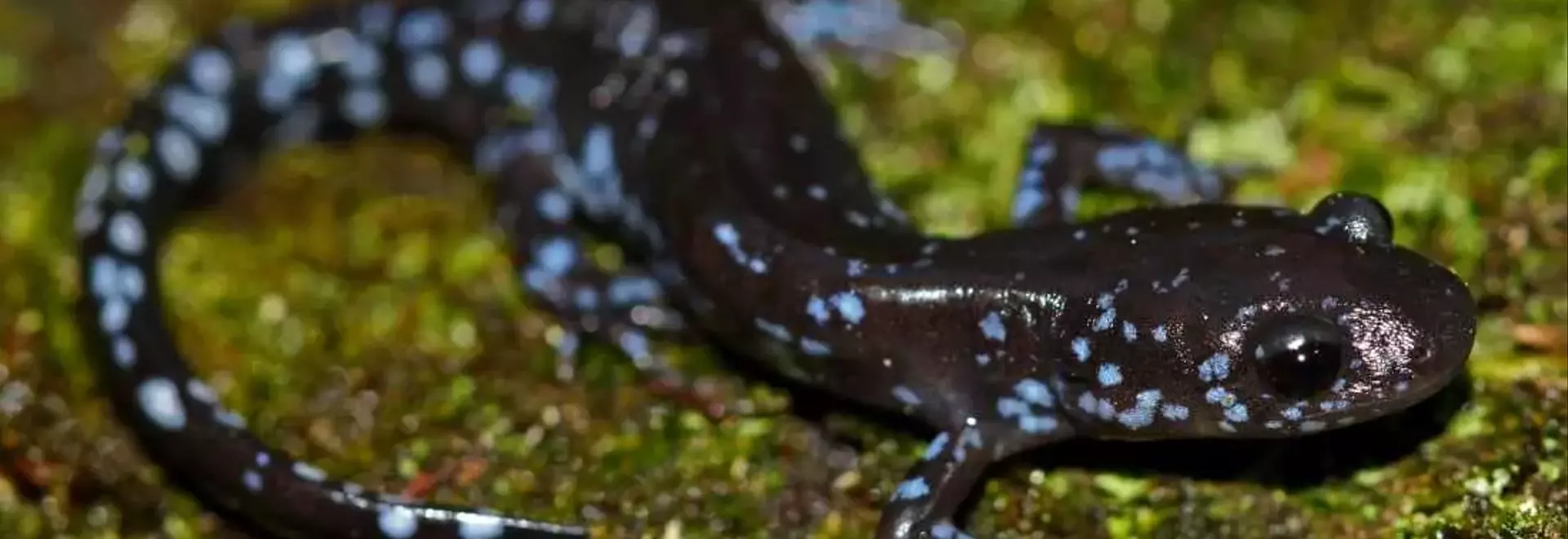
The discovery was made by a team of researchers who observed these amphibians in late winter at Bat Lake, located within Canada's Algonquin Provincial Park. Danilo Giacometti, a researcher now based at the University of São Paulo in Brazil, expressed his astonishment, noting the presence of salamanders on land despite the icy conditions and a frozen lake. These distinctive creatures, characterized by their black skin adorned with shimmering blue spots, are native to the northern United States, particularly the Great Lakes region and New England, extending into Canada.
Typically, these salamanders seek refuge underground during the harsh winter months, emerging in early spring to migrate to nearby bodies of water for breeding. Biologist Glenn Tattersall of Brock University in Ontario, a member of the research team, explained that while it was known that blue-spotted salamanders could occasionally be seen on snow, it was generally assumed this occurred during periods of slight warming. However, their recent observations, aided by a thermal camera, indicated that these salamanders were active even when their body temperatures plummeted below freezing, reaching as low as 25 degrees Fahrenheit. Tattersall emphasized that such movement would be impossible if the animals were actually frozen solid.
The researchers, in collaboration with Patrick Moldowan, utilized the thermal camera to accurately measure the salamanders' body temperatures. Their findings suggest that these amphibians employ a natural antifreeze mechanism, allowing them to enter a supercooled state and remain active. This groundbreaking research was published in the Canadian Journal of Zoology.
Don Larson from the University of Alaska, Fairbanks, who was not involved in the study, highlighted the significance of this discovery, stating that the ability to remain active in a supercooled state likely provides these salamanders with a crucial advantage. It enables them to commence their breeding cycles earlier and potentially evade predators that are still dormant. Larson noted that amphibians, in general, demonstrate impressive adaptations to cold temperatures, citing the Alaskan wood frog's ability to freeze solid for months with its heart completely stopped. He also mentioned Siberian salamanders, known to survive temperatures as low as minus 40 degrees Celsius or Fahrenheit. Despite these fascinating capabilities, Larson pointed out that there is still much to learn about how cold-blooded amphibians endure winter, especially compared to the extensive research on birds and mammals.
The revelation of blue-spotted salamanders' supercooling ability is a testament to the incredible adaptations found in nature. This capacity not only allows them to survive in frigid environments but also provides a competitive edge in reproduction and predator avoidance. It underscores the vast, unexplored depths of biological resilience and adaptation, particularly in cold-blooded creatures. This discovery opens new avenues for understanding physiological mechanisms in extreme conditions and reminds us of the hidden wonders continually unfolding in the natural world.
