Rising Dollar Poses New Challenge to AI Stock Rally
The artificial intelligence-driven stock market surge now faces a new and significant challenge: the escalating strength of the U.S. dollar. For months, the AI sector has demonstrated remarkable resilience and growth, largely unperturbed by traditional economic indicators. However, the recent ascent of the dollar index to a one-year peak presents a fresh dynamic that could influence the market's trajectory.
The Soaring Dollar: A New Hurdle for AI's Momentum
As of Tuesday, June 23, 2026, the U.S. Dollar Index (DX-Y.NYB) has dramatically risen, breaching the critical 100/101 threshold that historically acted as both a floor and a ceiling. This notable gain signals a potential shift in the broader financial landscape, drawing investor attention back to currency markets after a prolonged period dominated by AI-fueled stock gains. While a stronger dollar traditionally suggests a "risk-off" sentiment, potentially tightening global financial conditions, impacting overseas corporate earnings, and burdening emerging markets, some experts propose an alternative perspective.
Market analyst Jared Blikre, a prominent voice in global markets, highlights that the dollar's chart exhibits complexities beyond a simple interpretation. Historically, the dollar index, much like various currencies and cryptocurrencies, has been characterized by "false breakouts" around significant levels. Should the current surge fail and the index retreat below 100/101, it could revert to its previous trading range, potentially declining towards last year's lows of 96-97. Nevertheless, the present momentum behind the dollar's upward movement is undeniable, underscored by increasing Relative Strength Index (RSI) peaks during its rallies over the past year, indicating sustained buying pressure.
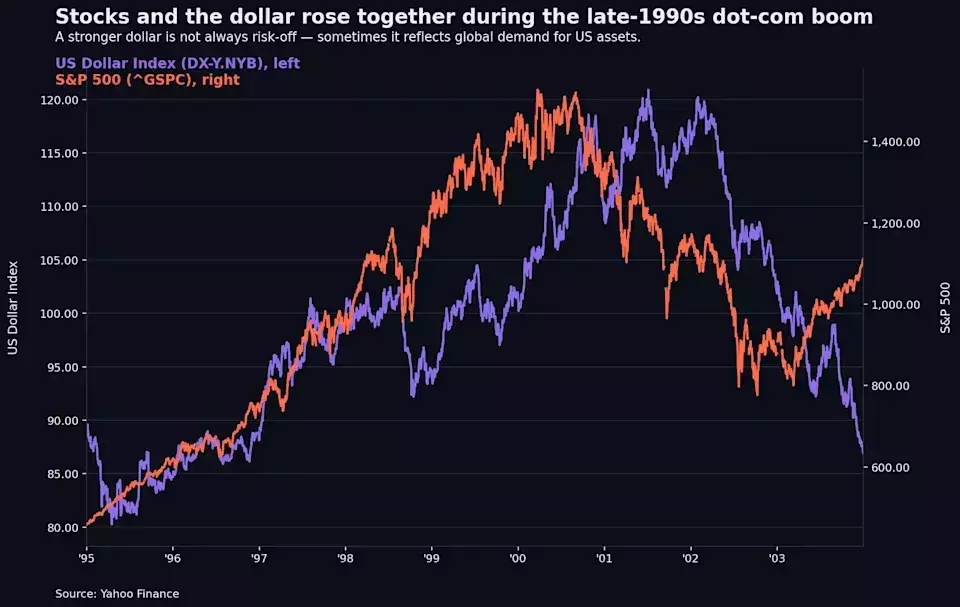
This evolving scenario compels a re-evaluation of the AI rally's future. While a robust dollar is often perceived as detrimental to equity markets, it can also signify strong international demand for American assets. Blikre points to the late-1990s dot-com era as a historical parallel, where both the dollar and the S&P 500 (^GSPC) simultaneously climbed. During that period, global capital flowed into U.S. technology companies, stocks, and the dollar, viewing them as attractive investments.
The same underlying logic could apply today. If the global investment community continues to seek exposure to U.S. markets due to the pervasive influence of the AI trend, then a strengthening dollar might not necessarily derail the rally. Instead, it could be an integral component of the ongoing capital flow narrative. The ultimate red flag for the AI trade might not reside solely in currency movements, but rather in the bond market. A scenario combining a rising dollar with a 30-year Treasury yield exceeding 5% would present a far more challenging environment, potentially translating dollar strength into a significant tightening shock for growth-oriented stocks.
For the moment, the dollar's breakout represents a critical test rather than a definitive judgment. As Blikre aptly notes, a stronger dollar doesn't always equate to fear; sometimes, it simply reflects overwhelming demand for U.S. financial instruments and assets.
