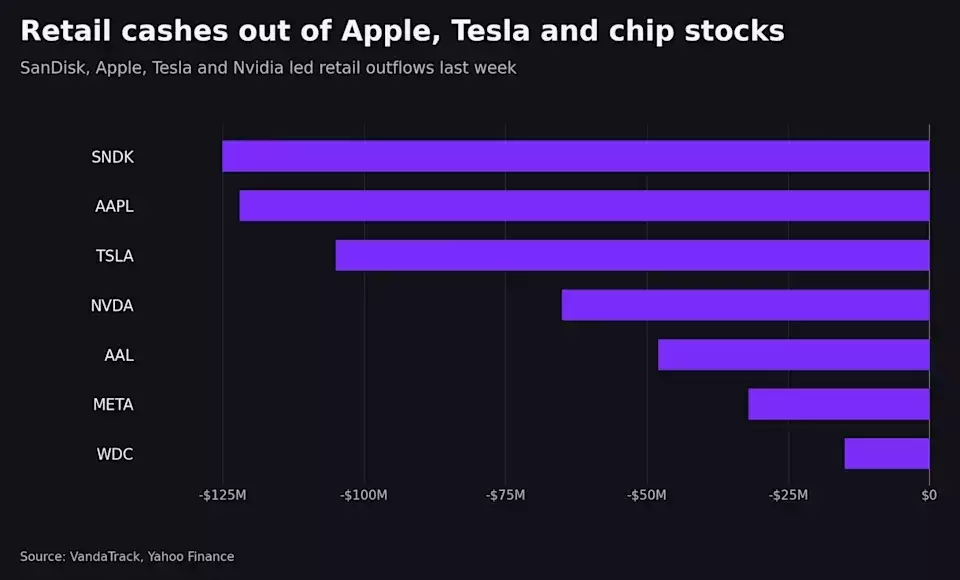
Retail Investors Shift Focus: Cashing Out of Tech Giants for New Opportunities
Retail investors are increasingly reallocating their portfolios, divesting from prominent technology companies such as Apple, Tesla, and various semiconductor firms. This strategic shift is not indicative of a widespread de-risking but rather a rotation towards newer market narratives. While individual investors adjust their holdings, the overall market demonstrates expanding participation, with the S&P 500's advance-decline line reaching unprecedented levels, signaling a robust and broad-based market uptrend.
Shifting Tides: Retail Investors Exit Major Tech and Chip Stocks
Individual investors are showing a distinct change in their trading patterns, moving away from leading technology companies like Apple, Tesla, and a range of semiconductor stocks. Data from VandaTrack highlights a significant sell-off in these once-favored assets, with SK Hynix experiencing a sharp decline after substantial retail purchases, underscoring the volatile nature of these investments. This exodus from established tech and chip sectors suggests that retail traders are actively seeking fresh opportunities within the market, rather than retreating from investing altogether. The shift reflects a dynamic approach where investors are selectively backing new prospects, moving capital from previously dominant players to emerging growth areas, indicating a strategic reallocation rather than a blanket withdrawal from the stock market.
This emerging trend illustrates a notable departure from past retail investment behaviors, where tech giants consistently drew significant capital. The shift reveals a growing sophistication among individual investors who are now more inclined to identify and pursue what they perceive as the 'next big thing.' For instance, while some tech behemoths still attract net buying, others, including Apple and Tesla, have become sources of liquidity for retail traders. This rotation signifies a more discerning investment strategy, where past performance is no longer the sole determinant for capital allocation. The market is witnessing a re-evaluation of investment priorities as retail participants actively seek out new avenues for growth, moving away from the concentrated positions in mega-cap technology firms that characterized earlier periods.
Broad Market Health Persists Amid Sectoral Rotation
Despite the notable rotation of retail capital away from major tech and chip stocks, the broader market remains resilient and continues to show signs of expanding participation. The S&P 500's advance-decline line, a key indicator of market breadth, recently achieved a new record high, signaling that an increasing number of stocks are contributing to the market's upward momentum. This expansion in market breadth stands in contrast to earlier periods where a narrow group of large-cap stocks, particularly the 'Magnificent Seven,' disproportionately drove index gains. The current environment suggests a healthier, more diversified market where growth is not confined to a few dominant players, offering a more stable foundation for overall market performance.
The sustained strength of the broader market, even as retail investors recalibrate their portfolios, points to underlying systemic health. The S&P 500's robust advance-decline line confirms that the market's rally is becoming more inclusive, with a wider array of companies participating in the upswing. This development is particularly significant given the previous concerns about market breadth divergence, where a rising index masked a decline in the number of advancing stocks. Now, with strong participation across the S&P 500, the market appears better positioned to absorb sectoral rotations and potential volatility. As companies head into earnings season, strong profit reports are anticipated to further bolster this market resilience, ensuring that even localized pressures, such as those affecting the semiconductor industry, do not trigger a widespread downturn, as supported by analysis from leading financial institutions like JPMorgan.
