Rare Deep-Sea Shark Sighting in Antarctic Waters
A recent expedition to the remote Antarctic Ocean has yielded a remarkable discovery: the first-ever documented sighting of a large sleeper shark in its near-freezing depths. This unexpected encounter, captured by a deep-sea camera in January 2025, provides unprecedented insights into the marine biodiversity of one of Earth's most extreme environments. The finding challenges long-held scientific beliefs about the presence of sharks in such frigid conditions and opens new avenues for research into the resilience of marine life.
Details of the Extraordinary Antarctic Shark Sighting
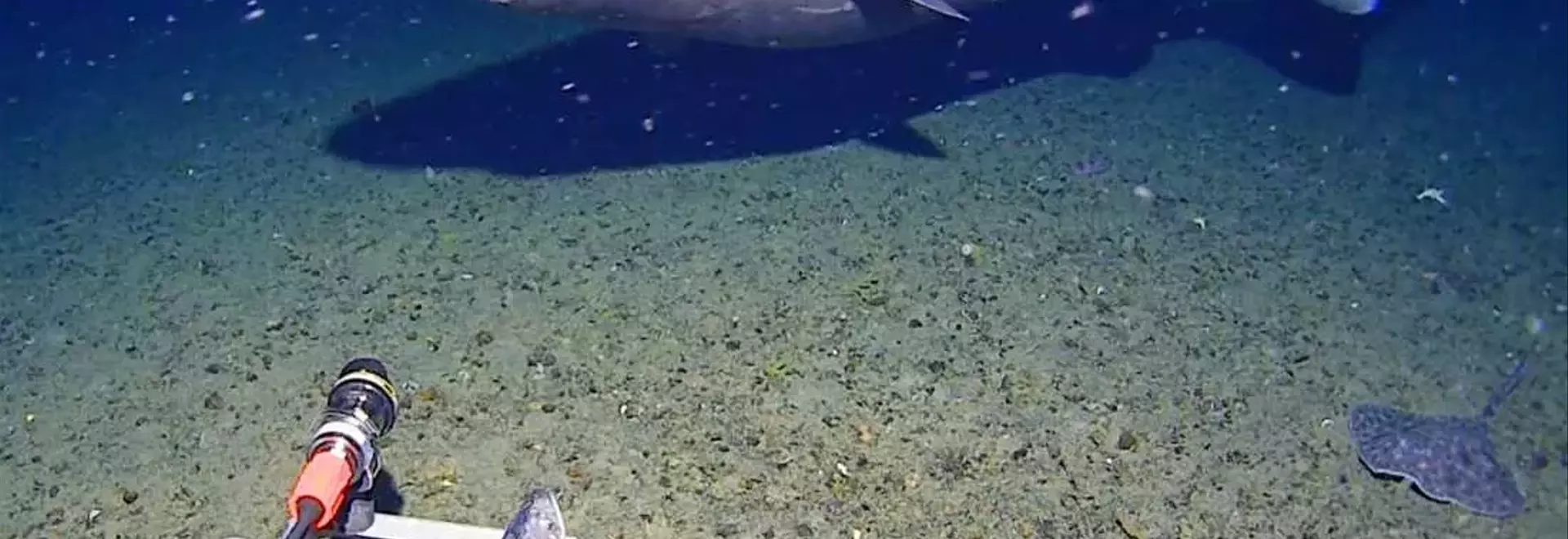
In January 2025, researchers operating a specialized video camera deployed by the Minderoo-UWA Deep-Sea Research Centre near the South Shetland Islands, off the Antarctic Peninsula, recorded an extraordinary event. A robust sleeper shark, estimated to be between 3 and 4 meters (10 to 13 feet) in length, slowly glided into view against a stark seabed. This groundbreaking footage, released to the public by the center on a Wednesday, marks the first photographic evidence of a shark species residing within the defined boundaries of the Antarctic Ocean, specifically below the 60-degree south latitude line.
The deep-sea camera was positioned at an impressive depth of 490 meters (1,608 feet), where water temperatures hovered around a frigid 1.27 degrees Celsius (34.29 degrees Fahrenheit). Alan Jamieson, the founding director of the University of Western Australia-based research center, expressed his astonishment, noting that scientists previously believed sharks were absent from these icy realms. He highlighted the significant size of the observed specimen, referring to it as a "hunk of a shark."
Interestingly, the footage also captured a skate, a relative of sharks resembling a stingray, resting motionlessly on the seafloor, seemingly undisturbed by the passing shark. The presence of skates in this region was already known to scientists. Peter Kyne, a conservation biologist from Charles Darwin University, corroborated the significance of this discovery, confirming that no shark had ever been recorded this far south previously. He posited that the slow-moving nature of sleeper sharks might explain why their presence in Antarctica has gone unnoticed for so long.
Jamieson further elaborated on the shark's behavior, explaining that it maintained a depth of approximately 500 meters (1,640 feet). This particular depth corresponds to the warmest layer within the Antarctic Ocean's heavily stratified water column, which can extend down to around 1,000 meters (3,280 feet). This stratification results from the interaction of colder, denser water from below and freshwater runoff from melting ice above, which resist easy mixing. Researchers hypothesize that other shark species might also inhabit this specific thermal layer, potentially feeding on the remains of whales, giant squids, and other marine creatures that eventually settle on the ocean floor. The scarcity of research cameras deployed at this precise depth, coupled with the limited operational window during the Southern Hemisphere's summer months (December to February), suggests that many such deep-sea surprises may still await discovery.
This unprecedented observation offers a tantalizing glimpse into the hidden world of Antarctic marine ecosystems. The presence of a substantial predator like the sleeper shark in these extreme conditions underscores the adaptability of life and challenges our conventional understanding of species distribution. Future research, especially with more advanced and year-round deep-sea monitoring technologies, is crucial to unraveling the mysteries of these remote and largely unexplored oceanic environments, providing vital data for conservation efforts in a rapidly changing climate.
