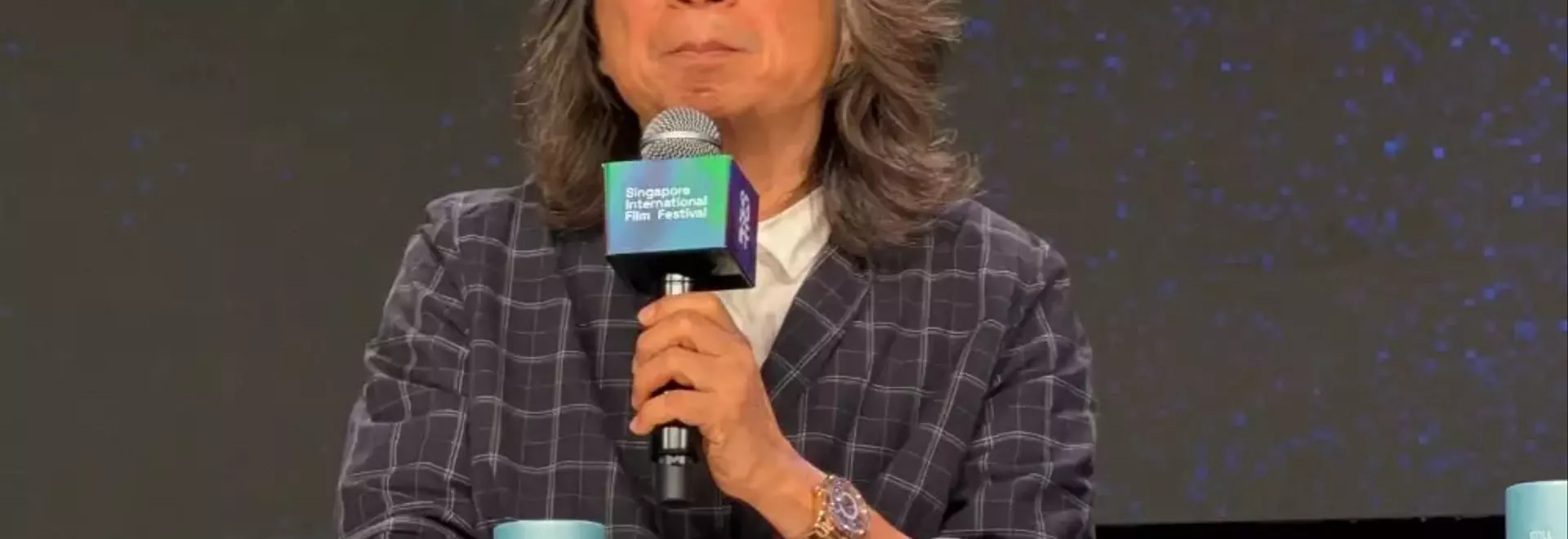
Peter Chan Advocates for Human Creativity in Filmmaking Amidst AI Debates
In an era grappling with technological advancements, renowned director Peter Chan offers a nuanced perspective on artificial intelligence's place within the cinematic arts. He firmly draws a line between leveraging AI for technical enhancement and outright AI-generated content, championing the indispensable element of human creativity in storytelling. Furthermore, Chan observes the paradoxical trends in audience engagement – from fleeting vertical dramas to deep-dive podcasts – affirming his conviction in the sustained relevance and unique power of traditional feature films.
Filmmaker Peter Chan Shares Insights at Singapore International Film Festival
During a candid "In Conversation" session at the esteemed Singapore International Film Festival on October 22, 2026, celebrated Asian filmmaker Peter Chan Ho-sun articulated his firm stance on the burgeoning influence of artificial intelligence in moviemaking. The director, acclaimed for works such as "Comrades: Almost a Love Story" and "The Warlords," clarified his openness to utilizing AI as a technical aid, akin to existing computer-generated imagery (CGI) and special effects, which he notes have long incorporated AI principles without explicit labeling. However, he unequivocally rejected the concept of AI-generated content, underscoring that the essence of artistic creation remains intrinsically human. "Any technology that assists me in creating films is welcome, but art will always be beyond its grasp," Chan asserted, adding, "Movies are fundamentally human creations."
Addressing a query from an audience member regarding the challenges of the current film industry, Chan acknowledged the prevailing difficulties but maintained an optimistic outlook on the future of feature films. He contended that despite the growing popularity of short-form and vertical dramas catering to shrinking attention spans, and conversely, the rise of extensive podcasts, feature films will continue to thrive. He pointed to the contrasting consumption habits – quick, bite-sized entertainment versus in-depth, hours-long audio content – as evidence of a diverse and robust media landscape where two-hour narratives still command an important space. Chan shared these thoughts with an engaged audience at the Grand Ballroom, Marina Bay Sands, reinforcing his belief that the medium he cherishes is far from obsolescence.
Chan also delved into his latest cinematic endeavor, "The Road Not Taken," which premiered at the Toronto Film Festival. He revealed that while the film centrally addresses Alzheimer's disease, its narrative scope extends to portray the intricate struggles within a fractured family. The story intricately weaves the lives of a divorcing couple, where the wife's early-onset Alzheimer's leads her to relive their youthful romance, alongside the complexities of their relationship with their Gen Z daughter. The film's English title, a nod to Robert Frost's iconic poem, reflects Chan's personal philosophy on life's unpredictable journey, while its Chinese title, "Ming Tian Hui Geng Hao" ("Tomorrow Will Be Better"), conveys a hopeful message. His research for the film included visits to Alzheimer's care facilities in Chengdu, China, where he distilled his career ethos into an eight-word Mandarin phrase: embrace the flow and recognize when to pause.
Reflecting on his expansive career, Chan recounted his unexpected venture into directing "The Warlords" – a historical epic he never envisioned making. He also fondly recalled the 30th anniversary of "Comrades: Almost a Love Story," a film that profoundly influenced filmmakers across Asia despite its modest box office returns, granting him a revitalized cinematic journey for decades. He candidly spoke of the challenges faced during his Hollywood experience with DreamWorks' "The Love Letter," attributing difficulties not to cultural barriers, but to an opaque corporate system and an overreliance on test screenings, which he likened to contemporary algorithms. This experience, he noted, made him adaptable, even to navigating mainland China's censorship, which he views as another constraint that can fuel creative solutions. Chan’s journey includes establishing Applause Pictures, a pan-Asian production company focusing initially on horror films like "The Eye" franchise, before shifting his focus to mainland China with films such as the 2005 musical "Perhaps Love." He humorously addressed his rigorous approach to screenwriters, acknowledging his demanding nature in pursuit of cinematic excellence.
Peter Chan's profound insights illuminate the ongoing dialogue surrounding technology, artistry, and the evolution of storytelling. His steadfast belief in the human element of filmmaking, coupled with an adaptable spirit to industry changes, serves as a powerful reminder that while tools may change, the heart of narrative creation remains with the human imagination. His experiences traversing diverse cinematic landscapes, from Hong Kong to Hollywood and mainland China, underscore the resilience required to thrive in a constantly shifting creative environment. Ultimately, Chan’s perspective encourages us to view technological advancements not as threats to art, but as new avenues for expression, provided that human creativity and vision remain at the helm.
