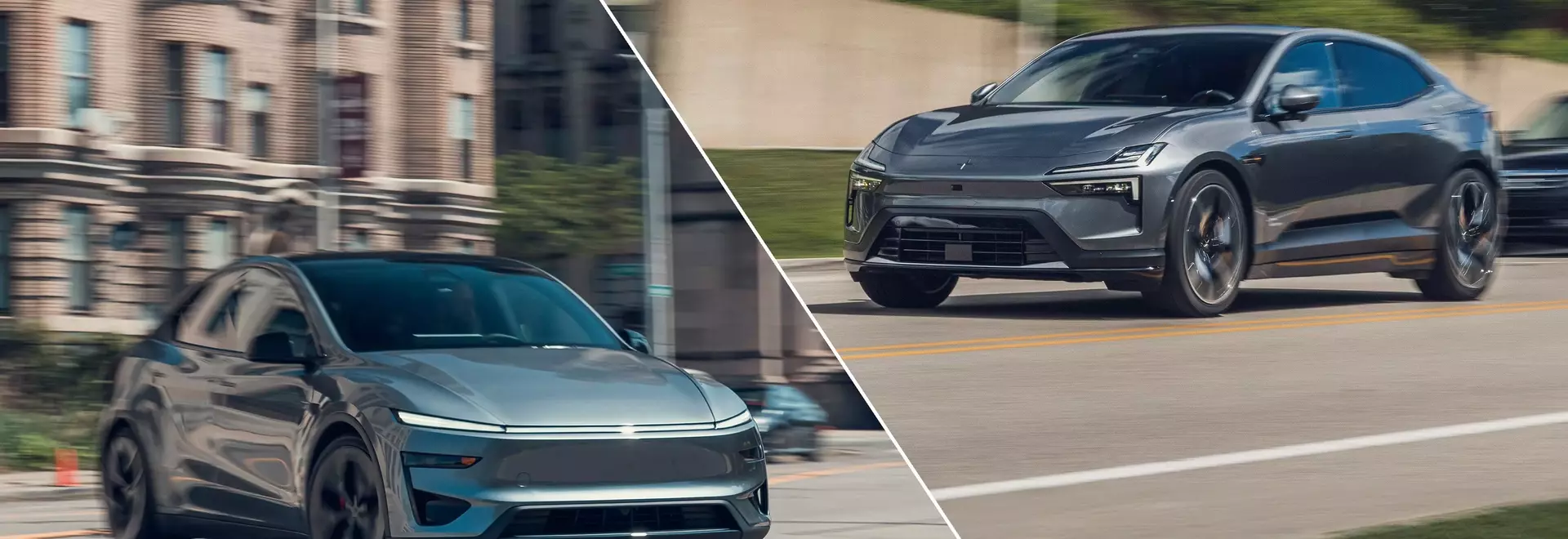
Performance Showdown: Tesla Model Y vs. Polestar 4
In the evolving landscape of electric vehicles, the distinction of "performance" in a compact electric SUV is becoming increasingly nuanced. This analysis rigorously compares two prominent contenders: the 2026 Tesla Model Y Performance and the 2026 Polestar 4 Dual Motor Performance Plus. Our objective is to ascertain which of these vehicles delivers a more cohesive and satisfying high-performance experience, considering aspects from design and interior comfort to raw power and driving dynamics, ultimately providing insight into their respective market positions.
The Tesla Model Y, a well-established and globally recognized electric vehicle, enters this competition from a position of widespread popularity. Its consistent sales performance over several years has cemented its status as a favored option among consumers. In stark contrast, the Polestar 4 is a relative newcomer, with the 2026 model year marking its debut. However, its future in the United States appears to be short-lived, as new regulations prohibiting its sale from 2027 onwards loom. This makes the current opportunity to acquire a Polestar 4 particularly time-sensitive for interested buyers.
Despite the Polestar's impending market withdrawal, we proceeded with a comprehensive evaluation. The 2026 Model Y Performance has undergone revisions, moving away from some of its previous track-focused attributes to better suit dynamic driving on scenic routes. Meanwhile, Polestar, having less historical data to draw upon, has approached the performance aspect of its 4 Dual Motor, equipped with the Performance and Plus packages, with a more assertive, track-oriented philosophy. This sets the stage for an intriguing contest between an experienced player and a bold challenger.
Visually, the Tesla Model Y maintains its familiar, understated, oval-shaped silhouette, which has seen minimal alteration since its introduction. The 2026 refresh introduced updated lighting elements that add a touch of modernity, yet its overall design remains conservative. The Polestar 4, on the other hand, embraces a more avant-garde aesthetic. Its sharply angled, coupe-like design features numerous intricate lines and a distinctly contemporary flair. A notable design choice is the absence of a conventional rear window, relying instead on a digital rearview mirror for visibility, a feature that some drivers found required an adjustment period to overcome spatial awareness challenges.
Inside, both vehicles champion a minimalist design philosophy centered around a large central touchscreen. While Tesla pioneered this techno-minimalist approach, the Polestar 4 elevates it with premium materials and smooth textures, creating a luxurious and serene cabin environment. Optional features such as an electrochromic glass roof and nappa leather upholstery further enhance this premium feel. The Model Y's refreshed interior also shows improvements in material quality and build, making it a significant upgrade from its predecessors. Both cars offer comparable practical cargo space, with the Polestar 4 accommodating seven carry-on suitcases behind its rear seats and twenty with the seats folded, mirroring the Model Y's capacity, though the Tesla utilizes its front trunk for the final few items.
Both vehicles rely heavily on their central touchscreens for control, integrating most functions into digital menus. While this can initially be challenging for new users, both systems prove intuitive with some practice. The Polestar includes a dedicated volume knob, a welcome physical control. The Model Y's larger 16.0-inch display serves as the primary information hub, whereas the Polestar augments its 15.4-inch screen with a smaller digital display directly behind the steering wheel, positioning crucial information like speed and battery status directly in the driver's line of sight.
In terms of propulsion, both SUVs feature dual-motor, all-wheel-drive configurations. The Polestar 4 boasts a slight power advantage with 536 horsepower, compared to the Model Y's 510 horsepower. However, the Polestar's heavier curb weight of 5254 pounds offsets some of this power, making it 816 pounds heavier than the 4438-pound Model Y. Despite the weight difference, both vehicles demonstrate impressive acceleration, with the Polestar edging out the Tesla in a 0-60 mph sprint, achieving it in 3.2 seconds versus the Model Y's 3.3 seconds. The choice of tires significantly impacts performance, with the Polestar's custom Pirelli P Zero PZ5 Elect summer tires offering superior grip compared to the Tesla's Hankook Ion Evo all-season tires, a difference also evident on the skidpad where the Polestar registered 0.96 g versus the Model Y's 0.88 g.
Braking performance is also a key differentiator. The Polestar 4 utilizes more robust, track-inspired four-piston Brembo calipers and ventilated discs, stopping from 70 mph in 169 feet. The Model Y Performance, with brakes adapted from its Premium trim and enhanced with larger rear rotors and grippier pads, stopped in 179 feet. The driving dynamics further distinguish the two. The Polestar 4's steering, while precise, lacks feedback, and its adaptive suspension, despite adjustable settings, struggles to find a perfect balance between comfort and handling, leading to a somewhat disconnected feel during aggressive cornering. The Tesla Model Y, benefiting from more development time, offers a more refined and integrated driving experience. Its steering is responsive with good feedback, and its adaptive dampers effectively manage body roll, though the stiffest setting can be a bit harsh over uneven surfaces. While the refreshed Model Y Performance removed some adjustable drive modes, its overall performance remains robust and satisfying for everyday and spirited driving.
The Tesla also offers a Full Self-Driving (Supervised) Level 2 autonomous system, available as a subscription, which, despite occasional issues, performs remarkably well and enhances the driving experience. The Polestar 4's Pilot Assist system offers more basic steering assist and lane-keeping functions. From a practical standpoint, the Model Y offers a superior EPA estimated range of 306 miles, significantly more than the Polestar 4's 255 miles. In real-world highway testing, the Polestar 4 achieved 250 miles and the Model Y 270 miles. Charging times also favor the Tesla, with its 81-kWh battery and 250 kW peak charge rate surpassing the Polestar's 94-kWh battery and 200 kW peak charge rate, meaning longer waits at the charger for the Polestar.
Ultimately, the Tesla Model Y Performance emerges as the more refined and complete package. While the Polestar 4 boasts a luxurious interior, formidable acceleration, and powerful brakes, its chassis dynamics feel less resolved, and its steep price—especially with performance and interior upgrades pushing it over $80,000—makes it a less compelling value proposition. The Model Y, priced at a more accessible $59,630, delivers a comprehensively engineered vehicle that excels in handling, acceleration, and daily comfort. Its blend of performance and practicality makes it a strong contender in the compact electric SUV market, demonstrating that continuous refinement and a balanced approach ultimately lead to a more satisfying ownership experience.
