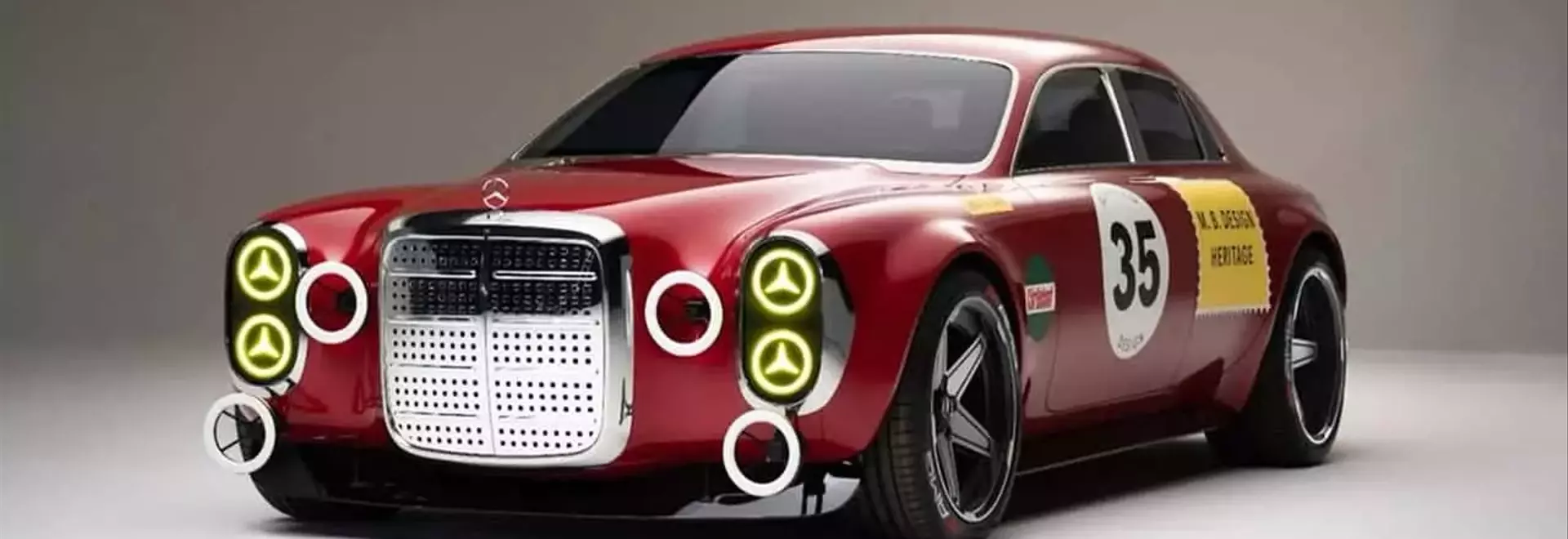
Mercedes-AMG's Iconic "Red Pig" Sedan Gets a Modern Redesign
A contemporary interpretation of the iconic Mercedes-AMG "Red Pig" sedan has been unveiled by former Mercedes design executive Gorden Wagener. This legendary V8-powered racing machine, renowned for its remarkable second-place achievement at the 1971 Spa 24 Hours, has been reimagined with modern design elements, featuring updated lighting and wheel aesthetics. While this tribute exists purely as a virtual concept and is not available for purchase, it serves as a powerful homage to AMG's illustrious racing history and Mercedes' commitment to design innovation, underscoring the enduring appeal of this high-performance automobile.
Mercedes-Benz gained a controlling interest in AMG in 1999, eventually integrating it as a wholly-owned subsidiary six years later. However, the origins of AMG stretch back to 1967, when founders Hans Werner Aufrecht and Erhard Melcher established their venture near Stuttgart. These two engineers, previously involved in developing racing engines for the 300 SE, departed Mercedes to launch their independent firm. The full name of their company, a mouthful, was Aufrecht Melcher Großaspach Ingenieurbüro, Konstruktion und Versuch zur Entwicklung von Rennmotoren, which translates to Aufrecht Melcher Großaspach engineering firm for the design and testing of racing engines.
The roots of AMG's success are deeply embedded in motorsports. A pivotal moment occurred just four years after its inception, when an AMG Mercedes 300 SEL 6.8 not only secured victory in its class but also achieved an impressive second place overall at the 1971 Spa 24 Hours. More than five decades later, this formidable sedan, affectionately known as the "Red Pig," has made a virtual reappearance. Gorden Wagener, who recently concluded his 29-year tenure at Mercedes, has brought to light a secretly modernized rendition of this V8-powered legend. His reimagining of the "Red Pig" is showcased through a series of images shared on Instagram.
Wagener's design philosophy for the modern "Red Pig" incorporates contemporary elements while retaining the essence of the original. Notably, he integrated the signature three-pointed stars into the headlights, a design cue consistent with recent Mercedes models. The auxiliary lights of the original race car have been replaced with sleek LED rings, and the five-spoke wheels are a respectful nod to the classic design. It's important to recall that the original "Red Pig" no longer exists. Constructed from a damaged W109 S-Class, the 422-horsepower race car, with its formidable 6.8-liter engine, was later acquired by Matra, a now-defunct French industrial conglomerate, which repurposed it for testing aircraft landing gear. This second life ultimately led to its destruction.
The original car's suitability for this role stemmed from its status as the fastest German production car of its era and one of the world's quickest four-door vehicles. Recognizing its historical significance, Mercedes painstakingly reconstructed a faithful replica in the mid-2000s, utilizing the original blueprints. Decades later, Wagener has resurrected the spirit of the "Red Pig" within his "Iconic Design" book, which also features a collection of his previously unreleased works. His reinterpretation is a testament to the enduring influence of this automotive icon and its foundational role in AMG's storied legacy.
Gorden Wagener's courageous endeavor to modernize the car that laid the groundwork for AMG speaks volumes about his artistic vision. This undertaking reimagines an iconic vehicle for the 21st century, a feat that will resonate with AMG enthusiasts who appreciate such speculative design exercises. While a production version of this modernized "Red Pig" remains a fantasy, the concept art allows us to contemplate its potential evolution over half a century after its historic performance at Spa-Francorchamps. Wagener's profound impact on Mercedes' design over the past two decades is undeniable, and his decision to revisit one of AMG's earliest masterpieces is a fitting tribute. Furthermore, the anticipation of a return to the imposing grille, as hinted by last year's Vision Iconic concept, suggests a future design language that skillfully blends heritage with innovation.
