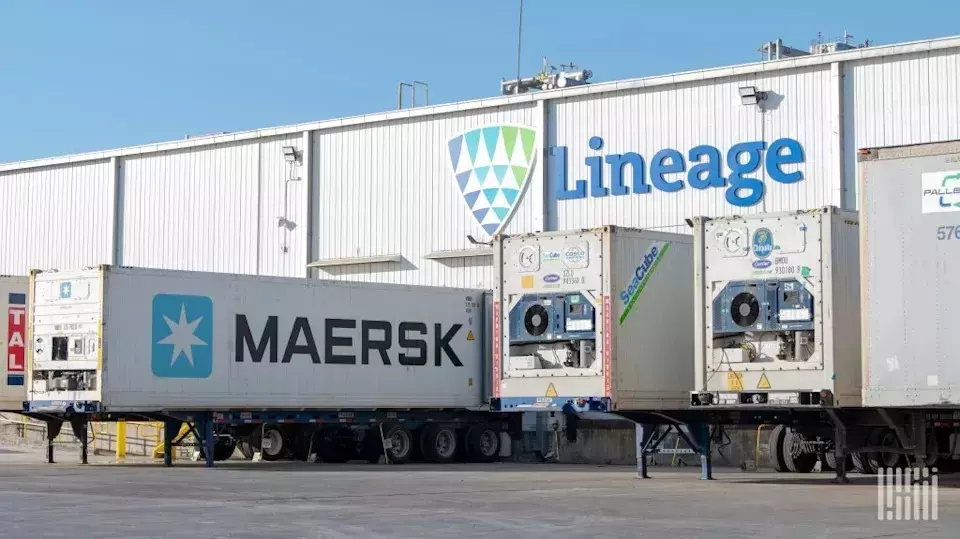
Lineage Logistics Navigates Cold Storage Oversupply with Facility Closures
Lineage Logistics is actively addressing a persistent oversupply in the cold storage sector by strategically idling numerous facilities, a move that is expected to reshape the market dynamics. This strategic rationalization is complemented by plans for significant asset sales, designed to strengthen the company's financial position and focus on automated, efficient operations. The company's recent financial results reflect these challenging market conditions, yet also indicate signs of stabilization and future growth opportunities through new construction and a revised outlook.
The cold storage industry has been grappling with an excess of capacity, a direct consequence of expansion efforts during the pandemic. Lineage Logistics, a prominent player in this market, has taken decisive steps to mitigate this issue. These actions, coupled with the financial adjustments and forward-looking strategies, underscore the company's commitment to navigating a competitive landscape and capitalizing on its operational strengths.
Lineage's Strategic Response to Cold Storage Glut
Lineage Logistics is actively confronting a significant oversupply in the cold storage market, which it estimates to be approximately 10% overbuilt, a situation exacerbated by rapid capacity expansion during the pandemic. To counter this, the company has idled five additional facilities this year, following ten closures in the previous year. This strategic consolidation has removed 2.5 million square feet, or 1% of its total U.S. portfolio, from operation. Management has indicated that some of these temporarily closed locations might eventually resume activities as market conditions evolve. Furthermore, Lineage plans to divest approximately $1 billion in assets, using the proceeds to reduce its net debt-to-EBITDA ratio from 6x to a target range of 5-5.5x. This rationalization strategy prioritizes scaled providers with advanced automation and robust transportation networks, suggesting a future market dominated by more efficient and technologically capable operators.
The company's proactive measures reflect a broader industry trend of adjusting to post-pandemic demand shifts. By reducing its footprint and focusing on asset sales, Lineage aims to streamline its operations and enhance its competitive edge. This approach is not merely about scaling back but about optimizing resources and improving overall financial health. The emphasis on automation and transportation capabilities highlights a strategic pivot towards operational excellence and efficiency, which will be crucial for long-term success in a volatile market. The potential re-opening of idled facilities also suggests a flexible strategy, allowing Lineage to adapt swiftly to any future shifts in supply and demand, positioning itself for sustained leadership in the cold storage logistics sector.
Financial Performance and Future Outlook Amid Market Challenges
Lineage Logistics reported a net loss of $32 million for the second quarter, alongside adjusted funds from operations (AFFO) of 76 cents per share, which represented a 5-cent year-over-year decrease. Despite these figures, consolidated net revenue reached $1.36 billion, a 1% increase year-over-year and slightly surpassing the consensus estimate of $1.35 billion. Operational metrics showed physical occupancy at 75.8% for same-warehouse comparisons, an improvement of 90 basis points year-over-year but a 60 basis point sequential decline. Pallet throughput saw a 2% year-over-year decrease, and storage revenue per pallet also declined by 1%, primarily due to a 14% drop in food-related container volumes at ports. However, management noted stabilizing food inventories and anticipate a return to normal seasonal demand patterns, projecting a modest year-over-year decline in both pallet throughput and revenue per pallet, with net pricing expected to increase by 1% to 2%.
Adjusted EBITDA for the quarter was $320 million, down 2% year-over-year, with the margin falling 60 basis points to 23.5%. The company adjusted its full-year adjusted EBITDA guidance to a range of $1.26 billion to $1.29 billion, maintaining the midpoint, despite a $15 million EBITDA headwind from a California facility fire. AFFO guidance was raised to $2.80 to $3.05 per share, reflecting a 5-cent increase at both ends. Lineage is also investing in growth, with 20 facilities currently under construction, projected to generate an additional $134 million in net operating income. The company manages 500 facilities globally, encompassing 3.1 billion cubic feet of space, and offers diverse services including freight forwarding and transportation. These strategic initiatives, combined with a positive outlook on inventory stabilization, aim to enhance Lineage’s market position and financial resilience.
