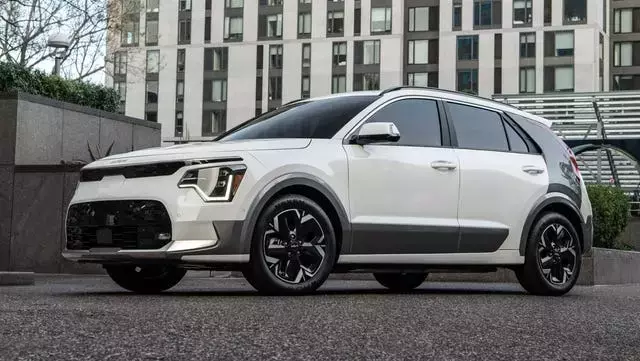
Kia Discontinues Niro EV: A Shift Towards Hybrid Models
Kia is making significant adjustments to its electric vehicle portfolio in the United States, notably phasing out the Niro EV by the 2026 model year. This move follows a series of delays and postponements for other Kia EV models, indicating a strategic shift in the company's approach to the burgeoning electric market. While the all-electric Niro will no longer be available, the refreshed Niro lineup, already introduced in South Korea, is anticipated to feature traditional hybrid and plug-in hybrid powertrains, with a potential U.S. launch in late 2026 for the 2027 model year. This recalibration highlights Kia's evolving strategy in an increasingly competitive automotive landscape.
The End of an Electric Era: Kia Niro EV's Sunset
Kia is reportedly discontinuing the Niro EV, with 2026 slated as its final model year, according to reports from The Korea Herald and InsideEVs. This decision marks a significant change in Kia's electric vehicle strategy in the United States, which has recently seen other EV models, such as the EV4 sedan and EV9 GT, either delayed indefinitely or postponed. The existing EV6 GT also did not return for the 2026 model year, suggesting a broader consolidation of Kia's electric offerings. This move to cease production of the Niro EV has been confirmed by Kia executives, who stated that the company plans to sell off its remaining inventory.
The discontinuation of the Niro EV is not entirely unexpected, given its position in the competitive electric vehicle market. The model, equipped with a 201-horsepower electric motor and a 64.8-kWh battery offering an EPA-estimated range of 253 miles, faced stiff competition. Its starting price of $41,195 for the 2026 model year placed it at a disadvantage compared to rivals like the Hyundai Ioniq 5 and Tesla Model Y Standard. The Ioniq 5, built on a dedicated EV platform, is more spacious and offers a longer range at a lower starting price, especially after recent price reductions. Similarly, the Tesla Model Y Standard provides superior performance and range at a comparable price point. Furthermore, the Niro EV's assembly in South Korea subjected it to import tariffs, unlike the Ioniq 5 and EV6, which are assembled in Georgia, making them more competitive.
A Hybrid Future: The Refreshed Niro's Path Forward
While the Niro EV is being phased out, Kia has revealed a refreshed version of the Niro for the Korean market, which is expected to continue with only hybrid and plug-in hybrid (PHEV) variants. This updated model features a cleaner design that aligns with Kia's current aesthetic, diverging from the previous generations that offered all three powertrain options. The focus on hybrid and PHEV technologies for the Niro lineup indicates Kia's commitment to these powertrains, which continue to attract a substantial market share.
The fate of the refreshed Niro in the United States remains to be officially announced by Kia. However, if it does make its way to the American market, it is anticipated to launch for the 2027 model year, with sales commencing towards the end of 2026. This potential launch would emphasize the hybrid and plug-in hybrid configurations, effectively cementing the Niro's role as a hybrid-centric offering rather than an all-electric one. The implications of the Niro EV's discontinuation also extend to its corporate cousin, the Hyundai Kona Electric, whose 2026 model year has been skipped. The long-term future of the Kona Electric could be influenced by Kia's decision regarding the Niro EV, potentially leading to a permanent hiatus if market conditions continue to favor other EV segments or hybrid alternatives.
