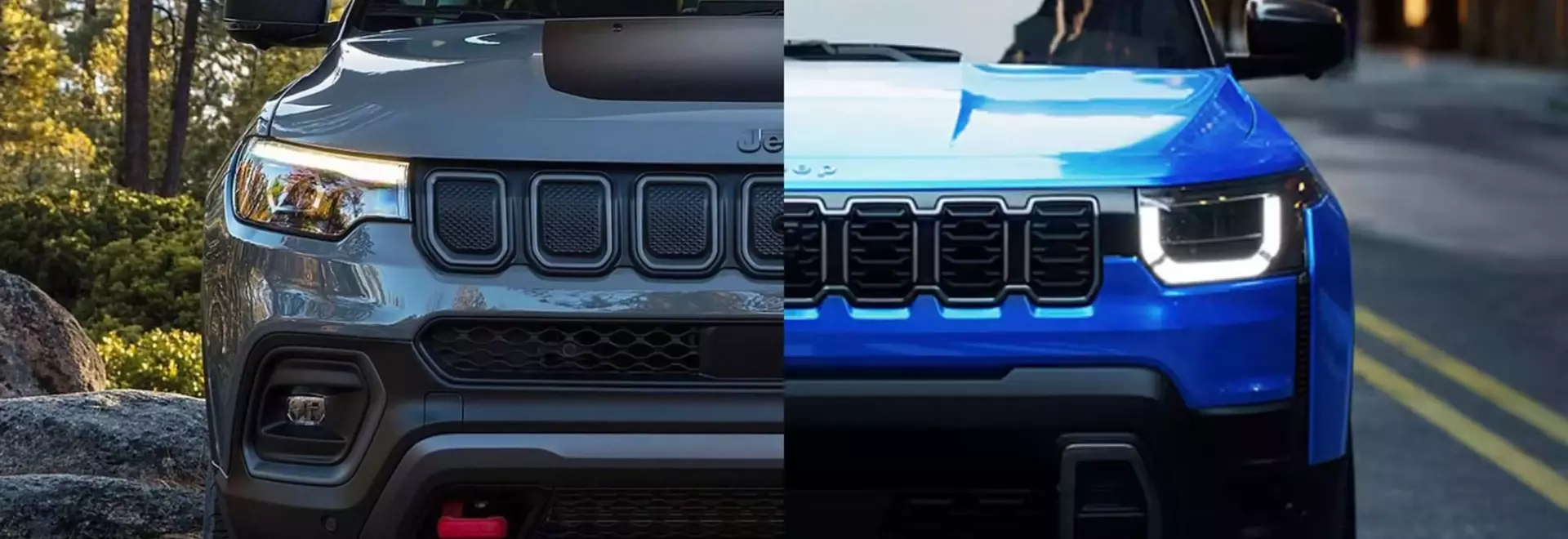
Jeep Compass vs. Cherokee: Unveiling the 5 Key Distinctions
Navigate Your Adventure: Compass vs. Cherokee – Finding Your Perfect Jeep Match
Generational Divide: The Modernity of the Cherokee Versus the Enduring Compass
The 2026 Jeep Cherokee stands as a testament to innovation, representing the sixth generation of this SUV, launched just last year on Stellantis's advanced STLA Large Transverse platform. In stark contrast, the 2026 Jeep Compass, while still a viable option in the US market, is essentially a continuation of its second generation. Despite newer versions being available internationally, the Compass in the US still rides on the Small Wide 4x4 LWB platform, which has been in use since 2016. This age gap inherently positions the Compass with older technology compared to its contemporary Cherokee counterpart, directly impacting performance and features.
Dimension Details: Comparing the Footprint and Interior Volume of the Two SUVs
Despite both being categorized as compact SUVs, the Cherokee boasts a noticeably larger physical presence than the Compass, which translates into more generous interior space. Observing their external dimensions reveals this difference: the Cherokee measures 188.1 inches in length, 113 inches in wheelbase, 83.6 inches in width (with mirrors), and 67.5 inches in height. The Compass, on the other hand, is more compact at 173.4 inches long, with a 103.8-inch wheelbase, 80 inches wide, and 64.6 inches tall. This increased size in the Cherokee provides 2.6 additional inches of rear shoulder room, enhancing comfort for three passengers in the second row, along with a larger cargo area of 33.6 cubic feet behind the second row, surpassing the Compass's 27.2 cubic feet.
Powertrain Perspectives: The Contrast Between Traditional Gasoline and Hybrid Efficiency
A significant divergence between these two Jeeps lies in their propulsion systems. The 2026 Compass models are uniformly equipped with a 2.0-liter turbocharged four-cylinder gasoline engine, delivering 200 horsepower and 221 lb-ft of torque, paired exclusively with an eight-speed automatic transmission. The 2026 Cherokee, however, adopts a more forward-thinking approach with a 1.6-liter turbocharged four-cylinder hybrid powertrain, collectively producing 210 hp and 230 lb-ft, mated to an electronically controlled CVT. While the Compass demonstrates quicker acceleration, achieving 60 mph in 7.5 seconds compared to the Cherokee's estimated 8.2 seconds, the hybrid Cherokee significantly outperforms in fuel efficiency, boasting EPA ratings of 39/35/37 mpg city/highway/combined, far exceeding the Compass's 23/31/26 mpg.
Off-Road Prowess: Differentiating Their Trail-Ready Capabilities
While neither the Compass nor the Cherokee is designed to rival the extreme off-road capabilities of a Wrangler, both offer respectable performance beyond paved roads. The Compass features standard full-time 4x4 with Jeep Active Drive, with only the Trailhawk trim receiving the more robust Jeep Active Drive Low system, which includes a 20:1 Crawl Ratio, 8.6 inches of ground clearance, and impressive approach, breakover, and departure angles. The Cherokee, by contrast, comes standard with 4x4 and Jeep Active Drive I, featuring a fully disconnecting 4x2 mode but lacking a low-range ratio. Its ground clearance of eight inches and angles of 19.6/18.8/29.4 degrees are less aggressive than the Compass Trailhawk, indicating a greater emphasis on on-road efficiency, making the Compass Trailhawk the more capable choice for challenging off-road conditions.
Interior Innovations: The Cherokee's Leap in Modern Amenities and Technology
The interior of the new Cherokee marks a substantial upgrade in modernity and feature set compared to the Compass. Both models incorporate the Uconnect 5 infotainment system, but the Cherokee offers a more advanced experience with a standard 10.25-inch digital instrument cluster and a 12.3-inch touchscreen across all trims. The Compass, conversely, starts with a smaller seven-inch TFT digital cluster and an 8.4-inch touchscreen. Furthermore, the Cherokee provides the option for heated rear seats and includes dual-zone automatic climate control, rear park assist, and Rough-Road Cruise Control as standard features, offering a more premium and technologically enhanced cabin experience from the outset.
Concluding Thoughts: Weighing Value and Modernity in Your SUV Choice
The 2026 Jeep Compass, with a starting price of $29,355, presents a more budget-friendly entry point into the Jeep brand. It remains a compelling option, especially for those who appreciate its Trailhawk trim's specialized off-road capabilities and are not deterred by its older design. However, the 2026 Jeep Cherokee, beginning at $35,000, clearly positions itself as the more modern and premium offering. Its all-new design, advanced hybrid powertrain, superior fuel efficiency, and enhanced interior technology make it a stronger contender for buyers seeking contemporary features and environmental performance. Until a new generation of the Compass emerges, the Cherokee offers a more comprehensive and appealing package for the discerning compact SUV buyer.
