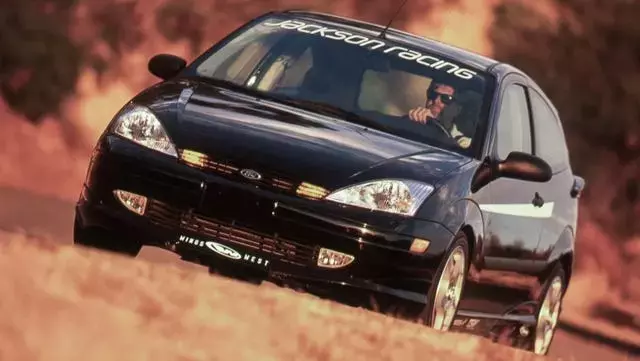
Jackson Racing Supercharged Focus ZX3: A Detailed Analysis
This report delves into the comprehensive evaluation of the Jackson Racing supercharged Ford Focus ZX3, as originally presented in the April 2002 edition of Car and Driver. It highlights the distinct approach of tuner Oscar Jackson, who, with years of experience, aims to enhance a vehicle's drivability and performance rather than transforming it into an extreme racing machine. The article provides an in-depth look at the modifications, including the Eaton supercharger, exhaust system, and suspension upgrades, and analyzes their impact on the car's power output and acceleration. Comparative data with both a standard Focus ZX3 and the factory-tuned SVT Focus offers a clear perspective on the supercharged model's relative performance, emphasizing its role as a daily driver with expanded capabilities.
Jackson Racing Enhances Focus ZX3 with Supercharger Technology
In the spring of 2002, the automotive world witnessed an intriguing modification to the Ford Focus ZX3 by Jackson Racing, spearheaded by the seasoned tuner Oscar Jackson. Eschewing the conventional pursuit of raw speed, Jackson's vision for this compact car focused on augmenting its daily driving performance through meticulous engineering. The core of this transformation was the integration of an Eaton supercharger, specifically the compact 45-cubic-inch twin-rotor variant. This unit, operating at 1.73 times the engine speed, delivered a modest 6.0 pounds of boost to the 2.0-liter DOHC 16-valve Zetec engine.
Beyond the supercharger, the vehicle received a suite of upgrades including Focus Sport's 'shorty' headers and a stainless steel exhaust system, contributing to an overall clean installation that could be mistaken for a factory option. Dynojet tests conducted by Jackson Racing revealed a significant power increase from the stock 103.4 horsepower and 110.7 pound-feet of torque (at the wheels) to an impressive 150.2 horsepower and 129.5 pound-feet, with the power peak shifting closer to the engine's 7000-rpm redline. Performance metrics showed the supercharged Focus accelerating from 0 to 60 mph in 8.4 seconds, an improvement over the stock model's 9.1 seconds, and completing the quarter-mile in 16.6 seconds at 84 mph. Despite these gains, the initial acceleration from 0 to 30 mph remained identical to the stock version, suggesting that the supercharger primarily enhanced top-end power rather than low-end torque.
The suspension system also underwent significant enhancements, featuring Jackson Racing's sport springs that lowered the car by 1.25 inches, complemented by Koni adjustable shocks and TSW wheels fitted with Yokohama A520 tires. This setup, while improving handling, introduced a slight reduction in ride comfort. The total cost of these modifications, including the $3295 supercharger system, exceeded $7000, not accounting for installation. When compared to Ford's own 170-hp, six-speed SVT Focus, which achieved 0-60 mph in 7.8 seconds and a quarter-mile in 16.1 seconds at 87 mph, the Jackson Racing Focus offered a compelling, albeit more costly, alternative for enthusiasts seeking a refined performance upgrade.
This detailed examination of the Jackson Racing supercharged Focus ZX3 underscores a critical insight for automotive enthusiasts and engineers: true performance enhancement isn't solely about maximizing raw power but about optimizing the driving experience within a broader context. Jackson's philosophy, prioritizing daily drivability and refined power delivery over extreme speed, offers a valuable lesson in thoughtful vehicle modification. It highlights that integrating aftermarket components should ideally complement the original design, creating a harmonious balance of power, handling, and comfort. The comparison with the SVT Focus further illustrates the complexities of achieving superior performance and value, suggesting that while bespoke tuning can yield impressive results, factory-backed performance variants often offer a more integrated and cost-effective solution. This serves as a reminder that the art of tuning lies not just in mechanical prowess but also in understanding and delivering on specific driver needs and expectations.
