Iran's Critical Juncture: Why a Diplomatic Resolution is Imperative Amidst Oil Crisis
Iran finds itself at a pivotal moment, necessitating a diplomatic breakthrough not due to a weakening military or political position, but because its primary economic leverage—oil—has become a significant challenge. For an extended period, Iran's oil export strategy thrived despite international sanctions, relying on channels to China, discounted crude, ship-to-ship transfers, and an extensive logistical network spanning from Kharg Island to Southeast Asia and China's independent refining sector. While the current instability in the Strait of Hormuz has not dismantled this system entirely, it has critically hindered Iran's capacity to transport crude from the Gulf, a component of its strategy that is difficult to substitute.
This is why the upcoming agreement between the United States and Iran is immensely significant for Tehran. The immediate priority is the resumption of oil exports through the Strait of Hormuz, even more so than the broader Reconstruction and Development plan or the release of frozen Iranian assets. These political gains are valuable, but the pressing need is to reactivate Iran's export channels to avoid deeper and more damaging production curtailments caused by current storage limitations.
The Stranglehold on Iranian Oil Exports
The impact of the US military blockade is starkly evident in the export data. Iranian crude oil shipments, which averaged approximately 1.5 million barrels per day (b/d) in April, saw a 20% decline compared to March. May witnessed a drastic drop to just 260,000 b/d. The outlook for June appears even grimmer, with most loadings remaining without a designated destination and confined within the Gulf region; only three cargoes managed to traverse the Strait in June. The imposition of the US blockade on April 13, which barred Iranian vessels from entering or exiting the Strait, effectively neutralized Tehran's previous strategy of ensuring access for its own fleet while restricting others. The timing of this blockade was particularly detrimental, as Iranian Light crude had previously been selling at a premium to ICE Brent, yielding significant daily revenues for Tehran before the mid-April enforcement.
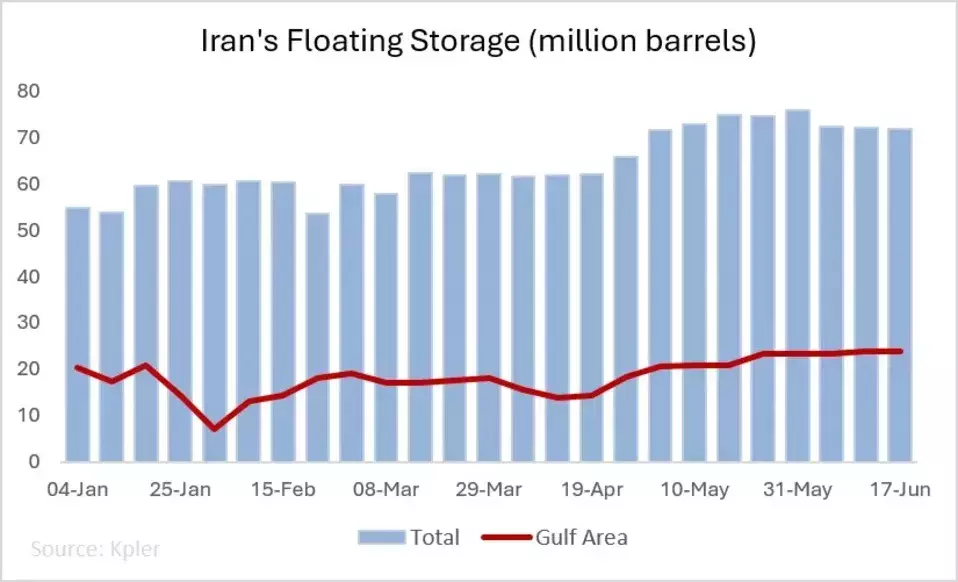
The structural pressure on Iran's oil sector is mounting, as reflected in rising inventories. Data from Kpler indicates that Iran's onshore oil reserves have reached levels last seen during the Covid pandemic, increasing by roughly 15% from 60.6 million barrels in mid-January 2026 to 72 million barrels by mid-June. This figure has shown minimal change since May, suggesting a maximum storage capacity issue. While total Iranian floating storage decreased from 43 million to 33.5 million barrels since mid-May, floating storage within the Gulf has steadily climbed from 14 million barrels in mid-May to approximately 24 million barrels following the blockade's implementation. This suggests that while Iran has been able to liquidate oil inventories held outside the Gulf, new crude production is now accumulating within the Gulf, unable to find buyers.
The Path to Resuming Oil Trade and Addressing Lingering Challenges
The decline in floating storage near Singapore and China indicates Iran's efforts to sell off barrels that had already moved beyond the Gulf before the blockade fully severed the export route. Conversely, the increase in floating storage within the Gulf highlights a critical problem: new crude volumes are becoming trapped, with minimal prospects of passing through the US blockade. Tehran has been utilizing its last available liquid reserves around Singapore, while fresh crude continues to amass in the Gulf, where it cannot be sold. Furthermore, since early June, both onshore inventories and the floating fleet have remained relatively stable despite the blockade. This strongly suggests that Iran has either reduced or partially halted oil production, likely beginning around mid-to-late May. Such production halts are not merely technical adjustments; restarting operations can be challenging, domestic oilfield services face disruption, and revenue losses deepen. What initially presented as an export issue is gradually evolving into a broader production crisis for Iran.
Even if the Strait reopens, the path to full normalization of Iran's oil trade will not be immediate. A backlog of vessels will need to be cleared, and insurers, charterers, and refiners will have to reassess the inherent risks. The initial 60-day ceasefire must be sustained and eventually extended to foster a stable environment for normalization. Any lifting of sanctions on Iranian oil will also necessitate rigorous compliance protocols, especially given that Iran's banking system largely remains under sanctions. Previous rare transactions by non-Chinese buyers relied on complex payment mechanisms, as exemplified by Indian Oil Corp's reported purchase of Iranian crude, with payment channeled through China. Pricing will remain a significant factor, with every entity involved in Gulf cargo handling needing to factor in risk. This will manifest in freight costs, insurance premiums, payment terms, and crude differentials, likely forcing Iran to revert to its pre-crisis discounted crude model. However, China is expected to swiftly re-engage with Iranian crude, as discounted oil, even with geopolitical and logistical risks, remains more attractive than other Middle Eastern alternatives that carry similar regional risks but lack the same price advantage.
