Home Depot Navigates Leadership Transition Amidst Earnings Release
Money

Home Depot Navigates Leadership Transition Amidst Earnings Release

authorBy Chika Uwazie
DateAug 16, 2026
Read Time2 min

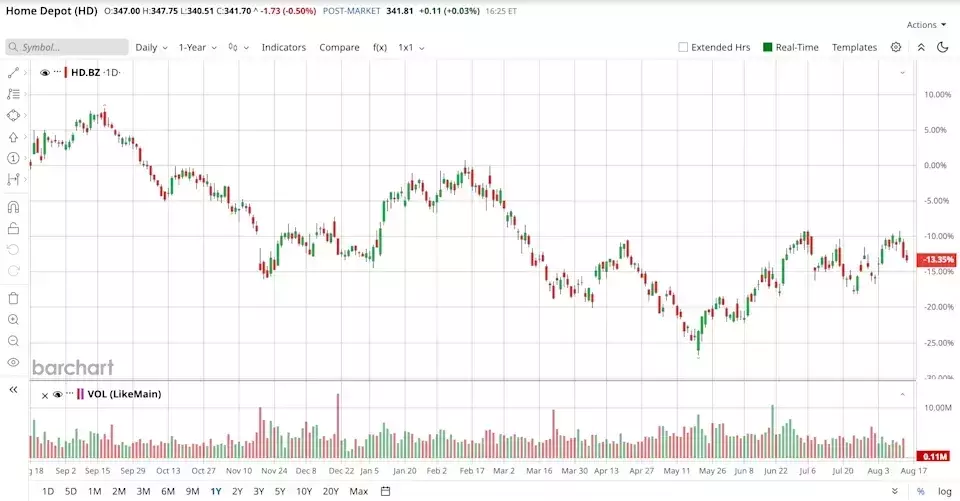
Home Depot faces a temporary leadership change as CEO Ted Decker takes a medical leave for several months, coinciding with the upcoming fiscal second-quarter earnings announcement. Investors are closely watching this development, particularly as the company prepares to release its financial results on August 18th, which will offer insights into housing market conditions and consumer spending habits.

Despite the unexpected timing, the company has taken proactive steps to ensure continuity. Home Depot has not appointed an interim CEO; instead, it has strategically divided Decker's responsibilities between two seasoned executives. Ann-Marie Campbell, the senior executive vice president of U.S. stores and operations, will oversee operational aspects, while CFO Richard McPhail will manage financial matters and the company's Pro divisions. This measured approach suggests that the company views this as a temporary governance matter rather than a fundamental shift in its investment outlook. The upcoming earnings report will be crucial in assessing Home Depot's resilience in the current economic climate, particularly its performance in comparable sales, significant transactions, and demand within its professional contractor segment.

The company's performance in the fiscal first quarter demonstrated its ability to achieve moderate growth despite a challenging housing market, with revenue increasing by 4.8% year-over-year to $41.8 billion. Comparable sales saw a modest rise of 0.6% globally and 0.4% in the U.S., while adjusted earnings per share reached $3.43, exceeding analyst expectations. Home Depot has reaffirmed its fiscal 2026 guidance, projecting total sales growth of approximately 2.5% to 4.5% and adjusted earnings per share growth of up to 4%. The Wall Street community maintains a "Moderate Buy" rating for Home Depot, indicating a cautious yet optimistic view. The stock's valuation, trading at about 23.62 times forward price-to-earnings, reflects its scale, profitability, and potential for future recovery in the housing sector, emphasizing the importance of strong earnings growth for sustained valuation improvement. Therefore, the company's future stock performance is more likely to be influenced by the recovery of housing turnover, remodeling activities, and major projects, rather than the temporary leadership adjustment.

More Articles
Money
Michael Burry's Bearish Stance on Nebius Stock: A Warning for AI Investors
Despite Nebius Group's impressive Q2 performance, with revenue quintupling, investor Michael Burry has increased his short position, signaling caution for the AI sector. Burry, known for predicting the 2008 housing crisis, believes the AI boom's accounting practices, particularly regarding GPU depreciation and off-balance-sheet commitments, may inflate current profits and pose long-term risks. His bearish bet suggests that even strong quarterly results might not reflect the underlying financial health of AI infrastructure companies.
By T. Harv EkerAug 16, 2026
Money
Teen Entrepreneur's Financial Predicament: High Income, Hefty Debt
A 19-year-old pressure washing entrepreneur earning $11,000 monthly faces $58,000 in debt due to commingling business and personal finances. Financial expert Dave Ramsey advises separating accounts and budgeting, highlighting how a salvaged truck significantly impacts his financial recovery. The case underscores the importance of proper financial management for self-employed individuals.
By Dave RamseyAug 16, 2026
Money
Understanding High-Yield Income ETFs: A Comprehensive Guide
This article explores three distinct exchange-traded funds (ETFs) that aim to provide substantial annual income, ranging from 12% to 20%. It delves into the operational mechanisms of SPYT, BIGY, and QDPL, highlighting their varied strategies involving options premiums, dividend futures, and underlying equity exposure. The analysis distinguishes how each fund generates its target distribution, offering insights into their risk-reward profiles and suitability for different investor objectives.
By Bola SokunbiAug 16, 2026
Money
Mandatory Roth 401(k) Catch-Up Contributions for High Earners in 2026
A new regulation for 2026 mandates that workers aged 50 and above who earned over $150,000 in Social Security wages in 2025 must direct all 401(k) catch-up contributions into Roth accounts. This change eliminates the pre-tax option previously available to high-income older savers, resulting in an upfront deduction loss of $1,900 to $2,700 annually. It also highlights the critical need to confirm employer plans support Roth options, as a lack thereof could prevent catch-up contributions entirely for affected individuals.
By Chika UwazieAug 16, 2026
Money
Pony.ai and Uber Expand Autonomous Ride-Hailing Partnership
Pony.ai and Uber are deepening their partnership to deploy over 2,000 robotaxis across Europe, starting with Zagreb, Croatia, and extending to four more cities, with plans for the Middle East. This strategic move highlights Uber's shift towards autonomous vehicles to reduce driver-related expenses, leveraging partners like Pony.ai for technology while Uber provides its vast customer base. The expansion aims to enhance profitability and solidify Uber's future in autonomous transportation, despite some market skepticism about the timeline and competitive landscape.
By Dave RamseyAug 16, 2026