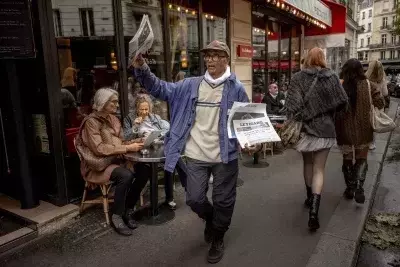
From Street Vendor to Knight: Ali Akbar's Half-Century Legacy in Paris
Ali Akbar, a dedicated Pakistani-born newspaper vendor, has been honored with one of France's most prestigious awards, the National Order of Merit. For half a century, Akbar has been a familiar and vibrant presence in the 6th arrondissement of Paris, renowned for his unmistakable calls of "Ça y est!" This recognition celebrates his enduring commitment, a journey that began in poverty and culminated in an extraordinary acknowledgment of his contributions to the city's unique charm and community spirit.
Known affectionately as the "voice of Paris' 6th arrondissement," Ali Akbar's daily routine involves navigating the city's streets on his bicycle, delivering newspapers like Le Monde and Libération. His clientele over the decades has been as diverse as Paris itself, including local residents, renowned intellectuals such as Jean-Paul Sartre, and even visiting dignitaries like former President Bill Clinton. His steadfast dedication to his craft has made him a beloved figure, a living testament to the city's vibrant street life and its rich cultural tapestry.
The pinnacle of Akbar's career came when French President Emmanuel Macron, a former customer himself, bestowed upon him the honor of knighthood. During the formal ceremony at the Élysée Palace, Macron lauded Akbar as "the accent of the 6th arrondissement" and "the voice of the French press." Macron further remarked on Akbar's profound integration into French society, describing him as "the most French of the French — a Voltairean who arrived from Pakistan." This accolade not only celebrates Akbar's individual journey but also highlights the diminishing role of traditional newspaper hawkers in an increasingly digital world, making his story even more poignant.
At 73, Akbar continues his rigorous seven-day-a-week, ten-hour-a-day schedule, driven by an unwavering work ethic. His journey to Paris began with a singular ambition: to earn enough money to build a home for his mother in Rawalpindi, Pakistan. This dream propelled him through various jobs and countries, including Greece and the Netherlands, before he settled in Paris in 1973. Despite encountering periods of homelessness and immense hardship, his focus remained on his family, ultimately allowing him to fulfill his mother's dream. His memoir, "I Make the World Laugh, but the World Makes Me Cry," subtly alludes to the challenges he overcame.
Akbar's recognition extends beyond the official ceremony; he is frequently stopped by strangers in the streets of Paris who wish to congratulate him. This public outpouring of affection underscores the deep impact he has had on the community. His son, Shamshad Akbar, noted that the medal offered a sense of closure and healing for old wounds. While the Élysée Palace did not comment on the matter, Macron has reportedly promised Akbar French citizenship. His long-time customers, like Michel Mimran, value Akbar for providing a rare and cherished sense of human connection in a bustling metropolis. Earning a modest living of about 60 euros daily, Akbar acknowledges that with his eventual retirement, the tradition of the newspaper hawker in Paris will likely come to an end. Nevertheless, he has no immediate plans to stop, continuing to embody the resilient and cheerful spirit that has made him a Parisian icon. His enduring presence and unwavering dedication represent a cherished link to a bygone era of print media and person-to-person interaction.
