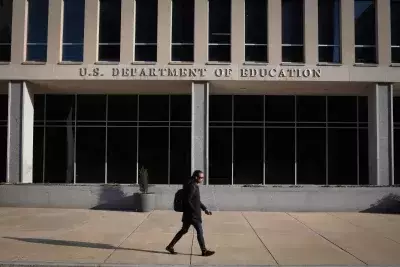
Federal Judge Rules Education Department's Partisan Emails Violated First Amendment
A recent federal court decision has underscored the principle that public sector employees retain their First Amendment rights, ruling against the Trump administration's directive to inject partisan language into the automated email responses of Education Department staff. This judgment highlights a critical boundary concerning political expression within government agencies, affirming that workers should not be conscripted into disseminating a particular administration's political viewpoints.
The controversy emerged when the Trump administration mandated that the Education Department's employees alter their out-of-office email notifications. Instead of standard messages, these auto-replies were to include politically charged statements blaming Democratic senators for an impending government shutdown. This move sparked a legal challenge from the American Federation of Government Employees (AFGE), representing many affected employees. The union contended that this action coerced federal workers into becoming unwitting political mouthpieces for the administration, thereby infringing on their constitutional rights.
U.S. District Judge Christopher Cooper, in his comprehensive ruling, explicitly stated that government employees do not surrender their First Amendment protections upon entering public service. He criticized the department for "overplaying its hand" by transforming its workforce into de facto political spokespeople through their official communication channels. The judge's decision not only sided with the union but also mandated that the department immediately reinstate personalized out-of-office messages for union members. Furthermore, he warned that if this restoration proved impossible, the department would be required to expunge all partisan language from every employee's email account, irrespective of union affiliation.
Prior to the shutdown, employees had been provided with a neutral template for their out-of-office messages, which simply stated that they were unable to respond due to a lapse in appropriations and would do so once funding was restored. However, on the shutdown's initial day, the department's deputy chief of staff for operations unilaterally superseded these individual messages with a highly partisan one. This new message explicitly cited the House of Representatives' passage of H.R. 5371 and accused Democratic senators of blocking its passage, leading to the lapse in appropriations. Several employees subsequently informed NPR that they neither authored this message nor were they aware it would replace their original auto-replies.
Despite the criticism, a department spokesperson, Madi Biedermann, defended the action at the time, asserting that the email merely reminded correspondents that a response was delayed because "Senate Democrats are refusing to vote for a clean CR and fund the government." Judge Cooper's ruling, however, found this defense insufficient, reiterating the importance of nonpartisanship as a cornerstone of the federal civil-service system, a principle enshrined in the Hatch Act of 1939. This act was designed to safeguard public employees from political pressure and ensure the impartial administration of federal programs, a goal that the Education Department's actions were found to have undermined.
This judicial intervention serves as a powerful reminder of the protections afforded to federal workers under the First Amendment and the Hatch Act. It reinforces the idea that government agencies cannot compel their employees to endorse or disseminate partisan political messages, even during periods of governmental impasse. The decision upholds the integrity of federal service, ensuring that employees are not exploited for political messaging and that the government operates on principles of impartiality and fairness.
