Ethereum's Volatile Trajectory: A Deep Dive into Market Dynamics and Future Outlook
Money

Ethereum's Volatile Trajectory: A Deep Dive into Market Dynamics and Future Outlook

authorBy Scott Pape
DateJul 18, 2026
Read Time2 min

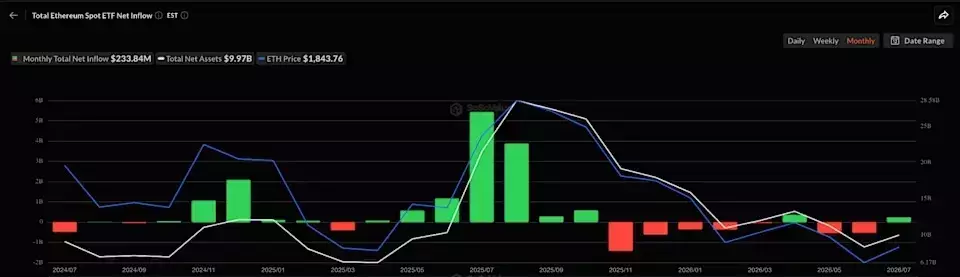
Ethereum has recently demonstrated resilience, holding steady above the crucial $1,800 threshold, a price point that has frequently served as both a floor and a ceiling for its value. Following a two-day decline, the cryptocurrency experienced a 1.5% increase, buoyed by a significant shift in market sentiment. This recovery is largely attributed to reports indicating a moderation in US inflation figures for June.

Despite the recent uptick and a notable surge in investor interest, evidenced by $106 million in positive net inflows into Ethereum-linked exchange-traded funds (ETFs) in July, the overall trading volume remains subdued. This lack of robust trading activity raises questions about the sustainability of any potential rally, especially as other technological sectors, such as artificial intelligence and space exploration, capture a larger share of market attention. The broader economic landscape, characterized by expectations of further interest rate hikes from the Federal Reserve, further constrains cryptocurrency prices and could prevent Ethereum from breaking past the $2,000 mark.

An analysis of trading volumes reveals a critical pattern: Ethereum's price typically ascends when its 7-day moving average volume surpasses the 30-day moving average. Currently, these averages are moving in parallel, with the 7-day average actually trending downwards, indicating a decrease in investor engagement. This trend suggests that the current recovery might be short-lived. Technical indicators, such as the Relative Strength Index (RSI), show a bullish stance above 50, but a recent dip below the signal line points to weakening positive momentum. Should Ethereum fall below its $1,800 support level, it faces a potential drop to the $1,550 area, representing a 14% downside risk.

In this dynamic financial climate, Ethereum's path forward is uncertain. While recent positive movements offer a glimmer of hope, the underlying market conditions demand cautious optimism. Investors should remain vigilant, understanding that the interplay of global economic factors and intrinsic market indicators will ultimately shape Ethereum's trajectory. The journey of digital assets like Ethereum reflects the ever-evolving nature of finance, constantly challenging and redefining traditional investment paradigms.

More Articles
Money
Dollar Tree's Bold Strategy: Closing 'Substandard' Stores and Revitalizing the Brand
Dollar Tree is undertaking a significant strategic shift, announcing the closure of 75 locations and acknowledging that a large portion of its remaining stores are 'substandard.' This move echoes Domino's successful 'Pizza Turnaround' campaign, where admitting product flaws led to renewed trust and improved performance. Dollar Tree aims to revitalize its brand image and operational efficiency by addressing store quality directly.
By T. Harv EkerJul 18, 2026
Money
Bank of America's Bullish Outlook on Microsoft Stock Ahead of Q4 Earnings
Bank of America reaffirms its 'Buy' rating and $500 price target for Microsoft, emphasizing the critical role of Azure's growth in the upcoming Q4 earnings report. Despite a 20% year-to-date decline in stock performance, the bank anticipates strong Azure revenue and increased Copilot adoption to drive future monetization and justify significant AI infrastructure investments, presenting an attractive valuation opportunity for investors.
By Ramit SethiJul 18, 2026
Money
Americans' Emergency Savings: A Tale of Two Realities
While a majority of Americans can cover a minor $400 emergency, a significantly smaller portion are prepared for the substantial expenses of retirement. Data from 2026 reveals a stark contrast between short-term financial resilience and long-term retirement security, highlighting a widespread savings deficit amplified by declining personal saving rates and persistent inflation. Retirees typically need around $5,000 monthly, far exceeding what average 401(k) balances can provide.
By Scott PapeJul 18, 2026
Money
Closing the Retirement Savings Gap: A Guide for 55-Year-Olds
Many individuals approaching retirement face a substantial savings deficit. This article explores strategies for 55-year-olds to bridge the gap in their final decade of work, focusing on maximizing 401(k) contributions, leveraging Social Security delays, and adjusting spending habits amidst evolving economic conditions. It highlights the potential to significantly improve retirement income by utilizing available financial tools.
By T. Harv EkerJul 18, 2026
Money
JPMorgan Chase CEO Jamie Dimon Forecasts $1 Trillion AI Investment in the Coming Year
Jamie Dimon, CEO of JPMorgan Chase, projects a significant surge in AI spending, estimating it will hit $1 trillion next year, up from $700 billion this year and $400 billion last year. This remarkable growth is attributed to strong performances in investment banking, particularly from IPOs, as the banking sector experiences a robust market. Dimon, while optimistic about AI's potential, also advises caution, noting the inherent unpredictability of market longevity.
By T. Harv EkerJul 18, 2026