Despite Recent Tech Sector Pullback, Bull Market's Underlying Strength Endures
Money

Despite Recent Tech Sector Pullback, Bull Market's Underlying Strength Endures

authorBy JL Collins
DateJul 17, 2026
Read Time3 min

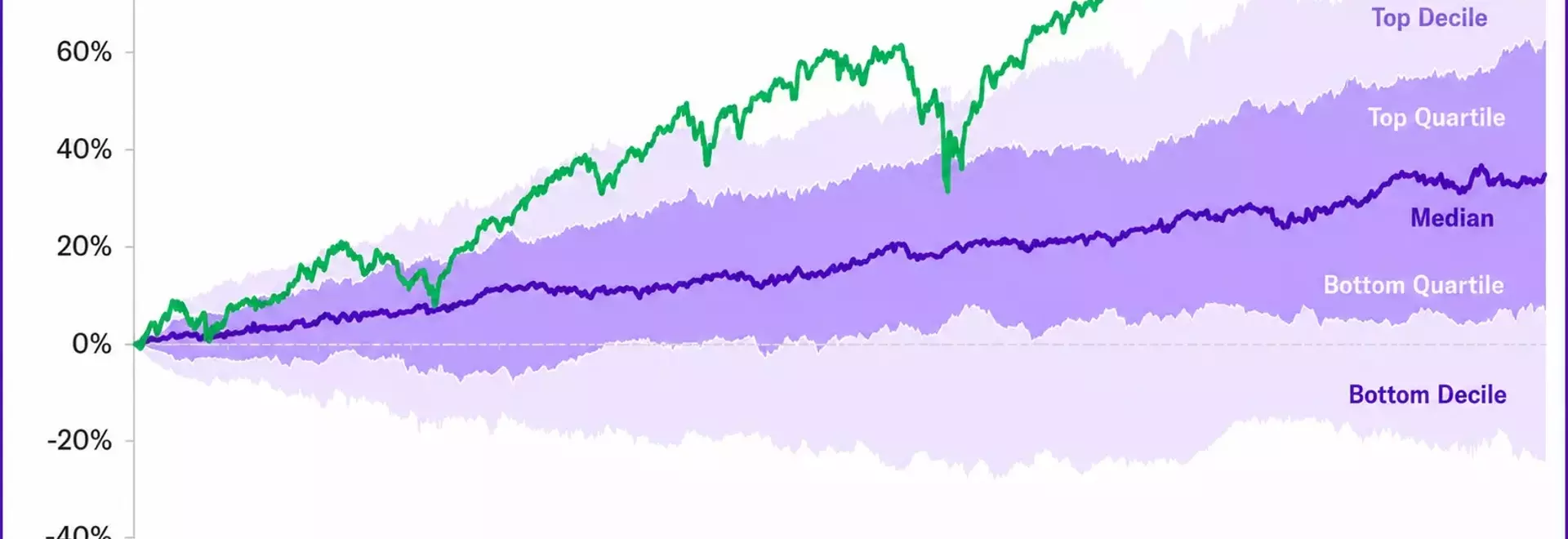
Despite recent market volatility, particularly affecting the technology sector, the current bull market continues to exhibit exceptional underlying strength. Analysis by Goldman Sachs indicates that the S&P 500's performance over the past few years positions it as one of the most robust bull markets in history, surpassing typical gains seen in previous economic expansions. This enduring momentum suggests that despite temporary setbacks driven by macroeconomic concerns and sector-specific corrections, the broader market remains on a strong upward trajectory.

During a period often characterized by diminished trading activity due to summer vacations and growing apprehension regarding potential Federal Reserve interest rate adjustments, the market, especially the tech-heavy Nasdaq Composite, has experienced notable pressure. However, insights from Goldman Sachs provide a crucial long-term perspective. Their data highlights that the S&P 500 has appreciated by an impressive 95% since the conclusion of 2022. This performance places the current bull market firmly within the top 10% historically when compared to similar stages of market cycles dating back to 1928. To put this into context, the top quarter of historical bull markets typically saw gains of approximately 50% over the same duration, while the median bull market achieved only about 35% growth after three and a half years. Since its low point in April 2025, the S&P 500 has already seen a 51% increase, underscoring its significant upward trend.

The past five trading sessions have witnessed considerable market turmoil. The memory chip sector, which was a top performer in 2026, has faced a substantial downturn, with semiconductor companies experiencing a collective market value reduction of roughly $1.5 trillion since June 25 alone. Major players like Micron, Sandisk, Intel, Applied Materials, and Lam Research each saw their market capitalizations decrease by over $100 billion. This significant sell-off is attributed to a combination of profit-taking following rapid gains and broader market corrections. Furthermore, President Trump's re-imposition of a blockade in the Strait of Hormuz has caused oil prices to spike, triggering a wider market sell-off and reminding investors of persistent geopolitical risks. This development complicates the Federal Reserve's potential interest rate decisions, especially when energy costs are rising. Adding to the market's woes, Netflix delivered disappointing third-quarter results, leading to an 8% drop in its share price during early trading, further unsettling investors who were not convinced by the company's earnings call explanations.

While the market has undeniably faced some deserved challenges recently, as no upward trend can last indefinitely without corrections, the overall momentum, as highlighted by Goldman Sachs, remains robust. It would require a confluence of much more adverse news to significantly deter the persistent confidence of market bulls and fundamentally alter the prevailing positive sentiment.

More Articles
Money
Invesco QQQ Income Advantage ETF: Generating Income Amidst Tech Market Fluctuations
The Invesco QQQ Income Advantage ETF (QQA) offers Nasdaq-100 exposure combined with a covered call/put strategy and an 18% cash buffer. This design aims to provide monthly distributions, such as the recent $0.50 per share, while reducing volatility. While QQA has slightly trailed QQQ in price appreciation over the past year, its cushioning effect during market pullbacks and double-digit yield make it attractive for income-focused investors and retirees seeking stability in their tech-heavy portfolios.
By Bola SokunbiJul 17, 2026
Money
SanDisk's Soaring Stock: A Deep Dive into Growth and Future Outlook
SanDisk's stock has surged over 3,000% in the past year, sparking speculation about a potential stock split. While the company's management may delay a split due to sustained investor demand and a desire to retain long-term shareholders, the core focus remains on its robust financial performance. The firm's data center and edge business segments have experienced exponential growth, largely fueled by the burgeoning artificial intelligence sector. This article explores the factors influencing a potential stock split and highlights the underlying drivers of SanDisk's remarkable success and future prospects.
By Vicki RobinJul 17, 2026
Money
Regulatory Hurdles Mount for Paramount-Warner Bros. Discovery Merger
A coalition of 12 U.S. states has initiated an antitrust lawsuit against the proposed $110 billion merger between Paramount Skydance and Warner Bros. Discovery. This legal challenge introduces significant uncertainty and potential delays for the deal, focusing on concerns about reduced competition in theatrical distribution and increased consumer costs, alongside existing financial pressures on both companies.
By Dave RamseyJul 17, 2026
Money
Nvidia Stock Declines Amidst AI Competition from China
Nvidia's stock experienced a nearly 5% decline on Friday, attributed to escalating competition in the AI model sector from China. Despite a partial recovery, shares remained down by 2.2% by late morning. This downturn follows news of Chinese startup Moonshot AI unveiling a new model that reportedly closes the gap with leading U.S. AI systems. Investors are weighing Nvidia's sustained strengths against these emerging risks, yet the company continues to expand its global AI footprint, including recent partnerships in Japan.
By T. Harv EkerJul 17, 2026
Money
Loan Issuers Embrace Extend-and-Amend Strategy to Reschedule Debts
Leveraged loan issuers are increasingly turning to amend-and-extend (A&E) deals to push back maturity dates, driven by elevated refinancing costs. This trend has seen A&E volume surge, with June reaching $27 billion and year-to-date figures significantly surpassing previous years. Borrowers prioritize these extensions as a cost-effective alternative to full refinancing, which remains more expensive than pre-2023 levels. The activity is balanced between institutional and pro rata loans, with sponsored borrowers leading institutional extensions and a focus on maturities from 2027 to 2029.
By Dave RamseyJul 17, 2026