Central Park Conservancy Hosts Juneteenth Celebration Honoring Seneca Village
In a poignant gathering, the Central Park Conservancy recently hosted a special event to commemorate Juneteenth, focusing on the rich but often overlooked history of Seneca Village. This initiative aimed to shed light on the vibrant African-American community that once flourished on the land now occupied by Central Park, emphasizing the need to acknowledge and celebrate its legacy. The evening served as a powerful reminder of historical injustices and the enduring spirit of a community that was displaced.
Seneca Village, a thriving postcolonial community of free African-American families, established itself between 1825 and 1853, boasting its own schools, churches, and businesses. However, by 1857, this significant residential area, spanning 775 acres, was dismantled due to systemic racism and the forced acquisition of land through eminent domain by the State of New York. This drastic action paved the way for the creation of what we now know as Central Park, effectively erasing a vital piece of Black history from the landscape.
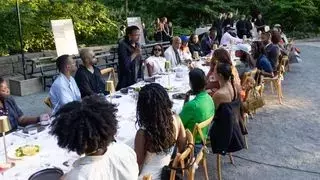
To rectify this historical oversight and honor the deep heritage of Seneca Village, the Central Park Conservancy organized a commemorative dinner. Held on Thursday evening, the event coincided with Juneteenth, the federal holiday observing the date—June 19, 1865—when Union troops announced the emancipation of enslaved people in Galveston, Texas. This timing underscored the theme of freedom and remembrance, providing a meaningful context for the celebration.
The gathering took place at Summit Rock, the highest elevation point within Central Park, a site that was once a prominent landmark within Seneca Village. Guests, including notable figures like Rachel Scott, Nichol King, State Senator Cordell Cleare, Teneshia Carr, and Shiona Turini, joined cultural heritage consultant Peggy King Jorde, stylist Gabriella Karefa-Johnson, and landscape architect Sara Zewde, who co-hosted the evening. The setting, surrounded by ancient American elm trees, red oaks, tulips, and ferns, created a solemn yet inspiring atmosphere.
Attendees followed a winding path to the open-air venue, where a beautifully set dining table awaited them. Adorned with white linens, delicate mini sunflower arrangements, and elegant gilded lamps, the table provided a backdrop for reflection and conversation. Anthony Bates, head mixologist from the Polo Bar, managed a well-appointed beverage station, serving custom cocktails crafted with a nod to Seneca Village's past, such as the Epiphany's Fashion, made with Black-owned Edmond’s Honor Bourbon, the Club Seneca Gin, and a non-alcoholic Dark N' Stormy sarsaparilla root spritzer.
During the cocktail hour, the atmosphere was further enriched by a spoken word monologue and dance recital performed by DeWitt Fleming Jr., accompanied by trumpeter Michael Cruse. Historian Cynthia Copeland and Jessica MacLean, the Conservancy's director of public history, delivered remarks highlighting the organization's dedication to advocating for change and acknowledging historical truths. Gabriella Karefa-Johnson encapsulated the sentiment of the evening, stating, "Tonight's commemoration is a reminder of why it's important for Black people to take up as much space as possible.”
Peggy King Jorde delivered a powerful call to action to those present, remarking, “What once was a village has now become a view. What happened here is not a metaphor, and having a dinner on top of a neighborhood is a revolutionary act of remembering.” This statement resonated deeply, emphasizing the significance of reclaiming and honoring the narrative of Seneca Village in its original location.
The culinary experience was thoughtfully curated by Bronx-born collective Ghetto Gastro and their zero-waste restaurant Gourmega, serving a three-course meal featuring green market salad, striped bass, and free-range bird. Vintage chinaware, glass carafes, and porcelain decanters, reminiscent of items owned by the displaced villagers, were strategically placed along the table, adding another layer of historical connection to the dining experience.
Following the main course, guests enjoyed a dessert of coconut ice cream infused with elderflower and strawberry, alongside coffee and a final round of craft cocktails. Writer Leah Faye Cooper expressed her appreciation, saying, “This event was well-needed. I always make time to support deeply cultural moments like this.” Cynthia Copeland added, “Though we cannot forget the atrocities of the past, we should always do our best to remain positive while working towards collective change,” reinforcing the event’s message of hope and continued progress.
As the day transitioned into evening, large, vibrant placards displaying archived village photographs and map drawings caught the fading sunlight, visually narrating the story of Seneca Village. Inspired by the evocative setting, landscape architect Sara Zewde reflected, “As a landscape architect, I’m a member of a profession that’s complicit in neighborhood erasure. But it’s important for me to honor the everyday acts of stewardship and community care that these villagers partook in.” New York City Councilmember Yusef Salaam, a member of the Central Park Exonerated Five, echoed this sentiment, drawing parallels between his past experiences and the history of Seneca Village, while underscoring the healing and progressive power of forgiveness.
The evening culminated with a reading that recounted James Baldwin’s discovery of Summit Rock, as detailed in his acclaimed 1953 novel, *Go Tell It on the Mountain*, further cementing the historical and literary significance of the site. John Reddick, the Conservancy’s director of community engagement, emphasized the lasting relevance of Baldwin’s words and the critical importance of ensuring that the memory and significance of Seneca Village within Central Park are never forgotten.
The event served as a powerful testament to the enduring significance of Juneteenth and the imperative to remember and honor marginalized histories. By bringing together community leaders, artists, and activists, the Central Park Conservancy not only shed light on Seneca Village’s past but also inspired a collective commitment to reconciliation and continued social change. The gathering underscored that acknowledging and integrating these forgotten narratives is crucial for a more inclusive future, ensuring that the legacy of those who came before is preserved and celebrated for generations to come.
