Budget Display Tech Battle: OLED vs. Mini-LED for PC Gaming
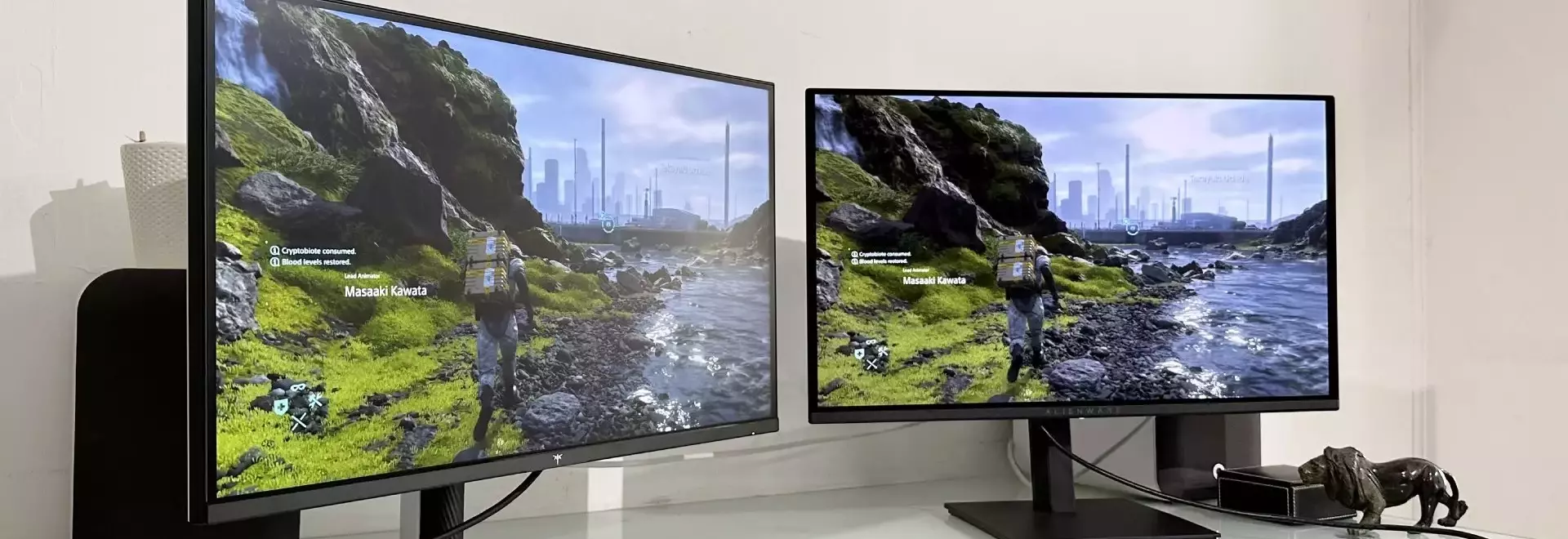
In an era where PC component costs are continuously on the rise, a segment offering both enhanced performance and affordability stands out: monitors. This piece examines two promising display technologies, Mini-LED and OLED, specifically focusing on their budget-friendly iterations, and assesses their suitability for PC gaming and everyday tasks. We compare the KTC M27T6S Mini-LED and the Alienware AW2726DM OLED, both 27-inch 1440p models priced under $350, evaluating their distinct characteristics and overall value proposition for consumers.
Budget-Friendly Display Technologies: A Detailed Comparison
For enthusiasts of PC hardware, the recent trends have been rather disheartening. The escalating costs of RAM, prolonged delays in new GPU releases, and the seemingly unstoppable rise in semiconductor prices paint a grim picture. Yet, amidst this landscape, the monitor market emerges as a beacon of progress, offering increasingly superior and more accessible options. Specifically, the emergence of affordable Mini-LED and OLED displays, now available for under $350 in 27-inch 1440p configurations, presents a compelling choice for consumers.
Representing the Mini-LED category, the KTC M27T6S stands out for its exceptional performance, notably altering perceptions of Mini-LED technology. In the OLED camp, the Alienware AW2726DM continues Alienware's tradition of making high-end display technology more attainable. While the KTC monitor is slightly more budget-friendly at around $290 compared to the Alienware OLED's $350, their price points are close enough to warrant a direct comparison for potential buyers. The central question then becomes: which of these advanced yet affordable display panels is the optimal choice for PC gaming?
Understanding the fundamental differences between OLED and Mini-LED is crucial, despite their shared goal of enhancing lighting control. Traditional LCD monitors often rely on a single, uniform backlight, struggling to simultaneously render both bright and dark elements effectively. Both Mini-LED and OLED address this limitation through advanced illumination techniques. Mini-LED technology, still based on LCD panels, employs an array of individual backlight zones, typically ranging from 1,000 to 2,000, to achieve more precise lighting control across the screen. In contrast, OLED panels offer unparalleled lighting precision, with each individual pixel acting as its own light source. This means that a 1440p OLED display, with its 3.7 million pixels, provides infinitely finer control over illumination compared to a Mini-LED panel, where each zone encompasses thousands of pixels.
OLED technology also boasts several inherent advantages beyond lighting control, such as significantly faster pixel response times. While LCD panels typically offer a claimed 1 ms response, OLED can achieve speeds as low as 0.03 ms, translating to nearly two orders of magnitude faster performance. Additionally, OLED displays provide superior viewing angles. However, OLED is not without its drawbacks. A notable limitation is full-screen brightness, where even the latest OLED monitors often peak below 350 nits, whereas some Mini-LED alternatives can surpass 1,000 nits. Another concern with OLED is the potential for screen burn-in, though recent evidence suggests this is less of an issue for the vast majority of users over many years, it remains a factor not present with Mini-LED displays.
For gaming performance, the Alienware AW2726DM appears superior on paper due to its faster refresh rate (240 Hz compared to the KTC M27T6S's 200 Hz, or 210 Hz with overclocking) and dramatically quicker pixel response (0.03 ms for OLED versus 1 ms for IPS). Yet, in real-world scenarios, the perceived speed difference is less pronounced than these figures suggest, highlighting the advancements in IPS panel technology. While the Alienware offers a noticeable speed advantage, it isn't a decisive factor unless competitive esports are the primary concern, in which case even faster TN panels might be preferred.
Where the Alienware truly excels is in HDR presentation, despite its lower peak brightness rating (400 nits versus the KTC's 1,000 nits). The Alienware's ability to achieve perfect contrast, displaying a 400-nit pixel next to a virtually black one, creates a much more profound sense of brightness and depth. This is particularly evident in dark scenes, where OLED's true blacks offer an immersive experience that Mini-LED, even with advanced local dimming algorithms like those in the KTC M27T6S, cannot fully replicate. The Alienware's glossy panel further enhances this clarity and crispness, unlike the KTC's matte anti-glare coating which can slightly diminish image sharpness and black levels.
Conversely, Mini-LED shines in scenes requiring high overall brightness, such as vibrant desert landscapes in games like Cyberpunk 2077. In these scenarios, the KTC M27T6S delivers a retina-searingly bright image that can make the Alienware OLED appear somewhat muted when viewed side-by-side. However, this brightness advantage often diminishes in isolation as human eyes adjust to ambient light levels, while the inherent contrast limitations and backlight glow of IPS panels, even with Mini-LED backlighting, remain perpetually noticeable. The immersive quality of OLED, with its absence of backlight bleed and glowing edges, creates a more natural window into game worlds.
For daily computing tasks, both monitors offer sufficient speed. The distinctions primarily lie in static image quality. The QD-OLED Alienware consistently delivers superior black levels and contrast, while the Mini-LED KTC offers higher peak brightness. The KTC, however, can be excessively bright for routine SDR content when pushed to its maximum. The Alienware's SDR brightness, rated at 200 nits, can be boosted by activating HDR mode and maximizing SDR content brightness in Windows, particularly benefiting users who prefer dark mode applications. In such configurations, the Alienware achieves a very punchy visual experience while maintaining its contrast and black level dominance. A specific consideration for QD-OLED, however, is its characteristic purple tint in brightly lit environments, which can be problematic near strong natural light sources and may present an overly warm color temperature compared to the KTC's more neutral IPS panel.
Ultimately, the choice between budget Mini-LED and OLED hinges significantly on individual preferences. While OLED, exemplified by the Alienware AW2726DM, generally offers superior speed, contrast, black levels, and viewing angles, the Mini-LED KTC boasts greater brightness and slightly more precise font rendering due to its RGB-stripe subpixel structure. The fact that neither technology presents an overwhelming victory underscores the competitive landscape of modern display technologies. If forced to make a definitive choice, the decision largely comes down to brightness. The QD-OLED Alienware, despite its lower overall brightness in SDR mode, becomes a more compelling option when HDR is enabled and used with dark mode applications, leveraging its profound contrast and true blacks. However, there will be instances in gaming where the Mini-LED's intense brightness provides a more immediate and vibrant visual impact. The optimal choice, therefore, remains a personal one, balancing these distinct advantages and considerations.
This detailed comparison reveals that both budget Mini-LED and OLED technologies have evolved to offer compelling advantages, making the decision more nuanced than a simple spec sheet comparison. The Alienware AW2726DM, with its QD-OLED panel, consistently demonstrates superior contrast and black levels, creating a deeply immersive gaming experience. Its faster pixel response and better viewing angles further enhance its appeal, particularly in dynamic gaming environments. While its full-screen brightness in SDR mode can be a limitation, strategic use of HDR and dark mode applications can significantly mitigate this. Conversely, the KTC M27T6S, leveraging Mini-LED, excels in scenarios demanding high peak brightness, delivering vivid and impactful visuals that can 'pop' in brightly lit game scenes. Its conventional RGB subpixel structure also offers a slight edge in text clarity for daily computing. However, the inherent limitations of LCD technology, even with Mini-LED backlighting, mean it cannot match OLED's perfect blacks and individual pixel control.
From a journalist's perspective, this market evolution signifies an exciting time for consumers. The accessibility of advanced display technologies, once exclusive to high-end segments, empowers a broader audience to experience premium visual fidelity. The ongoing innovation ensures that irrespective of the choice, users are getting more value for their money. This dynamic competition pushes manufacturers to refine their offerings, ultimately benefiting the end-user. As a tech enthusiast, witnessing such rapid advancements at increasingly competitive price points instills optimism for the future of PC hardware, suggesting that even in challenging economic climates, innovation can thrive and deliver tangible improvements to the user experience.
