Bond Market Shifts to New Normal: Elevated Yields Impact Equities
The financial landscape is witnessing a notable evolution in the bond market, characterized by persistently elevated yields. This sustained higher return on government bonds is creating increased competition for equity investments and simultaneously driving up borrowing expenses for both consumers and corporations. While the broader stock market has managed to absorb these shifts with relative stability, certain sectors that are particularly sensitive to interest rates are beginning to show signs of strain.
Details of the Evolving Bond Market
As of late July 2026, the 30-year Treasury yield has marked a significant period of being consistently above 5%, maintaining this level for 14 consecutive trading sessions. This prolonged presence above the 5% threshold represents the longest such stretch since July 2007, indicating a transition from a momentary "danger zone" to a new, more enduring benchmark. Throughout this year, the 30-year yield has surpassed 5% on 29 separate occasions, underscoring a structural change in market expectations.
This upward trend in bond yields is not confined to the United States; government bond returns across major developed economies are also on the rise. Several factors contribute to this phenomenon, including increasing global oil prices, robust economic indicators, and ongoing substantial government borrowing. The heightened demand for capital from governments intensifies the competition for investor funds.
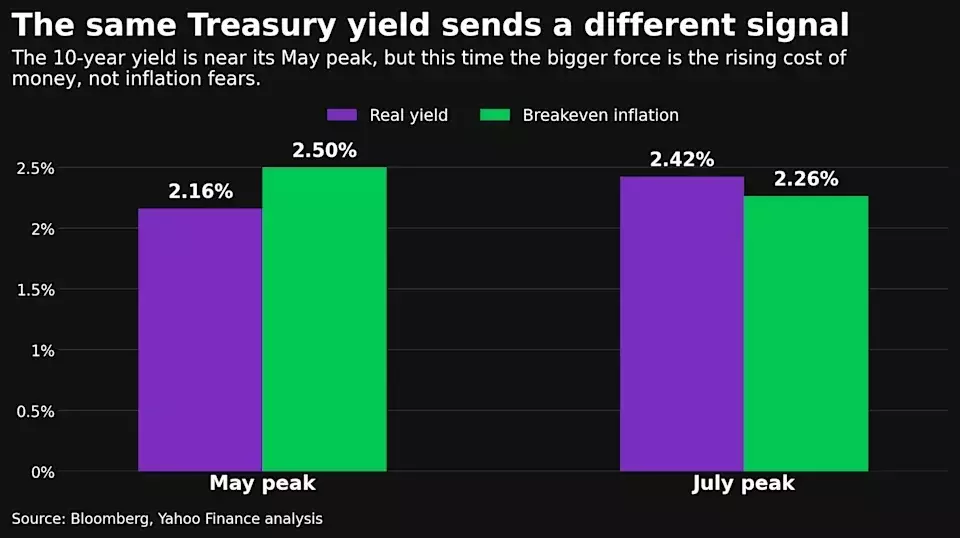
Interestingly, the recent surge in U.S. bond yields is primarily driven by an increased demand for basic returns, rather than a resurgence of inflation fears. Examining the 10-year Treasury yield, which recently peaked at 4.69%—a level similar to its May high—reveals a crucial difference. During the May peak, the 10-year real yield was 2.16%, with market-implied inflation (breakeven inflation) at 2.5%. However, in the recent period, the real yield has climbed to 2.42%, while breakeven inflation has receded to 2.26%. This divergence suggests that investors are demanding a higher real return for lending money, with inflationary expectations playing a comparatively smaller role.
The impact on the equity market has been varied. From early July through the latest trading week, the PHLX Semiconductor Index experienced an 8% decline, the Nasdaq Composite shed over 4%, and the S&P 500 saw a more modest dip of less than 2%. This uneven pressure highlights that rate-sensitive industries are the first to feel the squeeze. Despite these shifts, market volatility for Treasuries remains below earlier peaks, and solid corporate earnings have provided a buffer, helping the overall market withstand the higher yield environment.
Looking ahead, a pivotal moment for the markets will be the Federal Reserve's stance on monetary policy. The decision whether to implement further interest rate hikes or maintain the current hold will be critical in validating the bond market's "higher-for-longer" interest rate outlook.
The current bond market dynamics serve as a crucial reminder of the intricate connections within the global financial system. The sustained elevation of long-term bond yields suggests a fundamental re-evaluation of risk and return by investors. This shift, driven more by the cost of capital than by inflation, implies that the era of historically low interest rates may be drawing to a definitive close. For businesses, this means a recalibration of borrowing strategies and investment decisions, while for equity markets, it necessitates a closer examination of valuation models and a greater emphasis on companies with robust cash flows and lower debt burdens. The Federal Reserve's upcoming decisions will undoubtedly shape the narrative, potentially solidifying this "new normal" and requiring market participants to adapt to a more demanding capital environment.
