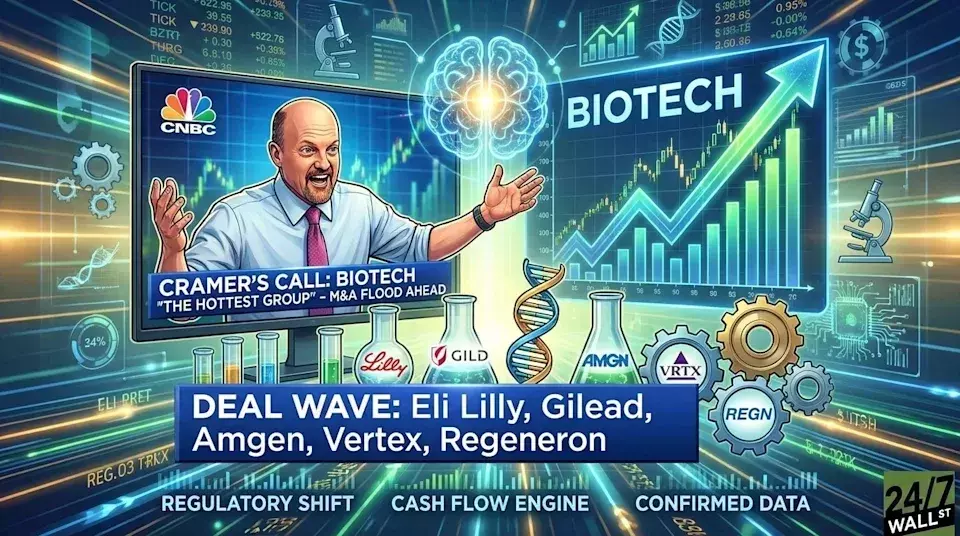
Biotech Sector Poised for Acquisition Surge, According to Jim Cramer
The Biotech Boom: A New Era of Strategic Acquisitions
Biotech on the Brink of a Dealmaking Frenzy
Financial commentator Jim Cramer recently highlighted the biotechnology sector as the most dynamic segment of the market, foreseeing an imminent wave of corporate consolidations. His analysis points to a shift in regulatory attitudes, making the environment more conducive to significant transactions. This anticipated surge follows a period where regulatory scrutiny had previously slowed down deal-making, particularly after a near-blocked acquisition involving Amgen. Now, with a more supportive stance from regulatory bodies, the floodgates are expected to open for a flurry of acquisitions.
Eli Lilly at the Forefront of Biotech Mergers
Eli Lilly is emerging as a dominant force in the biotech acquisition landscape, backed by robust financial performance. The company's first-quarter revenue for 2026 reached an impressive $19.80 billion, marking a 55.5% increase year-over-year. Key products like Mounjaro and Zepbound significantly contributed to this growth, with sales of $8.66 billion and $4.16 billion respectively. This financial strength has enabled Eli Lilly to pursue an aggressive acquisition strategy, having already completed four significant deals in the quarter, including the acquisition of Orna Therapeutics and Centessa Pharmaceuticals, among others.
Gilead's Proactive Acquisition Strategy
Gilead Sciences is actively pursuing a similar growth strategy through strategic acquisitions. The company recently finalized a $7.8 billion deal for Arcellx, primarily for its Anito-cel in multiple myeloma treatment. Additionally, Gilead has entered into agreements with Ouro Medicines and Tubulis, underscoring its commitment to expanding its oncology and inflammation portfolios. Despite incurring substantial IPR&D charges from these acquisitions, Gilead's proactive approach positions it for future market leadership.
Amgen's Influence on Past M&A Dynamics
Amgen's past acquisition attempts played a pivotal role in shaping the regulatory environment for biotech M&A. A near-blocked deal involving Amgen under a previous administration led to a cautious period for the entire sector. However, Amgen continues to demonstrate strong performance, with first-quarter 2026 revenue reaching $8.62 billion and significant growth across multiple brands. Its ongoing development in obesity treatments, particularly MariTide, maintains its relevance and competitive edge in the market.
Vertex and Regeneron: High-Value Acquisition Targets
Companies like Vertex Pharmaceuticals and Regeneron Pharmaceuticals exemplify the kind of high-value targets that command premium acquisition prices. Vertex's strong portfolio, driven by products like CASGEVY and JOURNAVX, contributed to over 25% of its quarterly growth. The company is also expanding into new therapeutic areas with the submission of povetacicept for IgA nephropathy. Regeneron is also demonstrating financial strength through share repurchases and robust sales of Dupixent, which reached $4.88 billion globally, despite competitive pressures from biosimilars.
Catalysts Driving Future Biotech Takeovers
The renewed regulatory flexibility is a primary catalyst for the anticipated increase in biotech takeovers. Companies with healthy balance sheets, such as Eli Lilly and Gilead, are actively seeking to acquire promising drug developers. This environment is particularly advantageous for mid-cap biotech firms with advanced-stage assets, as they become attractive targets for larger entities. As this trend evolves, investors are likely to re-evaluate biotech companies based on their growth potential and their appeal as acquisition candidates.
