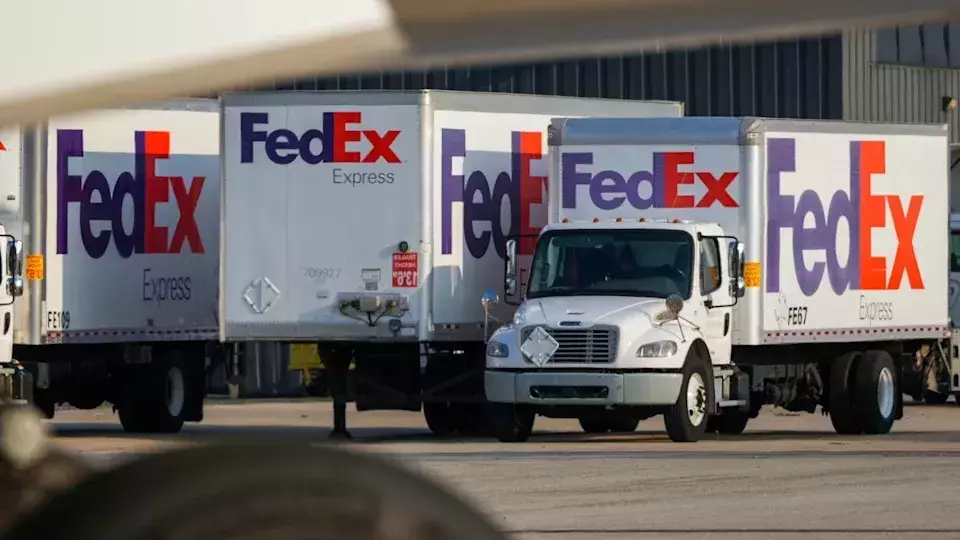
Bill Gates's Foundation Invests $180 Million in FedEx Freight, Signaling Confidence in LTL Shipping Market
The Bill and Melinda Gates Foundation Trust has made a notable investment of approximately $180 million in FedEx Freight (FDXF), a company that recently became an independently traded public entity. This substantial commitment, alongside a previous investment in Home Depot, indicates a strategic focus by the trust on key sectors of the American economy. The timing of the FedEx Freight purchase, occurring shortly after its spin-off, suggests a calculated move to capitalize on market dynamics that often follow such corporate separations. The trust's overall portfolio, valued at $34.42 billion, includes significant holdings in established companies like Berkshire Hathaway, Caterpillar, and Canadian National Railway, underscoring a preference for robust and essential industries.
FedEx Freight operates as a crucial component of the nation's supply chain, specializing in less-than-truckload (LTL) shipping for commercial and industrial goods rather than typical package delivery. Its extensive network, comprising nearly 30,000 vehicles, 40,000 team members, and over 365 locations across North America, positions it as the largest LTL carrier. This critical infrastructure supports the movement of manufactured goods from producers to distributors and retailers, making it a foundational element of economic activity. The decision to spin off FedEx Freight in December 2024, completed in June 2026, aimed to provide the business with independent management and capital allocation, thereby unlocking its specific growth potential and strategic focus.
Strategic Investment in a Post-Spin-off Market
The Bill and Melinda Gates Foundation Trust has injected approximately $180 million into FedEx Freight (FDXF), acquiring 1.19 million shares of the newly independent company. This significant investment is particularly noteworthy given that FDXF began trading independently only on June 1, 2026. The trust's swift action to establish a position in the company within weeks of its market debut highlights a keen interest in the potential of this less-than-truckload (LTL) shipping giant. This move reflects a broader investment strategy by the Gates Foundation, which manages a substantial $34.42 billion portfolio, to identify and invest in companies that form the bedrock of the American economy, as evidenced by its top holdings in diversified sectors.
The strategic rationale behind this investment aligns with insights from financial experts like Jim Cramer, who notes that spin-offs often create temporary market mispricings. When a subsidiary is separated, existing shareholders automatically receive shares in the new entity, and many may opt to sell these unfamiliar holdings, leading to an artificial price dip unrelated to the company's intrinsic value. This "temporary beatdown" presents a unique window of opportunity for long-term investors, such as the Gates Foundation, to acquire shares at a potentially undervalued price. FedEx Freight's first earnings report, delivered during a transitional period, further obscured its immediate financial picture, contributing to the market's initial uncertainty and creating the very scenario that value investors seek.
The Core Role of FedEx Freight and its Financial Outlook
FedEx Freight's operations are distinct from the well-known package delivery services of its former parent company. It focuses exclusively on less-than-truckload (LTL) shipping, which involves transporting commercial freight, pallets, and industrial goods across extensive networks. With an impressive fleet of nearly 30,000 vehicles, 17,000 tractors, and a workforce of 40,000 across North America, FedEx Freight stands as the largest LTL carrier on the continent. This infrastructure is vital for the seamless movement of goods throughout the supply chain, facilitating the flow from manufacturers to distributors and ultimately to retailers. Its independence, granted through a spin-off initiated in December 2024 and finalized in June 2026, aims to enhance its operational agility and allow for more focused management and capital allocation decisions.
Despite a reported decrease in full-year fiscal 2026 revenue of 1.1% to $8.8 billion, FedEx Freight's Q4 fiscal 2026 performance showed revenue growth of 4.8% year-over-year, reaching $2.4 billion, with revenue per shipment increasing by 11.5% to $415.22. While adjusted operating income saw a 23.9% decrease, the company's adjusted operating margin of 12.6% provides a solid foundation for future growth. Goldman Sachs, initiating coverage with a 'Buy' rating and a $186 price target, projects annual revenue growth of 4% to 6% through 2029, with EPS expected to climb from $4.65 in fiscal 2027 to $6.95 by 2029. This optimistic outlook is fueled by anticipated improvements in contract pricing, increased penetration in small and medium-sized businesses, healthcare, grocery, and data center logistics sectors, and enhanced productivity under dedicated leadership. While the current trading price suggests a premium for future growth, analysts foresee significant upside potential, reinforcing the strategic foresight of the Gates Foundation's investment in this critical economic backbone.
