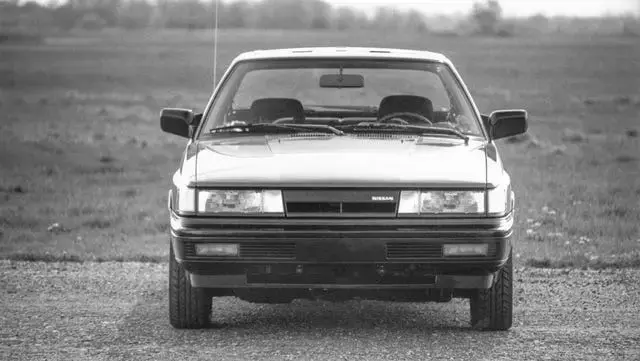
The 1987 Nissan Sentra SE: A Contradictory Sport Coupe
The 1987 Nissan Sentra SE emerges as a curious paradox within the competitive small-sedan market. While presenting itself with an appealing "sport coupe" aesthetic, it ultimately delivered a driving experience marked by significant performance limitations, failing to live up to the excitement its appearance suggested. Despite Nissan's efforts to refresh the Sentra line with visual updates and a more refined interior, the core mechanicals, particularly the engine, struggled to compete with rivals in terms of power and dynamic handling. This created a disconnect between the car's sporty aspirations and its actual capabilities, leading to a mixed reception from automotive enthusiasts and reviewers.
Reviewers of the era, while acknowledging the car's comfortable cabin and improved suspension, consistently pointed to the underwhelming 70-horsepower engine as its major flaw. This powerplant, despite incorporating throttle-body fuel injection for better drivability, offered minimal acceleration, especially at higher RPMs. Consequently, the Sentra SE, despite its stiffer suspension and wider tires compared to other Sentra models, could not fully exploit its chassis potential. In a segment where vehicles like the VW GTI and Mitsubishi Mirage Turbo set higher performance benchmarks, the Sentra SE found itself at a disadvantage, leaving potential buyers to weigh its stylish presentation against its modest driving dynamics.
Design and Interior: A Sporty Facade with Practical Comfort
The 1987 Nissan Sentra SE aimed to capture attention with its redesigned exterior, featuring a sleek fastback profile, a sloped hood, and a sharply beveled nose. This visual transformation was a conscious effort by Nissan to imbue the Sentra line, especially the sport coupe variant, with a more dynamic and contemporary appeal. The interior further supported this sporty pretense, particularly in the SE model, which boasted a driver-focused cabin. This included a supportive driver's seat with adjustable lumbar and seatback bolsters, designed to provide comfort and stability during spirited driving. A well-proportioned four-spoke steering wheel was also incorporated, promoting proper hand positioning and ensuring an unobstructed view of the instrument panel. The overall fit and finish of the interior were commendable, reflecting a focus on quality and driver experience, despite some stylistic choices like the black-and-white graph pattern for upholstery that might have been divisive.
Beyond aesthetics, the Sentra SE's interior was noted for its spaciousness and comfortable seating, making it a practical choice for daily use. Nissan's design philosophy for the Sentra SE was a blend of functionality and aspirational sportiness, attempting to elevate the car beyond its economy car roots. While the visual enhancements were successful in creating a more engaging look, the car's underlying structure retained elements of its more pedestrian counterparts. The expanded wheelbase, increased width, and slightly lowered height contributed to a more planted stance, but these modifications primarily served to enhance cosmetic appeal rather than radically transform its performance character. The intention was to offer a car that looked the part of a sport coupe, providing an enticing package for those who valued style and interior amenities in a compact vehicle, even if the driving excitement was not on par with its appearance.
Performance and Handling: The Underwhelming Reality
Despite its aggressive styling and the "sport coupe" moniker, the 1987 Nissan Sentra SE struggled to deliver a performance experience that matched its visual promise. The vehicle was equipped with a 1.6-liter, 70-horsepower OHC engine, a carryover from the previous year, which, even with the addition of throttle-body fuel injection, offered only a marginal increase in torque. Nissan engineers stated the injection system was primarily for improved drivability and starting, not power enhancement, a claim supported by the engine's uninspiring output. This resulted in a sluggish acceleration, with the car taking 13.4 seconds to reach 60 mph and managing only 70 mph in a quarter-mile run. The engine's power delivery was particularly flat above 4000 rpm, producing more noise and vibration than actual thrust, fundamentally undermining any sporty driving aspirations.
The chassis, while commendably stiff and free from torsional flex or rattling, was let down by a suspension system that possessed too much compliance and tires that lacked sufficient grip. Although the sport coupe featured stiffer spring rates and firmer shock damping compared to other Sentra models, along with larger anti-roll bars, these enhancements weren't enough to overcome the overall softness. On the skidpad, the SE managed a modest 0.76 g, indicating limitations in cornering prowess. While it felt reasonably agile during casual driving, pushing the car with any enthusiasm quickly revealed pronounced understeer and generally imprecise handling, betraying its economy-car origins. The performance gap was particularly evident when compared to direct competitors such as the VW GTI, Corolla GT-S, and Mirage Turbo, which offered superior horsepower and more dynamic handling at comparable price points, highlighting the Sentra SE's critical deficiency in delivering true sports coupe performance.
